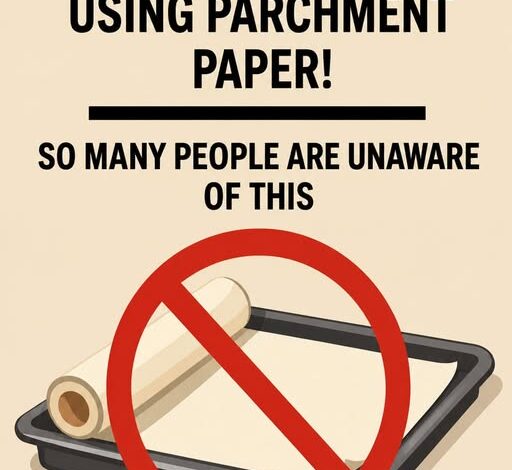
Parchment paper has earned a permanent place in modern kitchens.
It sits quietly in drawers and cabinets, ready to make cooking easier. We pull it out without thinking, line a baking sheet, slide food into the oven, and enjoy the simple pleasure of effortless cleanup. Cookies release perfectly. Vegetables roast without sticking. Scrubbing pans becomes optional.
For many home cooks, parchment paper feels almost invisible.
A tool so ordinary that it rarely inspires questions.
Yet like many conveniences, its simplicity can hide details most of us never stop to consider.
What exactly happens to parchment paper when it faces intense heat?
And are we asking it to do more than it was designed to handle?
The answer is not alarming.
But it is worth understanding.
Most parchment paper sold today is treated with coatings that give it its famous nonstick properties. These coatings help food release easily and prevent grease from soaking through the paper. Without them, parchment would simply behave like ordinary paper, sticking, burning, and becoming far less useful.
The two most common treatments are silicone and quilon.
Silicone-coated parchment has become increasingly popular because it performs well under typical baking conditions and is generally considered the safer option. Quilon-coated parchment, which uses a chromium-based treatment, is less common today but still exists in some products.
Under normal cooking temperatures, both perform their intended function effectively.
The problem arises when heat begins pushing toward the upper limits of what these materials were designed to withstand.
Most manufacturers recommend keeping parchment paper below temperatures of roughly 420°F to 450°F (215°C to 230°C), depending on the product. Within that range, the paper generally remains stable and useful.
Beyond it, things begin to change.
Not dramatically.
Not explosively.
But subtly.
The paper may darken.
Edges may become brittle.
The surface may lose some of its nonstick properties.
And occasionally, an unfamiliar smell may emerge from the oven.
These signs are easy to dismiss.
After all, nothing appears visibly wrong.
The food still cooks.
The kitchen doesn’t fill with smoke.
Dinner still reaches the table.
Yet those small changes are clues that the material is beginning to degrade.
The coatings that make parchment so convenient are not indestructible. As temperatures rise, they can gradually break down, releasing compounds and microscopic particles that were never intended to become part of the cooking process.
For most people, occasional exposure is unlikely to pose a significant risk.
The concern is not that parchment paper suddenly becomes dangerous.
The concern is that many cooks unknowingly use it in ways that exceed its intended purpose, assuming that if it doesn’t catch fire, it must be perfectly fine.
Cooking often teaches us otherwise.
Many kitchen mistakes happen long before visible damage appears.
Oil can degrade before it smokes.
Nonstick coatings can deteriorate before they peel.
Plastic containers can release compounds before they melt.
Parchment paper operates under a similar principle.
The absence of obvious warning signs doesn’t necessarily mean nothing is happening.
That realization has led some consumers to look more closely at the products they bring into their kitchens.
Not all parchment papers are created equally.
Unbleached parchment, for example, avoids some of the chemical processing used to create the bright white appearance many shoppers associate with baking products. While bleaching itself does not automatically make a product unsafe, some consumers prefer minimizing unnecessary processing whenever possible.
Likewise, many people now seek out parchment specifically labeled as silicone-coated rather than quilon-coated.
The distinction matters because silicone generally remains the preferred modern alternative, while quilon has gradually fallen out of favor due to environmental and manufacturing concerns.
Understanding those differences doesn’t require fear.
It simply encourages informed choices.
Perhaps the most practical lesson is recognizing that every kitchen tool has a purpose.
Parchment excels at moderate-temperature baking.
Cookies.
Cakes.
Pastries.
Roasted vegetables.
Fish.
Sheet-pan meals.
These are exactly the kinds of applications it was designed for.
Problems tend to arise when cooks push it into environments that demand more than it can comfortably provide.
High-temperature roasting.
Broiling.
Pizza stones operating near maximum oven temperatures.
Certain styles of artisan bread baking.
Open-flame cooking.
These situations place significantly greater stress on both the paper and its coatings.
In those cases, alternative options often perform better.
Reusable silicone baking mats have become increasingly popular because they tolerate repeated use and eliminate the constant need for disposable paper. For many baking tasks, they provide similar nonstick performance while generating less waste.
Traditional greasing methods remain highly effective as well.
A lightly oiled pan.
A thin layer of butter.
A dusting of flour.
Simple techniques used successfully for generations before parchment became a kitchen staple.
Aluminum foil can also play a role in high-heat cooking, particularly when lightly oiled to reduce sticking. While foil introduces its own considerations, it often handles temperatures that push parchment beyond its comfort zone.
The broader lesson extends beyond parchment paper itself.
Modern kitchens are filled with products designed to make cooking easier, faster, and cleaner. Most work exactly as intended when used appropriately. Problems often arise not because the products are inherently bad, but because convenience encourages us to stop asking questions.
We assume familiar means harmless.
Routine means risk-free.
Common means fully understood.
Yet even the most ordinary objects deserve occasional curiosity.
What are they made of?
How are they designed to function?
Where are their limits?
The answers rarely demand dramatic lifestyle changes.
Instead, they lead to small adjustments.
Smarter choices.
Better habits.
A little more awareness.
In the case of parchment paper, that awareness doesn’t mean abandoning a useful kitchen tool.
Far from it.
Parchment remains one of the simplest and most effective aids available to home cooks.
The goal is not elimination.
It’s understanding.
Use it where it shines.
Respect its limits.
Choose higher-quality products when possible.
Reserve other tools for situations where extreme heat enters the equation.
The reward is simple.
You keep everything people love about parchment paper: easy cleanup, reduced sticking, less mess, and more enjoyable cooking.
But you gain something else as well.
Confidence.
The confidence that convenience is working for you rather than replacing informed decision-making.
Because good cooking isn’t just about what ends up on the plate.
It’s also about understanding the tools that help get it there.
And sometimes, the smartest changes are not dramatic overhauls.
They’re small choices made quietly, one meal at a time.
A different brand.
A lower temperature.
A reusable mat.
A greased pan.
Tiny adjustments that preserve the convenience while reducing the questions lingering in the back of your mind.
After all, the goal of a good kitchen is not merely making food.
It’s creating meals you can enjoy without wondering what else might have been cooking alongside them.
And sometimes, peace of mind is one of the best ingredients you can bring to the table.