The moment I opened the front door, I stopped in my tracks.
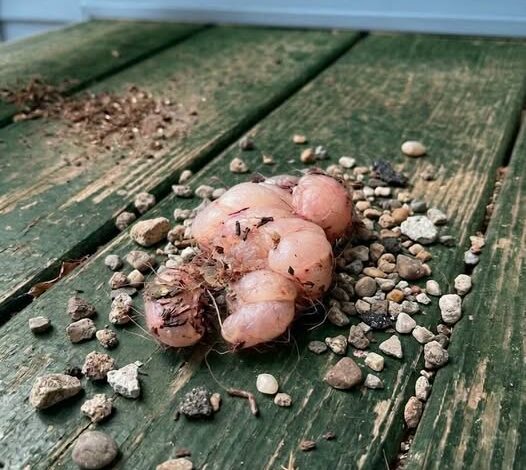
There, sitting on the porch, was a pale, plump cluster of strange, glossy creatures that looked completely out of place. For a few seconds, I couldn’t even decide whether I was looking at insects, mushrooms, or something far stranger.
Every instinct told me to back inside and close the door.
Instead, I stood frozen, watching for movement.
Nothing happened.
That somehow made it worse.
Curiosity eventually overcame caution. I edged forward one careful step at a time, ready to leap backward if the mysterious blobs suddenly came to life. The closer I got, the more unsettling they appeared. They were smooth, cream-colored, and slightly curved, with soft-looking bodies that seemed almost too large for whatever they were.
They definitely didn’t belong on my porch.
Or so I thought.
I quickly pulled out my phone and snapped several pictures from different angles before sending them to my brother.
“Any idea what these are?”
His reply arrived almost immediately.
“What on earth IS that?”
Not exactly the reassurance I had been hoping for.
With my anxiety climbing by the minute, I turned to the internet. I compared my photos with countless images of insects, larvae, and garden pests, convinced I was about to discover some horrifying infestation lurking beneath my house.
The possibilities seemed endless.
Every search result looked just alarming enough to keep the panic alive.
Then, buried among the photos, I found an exact match.
They weren’t mysterious creatures.
They weren’t dangerous parasites.
They were beetle grubs—the larval stage of certain beetles that live in soil.
Many species spend months underground feeding on decaying organic matter or, in some cases, plant roots before eventually developing into adult beetles. Heavy rain, saturated soil, or disturbed ground can sometimes bring them to the surface, leaving them scattered in places where they look completely unexpected.
Suddenly, the “alien invasion” made perfect sense.
The damp soil beneath my porch had likely become waterlogged, forcing the grubs upward in search of drier conditions. They hadn’t invaded my home at all.
They had simply taken a wrong turn.
I couldn’t help laughing.
Only minutes earlier, I’d been mentally preparing for exterminators, structural inspections, and worst-case scenarios.
Instead, I was looking at a handful of harmless beetle larvae that happened to appear in exactly the wrong place at exactly the wrong time.
After gently sweeping them into a nearby garden bed where they belonged, I stood there smiling at how dramatically my imagination had outrun reality.
The experience reminded me how easily unfamiliar things trigger alarm.
Our brains are remarkably good at recognizing potential danger, especially when something looks unusual or appears where we don’t expect it. That instinct has helped humans survive for thousands of years—but it also has a habit of turning perfectly ordinary discoveries into imagined disasters.
Sometimes the best response isn’t immediate panic.
It’s a closer look.
A reliable source.
And a little patience.
Now, whenever I stumble across something strange in the yard or around the house, I remember that morning on the porch.
Not every mystery is a menace.
Sometimes it’s simply nature going about its business in ways we’ve never noticed before.
What looked like something out of a science-fiction movie turned out to be nothing more than a few beetle grubs displaced by wet soil.
And what began as the most alarming moment of my morning ended as one of the funniest stories I’ve told all year.