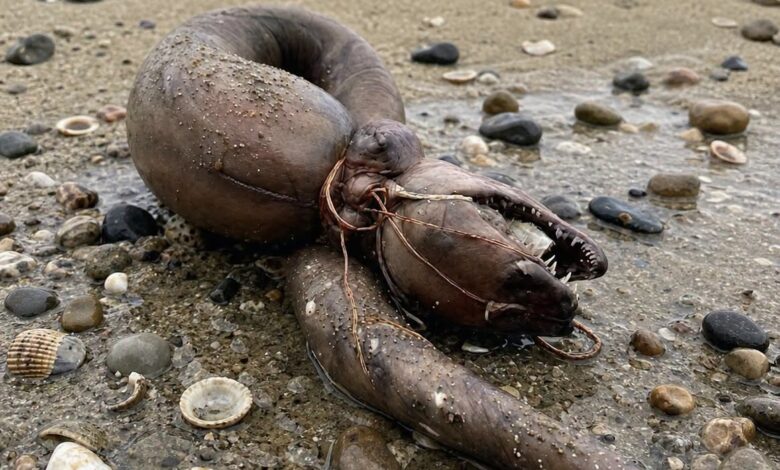
I almost walked past it.
From a distance, the dark shape half-buried in the wet sand looked like a piece of rope or seaweed thrown ashore by the tide. The beach was littered with the usual debris—shell fragments, driftwood, tangled plants—so there was no reason to think this was anything different.
Then my dog stopped.
Not slowed.
Stopped.
The leash tightened in my hand as he planted his paws in the sand and stared toward the waterline.
“What is it?”
His ears went back.
A low, uncertain whine came from his throat.
That was when I looked more carefully.
The object was long.
Too long for the ordinary fish I was used to seeing washed ashore.
Its body curved through the sand in a thick, twisted line, dark skin slick with seawater. Part of it had been covered by the retreating tide, making it difficult to tell where the animal ended and the beach began.
Then I saw the head.
And the mouth.
I stopped moving.
Its jaws were open, revealing rows of sharp-looking teeth. The expression was frozen into something that looked almost furious, as though the creature had died in the middle of a snarl.
For several seconds, I simply stared.
My first thought was embarrassingly primitive:
Do not go near that.
My second thought was:
What on earth is it?
I had seen dead fish on beaches before.
This did not look like any fish I immediately recognized.
Its body reminded me of a snake, but the head was wrong. The mouth seemed disproportionately large, and its overall appearance belonged more naturally in some deep-sea documentary than on a beach where, minutes earlier, I had been watching my dog investigate footprints.
I took one cautious step forward.
My dog immediately pulled backward.
That settled it.
“Okay,” I muttered. “You win.”
I was curious, but curiosity did not require putting my fingers near an unidentified animal with a mouth full of teeth.
Besides, even apparently dead wildlife is better observed from a respectful distance. An animal may not be as dead as it appears, and stranded marine creatures can present other risks as well.
So I used the safest investigative tool I had.
My phone.
I zoomed in instead of walking closer.
Through the screen, details became easier to see.
The elongated body.
The smooth-looking skin.
The powerful head.
The unmistakable jaws.
I took several photographs from different angles without approaching the animal.
Then a wave rolled farther up the beach.
Water surrounded the creature.
Its body shifted.
I jumped backward.
My dog nearly dragged me another six feet.
For one ridiculous second, I thought it had moved by itself.
Then the water retreated and left the animal lying in a slightly different position.
Dead.
Almost certainly dead.
But the illusion had been convincing enough.
I decided I had completed my field research.
We continued walking, although I kept looking over my shoulder.
The rest of the beach suddenly seemed different.
Every dark shape near the waterline deserved a second glance.
Every clump of seaweed looked suspicious.
My dog, meanwhile, recovered almost immediately. Five minutes later, he was fascinated by a stick.
I was not so fortunate.
The creature stayed in my head.
When I got home, I enlarged the photographs.
That did not make it prettier.
If anything, seeing the mouth clearly made the animal look even more extraordinary.
I began searching online.
At first, the possibilities seemed endless.
Conger eel?
Some kind of snake?
A strange deep-water fish?
An animal damaged enough by decomposition that its normal appearance had become difficult to recognize?
That last possibility mattered. Animals found dead on beaches can look dramatically different from healthy specimens. Damage, bloating, scavenging, dehydration, decomposition, and the simple fact that most of us rarely see marine animals outside photographs can make identification surprisingly difficult.
So I kept comparing.
Body shape.
Head.
Jaw.
Teeth.
Then I found photographs that made me stop scrolling.
Moray eel.
I opened more images.
Then more.
The resemblance was difficult to ignore.
The elongated, muscular body fit.
So did the intimidating jaws.
And that permanently open-mouthed appearance suddenly made more sense.
Morays are famous for looking as though they are perpetually ready to attack. In life, however, their habit of opening and closing their mouths has a practical purpose: it helps move water across their gills for respiration. To human eyes, the behavior can resemble a threat even when the animal is simply breathing.
That made the photographs slightly less sinister.
Slightly.
I compared the images again and concluded that the animal appeared to be a dead moray eel.
Having a name for it should have made the encounter less unsettling.
Instead, it made it more real.
That bizarre creature had not come from some fantasy.
It belonged in the same ocean beside which people were jogging, walking dogs, collecting shells, and taking photographs of the sunset.
Moray eels usually spend their lives around rocky areas, reefs, crevices, and other underwater structures where their long bodies are useful for hiding and hunting. They are not monsters roaming beaches in search of unsuspecting walkers.
The one I found had simply ended up somewhere it did not belong.
Exactly how it died or reached that particular stretch of sand was impossible for me to know.
Currents move things.
Storms move things.
Tides return things.
The ocean does not provide an explanation with everything it leaves behind.
And perhaps that was what bothered me most.
I had been treating the beach as familiar territory.
It was my walking route.
My dog’s playground.
A place of footprints, shells, gulls, and waves.
But the beach is not really the edge of our world.
It is the edge of another one.
Every wave touches an environment most of us barely know.
Under that familiar blue surface are animals living entire lives beyond our sight—hunting, hiding, reproducing, competing, surviving, and dying.
Occasionally, the boundary opens.
Something washes ashore.
And suddenly the invisible becomes impossible to ignore.
The next time I walked that beach, I found myself paying more attention.
Not fearfully.
Just differently.
I noticed tiny holes in the sand.
Tracks left by birds.
Shells I previously would have stepped over.
Dark objects tangled in seaweed.
The shoreline had become less like scenery and more like evidence.
My dog still investigated everything with his nose.
I remained committed to the zoom function.
There are some mysteries that do not require touching.
And if I encountered another unidentified marine animal, I would do essentially what I had done before: keep myself and my dog back, avoid handling it, take photographs if it could be done safely, and let local wildlife or marine authorities know if the animal appeared unusual, hazardous, protected, or possibly still alive.
But what stayed with me was not really the safety lesson.
It was the feeling.
That first moment when the waves pulled away and revealed a mouth full of teeth.
The sudden realization that something so strange had been lying only a few feet from an ordinary walking path.
Finding out it was probably a moray eel answered the question I had brought home:
What was that thing?
It did not answer the larger feeling behind it.
Maybe it couldn’t.
We spend so much of our lives making the world familiar.
We name streets.
Build paths.
Check weather forecasts.
Put fences around yards and maps on our phones.
We create routines that make the environment feel predictable.
Then the tide rolls in.
The tide rolls out.
And sometimes it leaves a creature from another world lying at your feet.
My dog had understood the situation before I did.
Look.
Be curious.
But maybe don’t get any closer.
For once, I was happy to follow his advice.