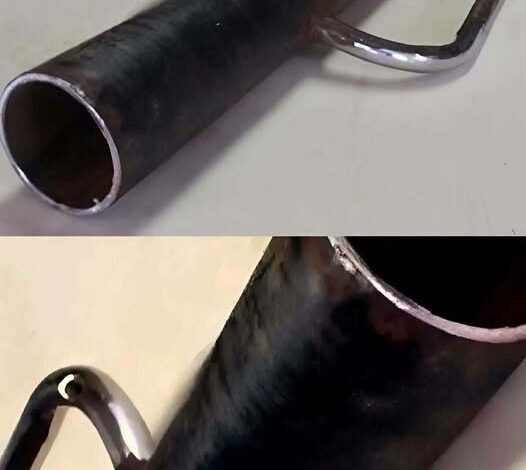
Most people who find one of these old metal tools have absolutely no idea what they’re looking at.
It resembles an oversized steel tube with handles.
No blade.
No obvious moving parts.
No electrical connection.
No engine.
Nothing that immediately explains what it’s supposed to do.
Some people guess it’s part of an old pump.
Others think it’s a strange exercise device, a piece of construction equipment, or something that once belonged to a machine that’s long since disappeared.
The truth is much simpler.
And once you see the tool being used, its design suddenly makes perfect sense.
It’s a manual post driver.
For generations, farmers, ranchers, builders, gardeners, and fence installers have used tools like this to drive posts into the ground using one of the oldest sources of power available:
Human muscle.
There’s no complicated mechanism hidden inside.
The tool itself is essentially a heavy hollow steel cylinder with handles attached to its sides.
To use it, you position the open end over the top of a suitable fence post.
Then you grab the handles.
Lift.
And slam the driver downward.
The weight of the steel strikes the top of the post and forces it farther into the soil.
Then you lift it again.
Bang.
Again.
Bang.
Again.
The process continues until the post reaches the required depth.
It’s brutally simple.
And that’s precisely why it works.
Imagine trying to hammer a long fence post into hard soil with an ordinary hammer.
You’d need to strike accurately while standing high enough to reach the top.
The post could wobble.
The hammer could slip.
And much of your energy could be wasted.
The post driver solves several of those problems at once.
Because the tube surrounds the upper portion of the post, the striking force remains centered over it.
The operator can use both hands.
And instead of depending mainly on arm strength to swing a hammer, the driver uses its own weight and gravity to help deliver each impact.
Lift.
Drop.
Lift.
Drop.
The rhythm becomes almost mechanical even though there’s no machine involved.
Anyone who has spent a day installing fence posts manually knows something else:
It’s exhausting.
The first few posts can make the tool seem almost enjoyable.
There’s something satisfying about watching a post disappear gradually into the earth with every strike.
After dozens of posts, however, your shoulders begin negotiating with you.
Your arms become heavy.
Your back starts asking serious questions about your life choices.
And the next fence post suddenly appears much farther away than the previous one.
Yet the tool keeps working.
That’s part of its appeal.
There’s no battery to charge.
No fuel tank to fill.
No cord to stretch across a field.
No complicated motor waiting to fail.
No software update.
No screen flashing an error code.
If the operator can lift it, the tool is ready.
That reliability made manual post drivers especially useful in places where electricity wasn’t available and powered equipment would have been inconvenient or unnecessarily expensive.
Picture a ranch fence running across a distant pasture.
There may be no electrical outlet for hundreds of yards.
A tractor might not easily reach every location.
But a person can carry a manual driver.
The same principle applies to gardens, temporary enclosures, construction projects, agricultural properties, event sites, and countless other outdoor jobs.
Whenever posts need to enter the ground, some version of this deceptively primitive-looking tool may appear.
Of course, not every post or soil condition is appropriate for manual driving.
Extremely rocky ground can make progress frustrating or impossible.
Larger structural posts may require holes, concrete, augers, hydraulic equipment, or other installation methods.
Utilities beneath the ground are another serious consideration.
Before driving posts, digging, or penetrating soil, buried electrical cables, gas lines, water lines, communication lines, and other services must be considered and located as required.
A simple tool can still create a serious problem if it’s used in the wrong place.
Technique matters too.
A post driver may look foolproof, but you’re repeatedly lifting a heavy steel object and bringing it down with considerable force.
Hands need to remain positioned safely on the handles.
The post needs to be suitable and stable.
People nearby need adequate distance.
Appropriate protective equipment and safe working practices matter.
And fatigue shouldn’t be ignored.
As people become tired, control deteriorates.
That’s when a simple repetitive job can become dangerous.
Despite those limitations, the basic design has survived remarkably well.
And that’s perhaps the most interesting thing about it.
Modern tools are often sold through features.
More power.
More settings.
More automation.
More electronics.
But the manual post driver represents the opposite philosophy.
Remove everything unnecessary.
What remains?
A heavy tube.
Two handles.
Gravity.
That’s enough.
The design works because the task itself hasn’t changed.
A fence post needs to go downward.
The tool needs to transfer force onto the top of that post.
The operator needs a controlled way to repeat the impact.
Once those requirements are satisfied, there isn’t much left to improve.
That’s why someone can discover an old post driver in a barn decades after it was purchased, brush away the dust, and immediately understand that it could probably still perform the job it was built for.
Compare that with many modern devices.
Leave an electronic gadget untouched for twenty years and it may become practically useless.
The battery dies.
The connector becomes obsolete.
Replacement parts disappear.
Software support ends.
A steel post driver doesn’t care what year it is.
A post from 1950 and a suitable post today present essentially the same challenge.
Put the driver over it.
Lift.
Strike.
Repeat.
The tool also represents a part of everyday infrastructure most people rarely consider.
Drive through the countryside and look at the fences.
Miles and miles of posts.
They divide pastures.
Protect crops.
Contain livestock.
Mark property boundaries.
Support wire.
Define roads and trails.
Each post had to be installed somehow.
Before hydraulic equipment and powered post drivers became widely accessible, much of that work depended on hand tools and physical labor.
Someone stood there.
Someone positioned the post.
Someone lifted the driver.
Someone brought it down.
Again.
And again.
And again.
A straight fence line that looks effortless from a passing car may represent days of exhausting work.
The same is true in smaller settings.
That garden fence behind someone’s house?
Posts.
The temporary barrier surrounding an outdoor event?
Posts.
Certain signs?
Posts.
Animal enclosures?
More posts.
The manual driver is one of those tools that disappears behind the finished result.
Nobody admires the tool afterward.
They admire the fence.
That’s probably why so many people fail to recognize one when they encounter it separately.
We’re accustomed to seeing what tools create, not necessarily the tools themselves.
Take away the fence and place the driver alone on a garage floor, and suddenly it looks mysterious.
But there’s another reason old tools like this fascinate people.
Their purpose is visible in their shape once you understand them.
The hollow cylinder isn’t decorative.
It fits over the post.
The weight isn’t an inconvenience.
It’s part of the mechanism.
The handles aren’t simply there for carrying it.
They allow the operator to lift and control the driver repeatedly.
Every part answers a practical question.
How do we hit the top of a tall post accurately?
Surround it.
How do we create enough impact?
Add weight.
How do we control that weight?
Add handles.
How do we keep doing it in the middle of a field?
Don’t depend on electricity.
That’s design reduced to necessity.
There is something almost refreshing about that in a world filled with increasingly complicated objects.
A modern device can contain hundreds of components and still leave its owner unsure how it works.
A manual post driver can be understood in seconds.
Its operation is visible.
Its energy source is obvious.
Its limitations are honest.
If the ground is hard, you’ll know.
If you’re tired, you’ll know that too.
There are powered alternatives today, of course.
Gas-powered, pneumatic, and hydraulic post-driving systems can dramatically reduce physical effort and increase productivity, especially when installing large numbers of posts.
For professionals, that efficiency can be essential.
Nobody needs to romanticize exhausting manual labor simply because the tool looks traditional.
But manual drivers continue to have advantages.
They’re relatively simple.
Portable.
Independent of fuel or electricity.
Easy to store.
Useful for smaller jobs.
And capable of sitting unused for long periods without worrying about whether an engine will start when they’re needed again.
That makes them difficult to completely replace.
Technology tends to win when it solves a genuine problem.
But simplicity survives when complexity doesn’t offer enough additional value.
The post driver is a perfect example.
It doesn’t need to connect to your phone.
It doesn’t need a digital display telling you how many strikes you’ve made.
It doesn’t need an app measuring post depth.
It just needs someone willing to lift it.
That’s why this strange-looking steel object continues appearing in barns, workshops, garages, sheds, ranches, farms, and construction sites.
And it’s why photographs of one can still leave thousands of people guessing.
Without context, it looks like a relic.
With context, it becomes beautifully obvious.
A fence post needs to enter the ground.
So someone, generations ago, developed a heavy tube that could repeatedly smash it downward while remaining centered over the post.
No elaborate engineering theater.
No unnecessary complication.
Just physics turned into a tool.
The next time you pass a long fence disappearing toward the horizon, consider what you’re actually seeing.
Not merely wood and wire.
You’re seeing hundreds of individual points where someone had to confront the earth and persuade a post to stay there.
Sometimes machinery did the work.
Sometimes an auger opened the ground first.
And sometimes a person stood beneath the sun holding one of these heavy steel cylinders.
Lift.
Bang.
Lift.
Bang.
Until the post stopped moving.
Then they walked to the next one.
In a world obsessed with making everything smarter, faster, and more connected, the manual post driver remains almost stubbornly unchanged.
Not because nobody thought to improve it.
But because sometimes the simplest design already answers the question perfectly.
A heavy steel tube.
Two handles.
Gravity.
Muscle.
And a fence post that isn’t going anywhere when the job is finished.