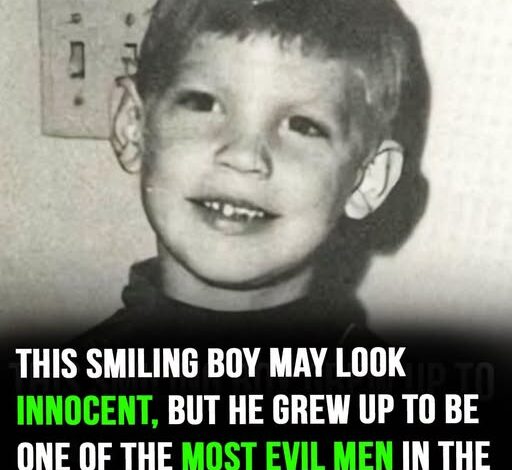
From the outside, there was little to suggest that his childhood would one day become the subject of endless books, documentaries, and psychological debate.
He was born into a family that, at first glance, seemed much like countless others. His parents were educated. His future appeared open with the ordinary possibilities every child deserves. Family photographs captured birthday parties, smiles, and quiet moments that looked entirely unremarkable.
Yet behind those pictures, life was far more complicated.
His home was marked by growing tension. His parents’ relationship steadily deteriorated, arguments became more frequent, and emotional instability cast a long shadow over the household. His mother struggled with serious personal difficulties, while his father was often consumed by work or absent for long stretches. As the family unraveled, the sense of security that children depend upon became increasingly fragile.
None of this, by itself, explains what he would later become.
Millions of children experience painful or chaotic upbringings and never commit acts of violence. Experts caution that there is no single childhood event—or even a combination of family hardships—that can fully account for why one individual develops into a serial killer. Human behavior emerges from an extraordinarily complex interaction of biological, psychological, developmental, and environmental factors, many of which remain poorly understood.
Still, those early years became an important part of the story researchers have tried to understand.
As he grew older, he developed an unusual fascination with death and animal remains. Family members later described interests that seemed increasingly disturbing in hindsight, though they did not necessarily predict the horrific crimes that would eventually follow. Like many details uncovered after notorious cases, these memories took on greater significance only after people knew the ending.
To those around him, he often appeared difficult to define.
Teachers generally remembered a quiet student who rarely demanded attention.
Classmates sometimes saw someone with an offbeat sense of humor who used jokes and awkward behavior to fit in.
Others recalled a teenager who seemed withdrawn, isolated, or disconnected, struggling to form lasting relationships while masking his discomfort behind laughter.
His parents, meanwhile, faced a son whose emotional world seemed increasingly difficult to reach.
As family tensions deepened and the household fractured, communication became more strained. Looking back, those closest to him have spoken about confusion, worry, and the painful realization that they did not fully understand what was unfolding beneath the surface.
Yet none of them could have imagined the scale of the horrors that would later be uncovered.
For years, his darkest thoughts remained hidden from public view.
Neighbors saw an ordinary apartment building.
Coworkers saw someone who blended into the background.
Casual acquaintances saw little reason for alarm.
Only after law enforcement entered his apartment did the unimaginable become visible.
The discovery exposed crimes so shocking that they continue to horrify people decades later. The contrast between the seemingly ordinary man and the reality concealed behind his front door forced the public to confront an unsettling truth: appearances alone often reveal very little about what another person may be capable of.
Since then, psychologists, criminologists, neuroscientists, and historians have spent years examining his life in search of answers.
They have explored his childhood, personality, mental health, social isolation, and developmental history, hoping to better understand how such extreme violence emerged. Yet despite decades of research, no single explanation has ever fully accounted for his actions.
That uncertainty remains one of the most disturbing aspects of the case.
People naturally search for clear causes because they offer the comforting belief that future tragedies can always be predicted or prevented. But reality is rarely that straightforward. While recognizing warning signs, expanding access to mental health care, and supporting families in crisis are all important, experts emphasize that there is no reliable formula that identifies who will become a violent offender.
In the end, the photographs of an innocent little boy continue to evoke the same difficult question.
How does a child who begins life with hopes and possibilities become someone responsible for unimaginable suffering?
The honest answer is that no one fully knows.
Understanding the circumstances surrounding a person’s life is not the same as excusing the choices they ultimately make. His victims—and the lives and families forever changed by his crimes—remain at the center of this story.
The enduring lesson is not that one difficult childhood inevitably leads to violence, but that human behavior is profoundly complex. The search for understanding continues not to diminish responsibility, but to help society recognize risk, strengthen prevention where possible, and ensure that compassion for struggling families never obscures accountability for those who choose to inflict harm.