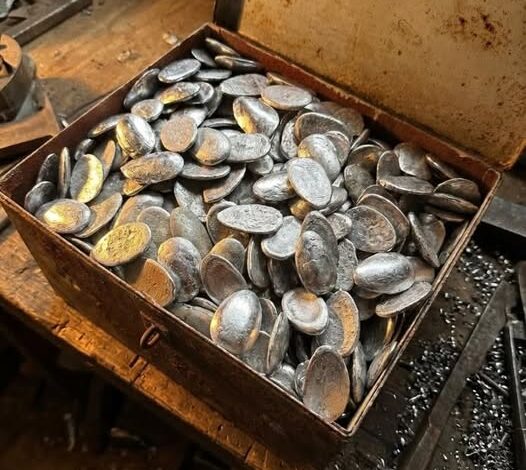
The strange metal object looked completely out of place.
I found it buried inside a box of forgotten household items at an estate sale, wedged between rusted tools, old photographs, and yellowed instruction manuals that nobody had bothered to examine. At first glance, it seemed insignificant—a curious piece of metal with an unusual shape and no obvious purpose.
Yet something about it refused to let me move on.
It wasn’t decorative.
It wasn’t broken.
And it certainly wasn’t random.
Every curve appeared intentional. Every opening seemed carefully placed. It looked like the kind of object that had once been used regularly by someone who understood exactly what it was for.
The problem was that nobody around me had any idea what it was.
“Probably junk,” one person suggested.
Another guessed it might be part of an old machine.
Someone else thought it could be a homemade tool.
But none of the explanations felt right.
The more I examined it, the more convinced I became that it had served a specific purpose—one important enough that generations of people may have used it without giving it a second thought.
And yet now, only a few decades later, that purpose had become a mystery.
That realization fascinated me.
How could something once considered useful become completely unrecognizable?
Determined to find answers, I began researching old household tools and historical everyday objects. What started as simple curiosity quickly turned into a journey through the forgotten routines of another era.
The deeper I looked, the more I discovered that the object itself wasn’t unusual.
In fact, history is filled with items that seem baffling to modern eyes.
Thousands of tools that were once common in homes, kitchens, workshops, and farms have quietly disappeared from everyday life. As technology evolved and lifestyles changed, many of the tasks those tools supported vanished along with them.
The result is a strange disconnect.
An object that was once instantly recognizable can now appear completely alien.
A century ago, people relied on tools that modern generations have never even seen.
Before electricity transformed households, daily life required ingenuity.
People solved problems using mechanical devices, handcrafted equipment, and practical tools designed for very specific tasks.
Every household contained items that today’s average person would struggle to identify.
Some were used for food preparation.
Others assisted with sewing, washing, heating, farming, or repairing equipment.
Many were remarkably simple.
Yet simplicity often concealed brilliance.
The more examples I found, the more impressed I became.
These weren’t primitive solutions.
They were thoughtful designs developed through years—sometimes centuries—of practical experience.
Each detail served a purpose.
A curved handle might reduce strain on the hand.
A narrow opening might improve precision.
A particular angle could make repetitive work easier and faster.
Nothing was accidental.
Every feature existed because someone had encountered a problem and found a clever way to solve it.
Modern products often prioritize appearance, marketing, and rapid replacement.
Older tools prioritized usefulness.
They were expected to last.
They were expected to work.
And perhaps most importantly, they were expected to earn their place in a home.
That perspective feels increasingly rare today.
We live in a world of constant upgrades.
Phones are replaced every few years.
Appliances are often discarded rather than repaired.
Products arrive, serve their purpose briefly, and disappear.
Convenience has become the dominant goal.
But older generations approached possessions differently.
A tool wasn’t simply something you owned.
It was something you depended on.
That distinction mattered.
As I continued researching, I found myself becoming less interested in the metal object itself and more interested in the people who had used items like it.
Who picked it up each morning?
What task did it help accomplish?
How many times had it been used before ending up forgotten in a box?
The object suddenly felt personal.
It became a connection to a life I would never fully know.
Perhaps it belonged to a farmer beginning work before sunrise.
Perhaps it sat in a grandmother’s kitchen for decades.
Perhaps it helped support a family through difficult times.
Whatever its story, it had once been part of someone’s routine.
Someone had reached for it instinctively.
Someone had trusted it.
Someone had depended on it enough to keep it nearby for years.
And now, separated from its original context, it appeared mysterious.
That transformation is one of the most fascinating aspects of history.
We often think major inventions tell the most important stories.
Automobiles.
Telephones.
Airplanes.
Computers.
But ordinary objects can reveal just as much.
Sometimes more.
Large inventions change society.
Small tools reveal how people actually lived.
They show us daily routines.
Practical challenges.
Household habits.
The small details that rarely appear in history books.
When you hold a forgotten object from the past, you’re holding evidence of someone’s ordinary life.
And ordinary lives are where history truly happens.
A century from now, future generations may experience something similar.
Imagine someone discovering an unfamiliar gadget from today.
Without context, many modern devices would seem just as puzzling.
Future historians may wonder why we relied on certain technologies or why specific products became essential.
The cycle continues.
Today’s everyday object becomes tomorrow’s mystery.
That thought gives these discoveries an unexpected significance.
They remind us that our own routines are temporary.
Our habits will eventually change.
Our tools will eventually disappear.
The things we consider normal today may one day seem strange to people looking back.
And perhaps that’s why old objects feel so captivating.
They serve as reminders that every generation believes its way of life is permanent.
Yet history shows otherwise.
The mysterious metal tool eventually revealed its purpose after considerable research.
Its function wasn’t particularly dramatic.
It wasn’t a rare treasure or a revolutionary invention.
It was simply a practical solution to an everyday problem.
And somehow, that made it even more interesting.
Because its true value wasn’t found in what it did.
It was found in what it represented.
Creativity.
Resourcefulness.
Thoughtful design.
The quiet intelligence of people solving real problems with the tools available to them.
Today, whenever I encounter an unfamiliar object from the past, I pause before dismissing it.
I’ve learned that mystery often hides remarkable stories.
What appears obsolete may once have been indispensable.
What seems ordinary may reveal extraordinary insight into another time.
And what looks like a forgotten piece of metal may actually be a doorway into a world that has almost vanished.
The next time you stumble across an object you can’t identify, resist the temptation to overlook it.
Ask questions.
Look closer.
Imagine the hands that once used it.
Consider the problem it was built to solve.
Because hidden inside many forgotten tools are stories of ingenuity, perseverance, and everyday life.
And sometimes, the smallest objects carry the most fascinating histories of all.