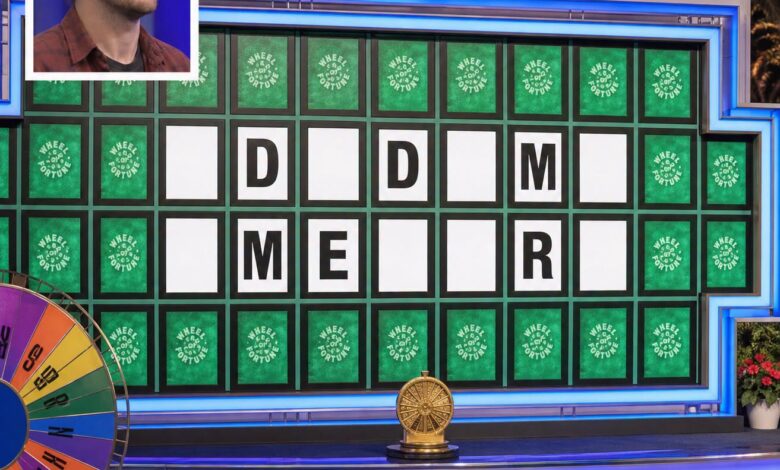
Conner Kemmsies had already won $19,080 in cash and prizes when he stepped into the Bonus Round.
Then a handful of blank spaces turned what should have been the triumphant ending of his Wheel of Fortune appearance into the moment viewers couldn’t stop debating.
Kemmsies, a commercial pilot, faced the category “Phrase.”
At first, things looked promising.
The available letters revealed enough of the puzzle for him to recognize the beginning:
“I DID MY…”
And then the clock started.
Those final seconds of the Bonus Round can feel brutally short from the comfort of a living room. Under studio lights, with thousands of dollars potentially riding on a single answer, they can feel even shorter.
Conner stared at the board.
“I did my…”
Nothing.
He tried to find the missing word.
The audience waited.
The music continued its unforgiving countdown.
Every passing second made the silence feel heavier.
The beginning seemed so familiar that the solution appeared as though it should arrive automatically.
But sometimes that is exactly what makes a puzzle difficult.
Once your brain decides it’s looking for a particular kind of answer, every other possibility can disappear.
The clock reached zero.
Then the completed puzzle appeared:
“I DID MY HOMEWORK.”
Conner’s reaction was immediate.
Rather than collapsing in disappointment, he laughed.
The answer was particularly amusing given his current profession. As a commercial pilot, homework presumably isn’t a regular part of his daily routine anymore, and he joked about exactly that.
It was the kind of good-natured reaction contestants often have when an answer suddenly seems painfully obvious after time expires.
But while Conner appeared ready to accept the loss and move forward, some viewers were not.
Almost immediately, attention shifted away from whether he should have guessed “homework” and toward the category itself.
Was “I DID MY HOMEWORK” really a phrase?
For some viewers, the answer was obvious: yes.
A phrase category on a game show can encompass familiar expressions, statements, and commonly recognizable combinations of words. “I did my homework” is certainly something people say, and once “I DID MY” appeared on the board, “HOMEWORK” was a logical possibility.
From that perspective, nothing unusual happened.
The puzzle was difficult under pressure.
Conner didn’t solve it in time.
That’s the game.
Others saw the situation very differently.
Their complaint wasn’t necessarily that the answer was impossible.
It was that the category might have sent Conner’s thinking in the wrong direction.
When many people hear the word “phrase,” they expect something idiomatic or expression-like—a familiar saying with a recognizable rhythm or meaning.
“I did my homework,” by contrast, sounds like a complete sentence someone might say literally.
That distinction became the center of the argument.
If Conner was mentally searching for an expression rather than an ordinary statement, some viewers reasoned, the category itself may have made the final word harder to identify.
And the Bonus Round offers almost no time to recover from that kind of mental detour.
Once the clock begins, contestants don’t have the luxury of stepping away and reconsidering how they’re interpreting the category.
They have seconds.
That’s what makes the moment so fascinating.
Sitting at home, the answer can look obvious.
“I did my…”
Homework.
Of course.
But game-show puzzles aren’t solved in a quiet living room with unlimited thinking time.
Contestants are standing beneath bright lights after already completing an entire episode. There’s an audience watching, cameras recording every hesitation, and a potentially valuable prize sitting just one correct answer away.
Pressure changes perception.
A word that seems obvious afterward can become completely inaccessible for ten crucial seconds.
Anyone who has ever forgotten a familiar name while introducing someone understands the phenomenon.
You know the answer.
Your brain simply refuses to deliver it when requested.
Then, seconds after the pressure disappears, it returns.
That’s essentially what made Conner’s loss so relatable.
He had most of the puzzle.
He knew the sentence structure.
The final word was common.
Yet the answer remained just beyond reach until the reveal.
And once “HOMEWORK” appeared, there was nothing left to do except laugh.
His joke afterward arguably made the moment even more memorable than a routine Bonus Round victory might have been.
Rather than reacting angrily or blaming the puzzle, he acknowledged the irony.
A commercial pilot had just lost because he couldn’t finish the sentence:
“I did my homework.”
The internet, naturally, was less willing to move on.
One side effectively argued that viewers were overthinking the category.
The other believed wording matters enormously in a game built entirely around words.
Both reactions point toward what makes Wheel of Fortune so enduringly watchable.
The puzzle doesn’t end when the letters are revealed.
People play along.
They imagine what they would have guessed.
They criticize answers from their couches.
They argue about categories.
And whenever a contestant misses something that seems obvious in hindsight, thousands of viewers experience the wonderful confidence that comes from solving a puzzle without actually standing on the stage.
But Conner’s situation also demonstrates why that confidence should probably come with a little humility.
At home, there is no countdown echoing in your ears.
There is no studio audience waiting.
There isn’t a mystery prize sitting behind an envelope.
Nobody is recording your face while your brain suddenly forgets a word you’ve known since elementary school.
Under those circumstances, “homework” might not arrive nearly as quickly as viewers imagine.
Whether the category helped or hurt him will probably remain a matter of interpretation.
Those who consider “I did my homework” a perfectly acceptable phrase will see an ordinary Bonus Round miss.
Those who expect the category to contain something more idiomatic may continue believing Conner was unintentionally steered away from the obvious answer.
Conner himself, however, still had something substantial to celebrate.
He walked into the round having already accumulated $19,080 in cash and prizes.
He walked away without the Bonus Round prize, but also without allowing one frustrating puzzle to erase everything he’d already won.
And perhaps that’s why the clip works so well.
There is disappointment.
There is irony.
There is an answer that becomes ridiculously obvious one second too late.
And there is a contestant capable of laughing when the board finally tells him what his brain couldn’t.
Conner lost the Bonus Round.
But judging by the argument that followed, Wheel of Fortune handed viewers another puzzle entirely:
Was “I DID MY HOMEWORK” a fair phrase?
Or did the category itself deserve some homework?