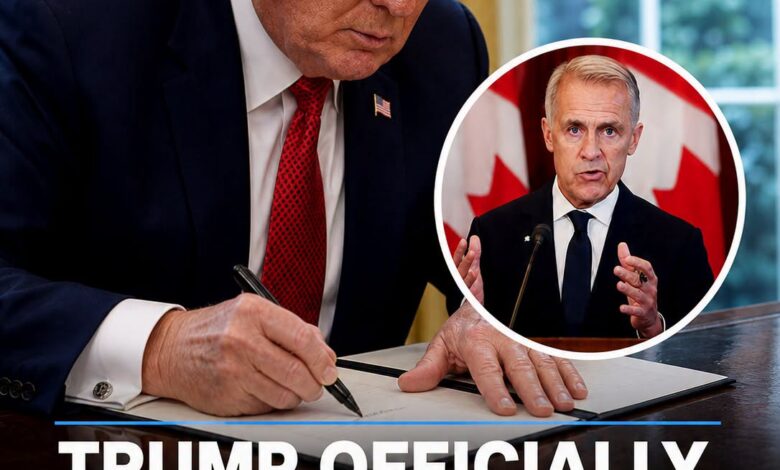
A lake cannot read an executive order.
It does not know where one country ends and another begins. It does not care about tariffs, campaign slogans, diplomatic insults, or which name appears on a government map.
For generations, Lake Ontario has simply stretched between the United States and Canada, carrying ships, feeding communities, shaping economies, and forming part of one of the most important international borders on Earth.
Then Donald Trump decided to call it “Lake America.”
On paper, the change might look like a naming dispute.
In reality, it is about something much larger.
Power.
National pride.
Trade.
And an increasingly bitter relationship between two countries that spent decades describing each other as among their closest friends.
The timing is what gives the order its sharpest edge.
It arrived amid a worsening confrontation between Washington and Ottawa, after trade negotiations had deteriorated and tariffs had become weapons in a broader political struggle.
Suddenly steel wasn’t simply steel.
Lumber wasn’t simply lumber.
Entertainment, language, cultural identity, border policy, and national sovereignty were being pulled into the argument.
Against that backdrop, renaming Lake Ontario doesn’t feel like an innocent exercise in geography.
It feels like a message.
And the message isn’t difficult to interpret.
America first.
Even on the map.
For Trump’s supporters, that symbolism may be precisely the attraction.
Trump has long understood that political gestures don’t need enormous practical consequences to generate enormous attention.
Sometimes the spectacle is the policy.
A renamed body of water can dominate headlines, provoke foreign officials, energize supporters, infuriate critics, and produce endless social-media arguments without moving a single border.
The physical lake remains exactly where it was.
The political landscape changes around it.
That’s what makes “Lake America” such a revealing move.
A name can sound trivial until people realize what names represent.
Ownership.
History.
Identity.
Authority.
Maps have never been completely neutral documents. What governments call territories, seas, mountains, and cities can reflect conquest, independence, ideology, cultural memory, or diplomatic recognition.
Changing a name can therefore become a declaration about who has the power to define a place.
But Lake Ontario presents an obvious problem for any attempt at unilateral reinvention.
The United States does not own it.
Neither does Canada.
The lake is shared.
Part of its shoreline belongs to the United States.
Much of it belongs to Canada.
Its waters are woven into the geography, economy, and history of both nations.
A presidential order can tell American federal agencies what terminology to use in official American documents.
It cannot command Canadians to adopt the same language.
Ottawa can continue calling it Lake Ontario.
Ontario can continue calling it Lake Ontario.
Canadian schools can print Lake Ontario in textbooks.
Canadian broadcasters can say Lake Ontario.
Canadian maps can label Lake Ontario.
People living along the Canadian shore can wake up tomorrow morning, look across the water, and continue using the name their families have used for generations.
Nothing an American president signs can magically erase that.
That limitation is almost comically important.
Because the grandeur of a presidential decree collides with an extraordinarily ordinary reality:
Canada can simply say no.
Not necessarily through some dramatic retaliatory ceremony.
Not with soldiers.
Not with a constitutional crisis.
Just with language.
Lake Ontario.
Two words.
Repeated as though nothing happened.
That quiet refusal exposes the boundary between domestic political authority and international reality.
Trump can influence how the United States government describes a place.
He cannot dictate Canada’s vocabulary.
And so one body of water can acquire two political identities depending on which side of the border is holding the map.
That would be unusual enough on its own.
But the deeper story is the deterioration of the relationship surrounding it.
For decades, Americans and Canadians have enjoyed the luxury of treating their border as almost boring.
That boredom was an achievement.
The two countries have had disagreements, sometimes serious ones, but the larger relationship was built on extensive trade, military cooperation, tourism, family connections, shared infrastructure, intelligence partnerships, cultural exchange, and an enormous amount of everyday cross-border commerce.
Their economies became deeply intertwined.
Factories on one side depended on components from the other.
Energy moved across the border.
Agricultural products moved across the border.
Tourists crossed in both directions.
Movies, television, music, news, sports, and digital entertainment ignored the political boundary almost as easily as the lake itself did.
Then trade became increasingly confrontational.
Tariffs changed the tone.
Products that once represented routine commerce became bargaining chips.
Steel.
Aluminum.
Lumber.
Automobiles.
Agricultural goods.
Each dispute carried economic consequences, but it also carried emotional ones.
Canadians began hearing American rhetoric not merely as negotiation but as disrespect.
Americans heard Canadian retaliation framed as hostility.
Political leaders responded to their own domestic audiences.
The cycle fed itself.
That is how allies can begin talking like adversaries without officially becoming enemies.
One insult invites another.
One tariff produces retaliation.
One symbolic gesture demands a symbolic response.
And eventually even geography becomes ammunition.
The tensions extend beyond conventional trade.
Canada is not culturally identical to the United States, despite the enormous amount the two countries share.
Quebec’s fierce protection of French language and culture is one obvious reminder.
Canadian governments have long maintained policies intended to preserve domestic cultural production against the overwhelming gravitational pull of the much larger American entertainment market.
Streaming services, broadcasting rules, digital platforms, language requirements, and cultural funding can therefore become political flashpoints.
To Americans, some regulations may look protectionist.
To Canadians, they may look like necessary defenses of cultural sovereignty.
That difference becomes more combustible when the overall relationship is already hostile.
Suddenly a streaming rule isn’t merely regulation.
It’s another grievance.
A tariff isn’t merely economics.
It’s disrespect.
And a lake isn’t merely water.
It’s territory in a symbolic argument over who gets to define North America.
This is why “Lake America” matters even if its immediate legal effect is limited.
Symbolism influences relationships.
Imagine two neighbors who have shared a driveway peacefully for decades.
Then, after an argument, one installs a sign naming the entire driveway after himself.
Technically, perhaps the sign stands only on his property.
The asphalt hasn’t moved.
Nobody’s deed has changed.
But the other neighbor understands the message perfectly.
That is the diplomatic power of a gesture like this.
It says:
I know this belongs partly to you.
I’m naming it for myself anyway.
For supporters, that can look like confidence.
For critics, it looks like needless provocation.
Those interpretations reflect two fundamentally different understandings of Trump’s political style.
One side sees a president refusing diplomatic niceties that they believe allowed other countries to take advantage of the United States.
They view confrontation as leverage.
If allies complain, so be it.
Friendship, in this interpretation, shouldn’t prevent America from aggressively defending its economic interests.
Trump’s willingness to offend foreign governments becomes evidence that he isn’t constrained by elite diplomatic etiquette.
The opposing interpretation is nearly the reverse.
Critics argue that alliances themselves are strategic assets.
Canada isn’t merely another competitor negotiating over prices.
It is a neighboring democracy integrated with the United States economically, militarily, geographically, and culturally.
Humiliating an ally may produce applause domestically while creating long-term costs that are much harder to measure.
Trust is one of those costs.
It takes decades to build and surprisingly little time to damage.
Governments remember.
Voters remember.
Businesses remember uncertainty.
Once companies begin questioning whether cross-border rules will change with every political dispute, they alter investment decisions.
Once citizens begin viewing a neighboring country with resentment, politicians find that resentment useful.
Temporary anger can harden into national habit.
That’s the danger hidden beneath the absurdity of arguing over a lake’s name.
The lake itself isn’t the crisis.
It is the symptom.
Lake Ontario has always represented cooperation whether politicians acknowledged it or not.
Water ignores customs checkpoints.
Pollution doesn’t stop at the border.
Neither do environmental consequences.
Shipping requires coordination.
Water levels require coordination.
Infrastructure requires coordination.
Emergency planning requires coordination.
The Great Lakes system works precisely because geography forces the United States and Canada into a relationship neither country can simply tweet away.
That reality remains after any executive order.
The water is still shared.
The shoreline is still shared.
The environmental risks are still shared.
The economic interests are still connected.
No branding exercise can change hydrology.
That may be the great irony of “Lake America.”
The stronger the symbolic claim sounds, the more clearly the physical lake demonstrates its limits.
Stand on the American shore and look north.
The water doesn’t become more American because Washington printed a new map.
Stand on the Canadian shore and look south.
It doesn’t become less Canadian because an American agency changed a label.
The lake remains stubbornly shared.
Perhaps that is why the dispute feels simultaneously ridiculous and serious.
Ridiculous because no decree can make Canada participate in a name change it rejects.
Serious because countries communicate through symbols, and symbols can reveal how leaders understand relationships.
An ally can be treated as a partner.
A competitor.
A subordinate.
Or an audience for humiliation.
Those choices matter.
The United States and Canada will almost certainly continue doing business with one another regardless of what the lake is called.
Their geography makes complete separation nearly impossible.
But proximity doesn’t guarantee friendship.
Neighbors can share a fence while despising each other.
Countries can share billions of dollars in commerce while steadily losing political trust.
And once distrust becomes embedded, every future disagreement becomes harder.
That is the larger warning contained in this strange naming battle.
International relationships rarely collapse because of one dramatic moment.
They erode.
A tariff here.
An insult there.
A canceled negotiation.
A retaliatory measure.
A mocking comment.
A symbolic provocation.
Each individual episode can be dismissed as temporary.
Together they change the emotional climate.
Eventually leaders stop assuming good faith.
Then citizens do too.
And cooperation that once seemed automatic becomes politically expensive.
That is a remarkable amount of tension to project onto one lake.
Yet Lake Ontario is uniquely suited to reveal the contradiction.
It belongs to neither country alone.
It physically connects the very governments arguing over what to call it.
Washington may put “Lake America” on American federal maps and documents.
Canada may continue printing “Lake Ontario.”
Travelers could theoretically encounter one name while approaching the water from the south and another after crossing the border.
The geography remains unchanged.
Only the story told about it changes.
And perhaps that is the most revealing part.
Political leaders can rename documents.
They can rename signs.
They can rename government databases.
They can create headlines.
They can provoke reactions.
What they cannot do so easily is rename reality.
The United States and Canada remain neighbors.
Their economies remain connected.
Their security interests overlap.
Their citizens cross the same border.
And between them lies the same enormous body of water that existed before the argument began.
Call it Lake America in Washington.
Call it Lake Ontario in Ottawa.
The lake will answer to neither.
It will simply continue touching both shores—a quiet reminder that geography can force countries to share what politics would sometimes rather claim for itself.