The claim arrived like a shockwave across an already volatile region.
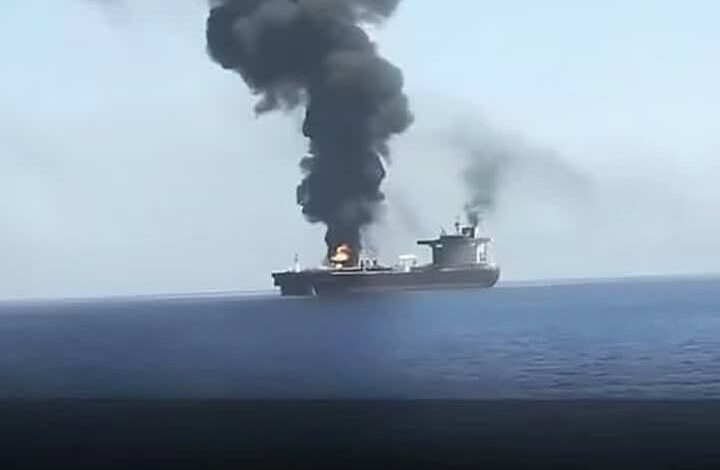
In the early hours of the morning, Iranian officials announced that naval forces from the Islamic Revolutionary Guard Corps had struck a U.S.-linked oil tanker in the northern Persian Gulf, leaving the vessel engulfed in flames. If true, the incident would represent one of the most serious maritime escalations in the region in recent years.
But as the world reacted, a critical question remained unanswered:
Did it actually happen?
At the time of Iran’s announcement, there was no independent confirmation of the reported attack. No verified images. No official acknowledgment from the Pentagon. No public distress signals from the vessel. No confirmation from major maritime monitoring organizations.
Yet despite the uncertainty, the claim alone was enough to send alarm through diplomatic circles, energy markets, military headquarters, and shipping companies around the world.
Because in the Persian Gulf, perception can be almost as powerful as reality.
According to Tehran, the operation was carried out by Revolutionary Guard naval units as part of what officials described as a new wartime phase of military activity. Iranian statements portrayed the alleged strike not as an isolated action, but as part of a broader campaign tied to escalating regional tensions.
More significantly, Iranian officials coupled the announcement with another warning.
They declared their intention to exert authority over passage through the Strait of Hormuz, one of the most strategically important waterways on Earth.
That declaration immediately raised concerns far beyond the Middle East.
The Strait of Hormuz is a narrow corridor connecting the Persian Gulf to global markets. Every day, enormous volumes of crude oil, liquefied natural gas, and commercial cargo pass through its waters. A disruption there has the potential to affect economies thousands of miles away.
For decades, the strait has served as one of the world’s most sensitive geopolitical pressure points.
Now it was once again at the center of international attention.
Iranian officials warned that vessels linked to the United States, Israel, Europe, and allied nations could face challenges transiting the waterway if tensions continue to escalate.
The message was unmistakable.
Whether or not the reported tanker strike occurred exactly as described, Tehran wanted the world to understand that maritime traffic could become part of the broader confrontation unfolding across the region.
That possibility immediately elevated the stakes.
Shipping companies began monitoring developments closely. Energy traders assessed potential disruptions. Governments reviewed contingency plans. Military analysts examined the implications of any threat to freedom of navigation through one of the world’s most vital commercial routes.
Because history has shown how quickly incidents in the Gulf can spiral into larger crises.
The timing of Iran’s claim only added to the anxiety.
The region has already been experiencing one of its most dangerous periods in years. A series of military strikes, retaliatory attacks, warnings, and escalating rhetoric involving Iran, Israel, and the United States has steadily increased fears of a wider conflict.
Each new development has pushed tensions higher.
Each response has carried the risk of triggering another.
And now, the possibility of an attack on commercial shipping has introduced an entirely new layer of uncertainty.
Yet despite the dramatic nature of Iran’s announcement, crucial details remain missing.
No verified information has emerged regarding the vessel’s exact location.
Its ownership remains unclear.
Its condition is unknown.
The status of the crew has not been independently confirmed.
There have been no publicly verified reports of injuries or fatalities.
Even the extent of any damage remains uncertain.
For maritime experts, these unanswered questions are significant.
In an age of satellite imagery, vessel-tracking systems, commercial monitoring networks, and near-instant communication, major maritime incidents often generate multiple streams of confirmation within a relatively short period.
The absence of such verification does not necessarily disprove Iran’s claim.
But it does mean the situation must be approached cautiously.
Until independent evidence emerges, the reported strike remains precisely that: a claim.
Still, claims themselves can have consequences.
Financial markets do not wait for perfect information.
Neither do governments.
Even unconfirmed reports involving the Strait of Hormuz can influence oil prices, insurance premiums, military readiness levels, and diplomatic calculations.
That reality helps explain why the international response has been so attentive despite the lack of confirmation.
The economic implications alone are substantial.
A verified attack on a tanker could increase shipping costs across the region. Insurance providers may reassess risk levels for vessels operating in Gulf waters. Energy traders could respond to fears of supply disruptions. Military forces may increase patrols and deployments to protect commercial routes.
The ripple effects would extend far beyond the Middle East.
What happens in the Strait of Hormuz rarely stays there.
But beneath the economic concerns lies an even larger issue.
Control.
Iran’s statements suggest that the reported incident was intended to communicate capability as much as action.
By linking the alleged strike to broader wartime authority and maritime control, Tehran appears to be signaling that it possesses both the willingness and the means to challenge movement through one of the world’s most important waterways.
Whether that message is primarily strategic, political, military, or symbolic remains unclear.
What is clear is that it was designed to be noticed.
And it was.
Across the globe, military planners, diplomats, intelligence analysts, and energy executives are now watching for signs that could confirm—or contradict—Iran’s account.
Satellite imagery may provide clues.
Shipping databases may reveal vessel movements.
Official government statements could offer additional details.
Crew communications, emergency alerts, or maritime advisories may help establish what actually occurred.
Until then, uncertainty remains the dominant reality.
The coming hours and days will likely determine whether this announcement becomes a brief episode in an ongoing regional standoff or a major turning point with far-reaching consequences.
Much depends on facts that have not yet emerged.
Was a tanker struck?
Was there significant damage?
Were lives endangered?
Was the vessel truly linked to American interests?
And perhaps most importantly, what happens next?
Because in moments of heightened tension, the aftermath can become more consequential than the incident itself.
A verified attack could trigger military responses, diplomatic confrontations, and further escalation.
A disputed claim could fuel information warfare and competing narratives.
A misunderstanding could become a crisis.
And a crisis, in an environment already filled with suspicion and hostility, can quickly become something larger.
For now, the world is left in a familiar but uncomfortable position—waiting for clarity while preparing for consequences.
The flames Iran described may or may not be real.
The tanker may or may not have been struck.
But the anxiety spreading through global markets and governments is unquestionably real.
And until more information emerges, one fact remains undeniable:
Any confirmed attack on commercial shipping near the Strait of Hormuz would represent a dangerous escalation, carrying risks that extend far beyond the waters where it allegedly occurred.
The claim has been made.
The world is watching.
And the next piece of evidence could determine whether this becomes another tense headline—or the beginning of a much larger crisis.