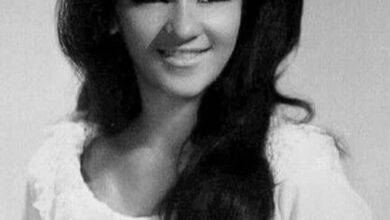
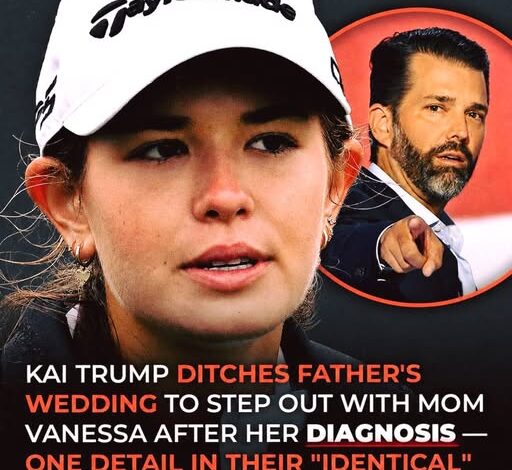
Vanessa Trump was seen out with her daughter Kai during a recent public appearance – photos

Illness has a strange way of rearranging public attention.
For years, Vanessa Trump existed mostly at the edges of headlines — recognizable, discussed occasionally, photographed at events, but no longer occupying the relentless center of national fascination the way the Trump name once guaranteed. Public curiosity had softened into background awareness. People remembered her, certainly, but memory is different from scrutiny.
Then came the health announcement.
And suddenly the internet remembered how quickly a human being can transform from a political or celebrity-adjacent figure into something far more universal:
a person afraid for her body,
leaning on family,
trying to move through uncertainty while strangers watch from every angle.
The announcement itself was restrained.
That mattered.
Modern public life rewards spectacle so aggressively that restraint now feels almost shocking when it appears. Vanessa did not post dramatic hospital photos. She did not frame herself as heroic or inspirational. She did not transform vulnerability into performance.
Instead, she spoke quietly about undergoing a medical procedure, about recovery, about relying on doctors and family support while stepping back from public attention.
The simplicity of it made the message feel human rather than strategic.
Then came the second revelation:
breast cancer.
That changed the emotional atmosphere immediately.
Because cancer alters how audiences perceive people almost instinctively. Political loyalties soften around illness. Online cynicism pauses, at least briefly. The public stops evaluating a person as a symbol and begins seeing them as physically fragile in the same way millions of ordinary families have experienced firsthand.
Underneath every public reaction sits private memory.
A mother.
A sister.
A spouse.
A friend.
Someone who sat beneath fluorescent treatment-room lights trying not to look afraid.
That emotional recognition explains why the response spread so quickly across social media.
People who rarely agreed politically offered support anyway.
Followers shared survival stories.
Women posted reminders about screenings and early detection.
Public figures wrote messages about strength, healing, and privacy.
Ivanka Trump’s public support drew particular attention, partly because audiences remain fascinated by family dynamics within the extended Trump orbit. Her message was brief but warm, emphasizing support and recovery rather than publicity or politics.
And for a moment, the internet behaved almost gently.
Not completely.
The internet is rarely completely gentle.
But noticeably softer than usual.
Then came the photographs from West Palm Beach.
Vanessa walking beside her daughter Kai.
Casual clothing.
Relaxed posture.
No visible attempt to stage an image.
Yet the photographs exploded online anyway.
Not because they contained scandal.
Because they contained familiarity.
People became fixated almost instantly on how much Kai resembled her mother. Comment sections filled with the same observations repeated in slightly different language:
“They look like sisters.”
“She’s her mother’s twin.”
“Same smile.”
“Same eyes.”
Public fascination with resemblance is deeply emotional. Families recognize themselves through faces, gestures, posture, even the way someone turns while laughing. Celebrity culture magnifies that instinct because audiences watch famous families age publicly across years.
Kai no longer looked merely like Vanessa’s daughter.
She looked like continuity.
And after a cancer announcement, continuity becomes emotionally charged.
The images carried an unspoken reassurance:
she is still here,
still walking,
still shopping,
still beside her child.
That emotional subtext mattered more than the photographs themselves.
What made the moment resonate further was its ordinariness.
No red carpet.
No press conference.
No heavily managed event.
Just a mother and daughter moving through an afternoon together while cameras transformed a private outing into public conversation.
That transformation says as much about modern culture as it does about Vanessa herself.
Famous people are rarely allowed ordinary moments anymore. Every appearance becomes interpreted for meaning:
How does she look?
Does she seem healthy?
Is she thinner?
Tired?
Recovering?
Strong?
Audiences search bodies for narratives constantly.
And illness intensifies that scrutiny.
A simple shopping trip becomes evidence of resilience.
A smile becomes proof of optimism.
A tired expression becomes tabloid speculation.
Public figures learn quickly that visibility during illness creates a paradox:
people genuinely care,
but caring also consumes privacy.
Vanessa’s recent appearances seem to reflect someone attempting to balance that tension carefully.
Present enough to reassure.
Private enough to protect herself.
That balance becomes even more complicated because of the additional media attention surrounding her reported relationship with Tiger Woods.
On paper, the pairing already carried enormous celebrity gravity:
one of the most recognizable names connected to American political culture,
and one of the most famous athletes in modern sports history.
Both also understand public scrutiny intimately.
Tiger Woods spent decades living beneath relentless observation — athletic triumphs, injuries, scandals, rehabilitation, personal collapse, professional resurgence. Very few public figures understand the exhausting machinery of fame better than he does.
That shared understanding may explain why reports describing their relationship consistently emphasize privacy and mutual support rather than spectacle.
People who survive intense public attention often become deeply protective of ordinary emotional space afterward.
Still, media coverage inevitably links their relationship to broader narratives:
Tiger’s professional setbacks,
legal matters,
public reinvention,
Vanessa’s health struggles,
family responsibilities,
the challenge of sustaining intimacy while millions speculate externally.
Whether all reporting around the relationship is fully accurate remains unclear, which is important to acknowledge. Much celebrity coverage operates partly through unnamed sources, assumptions, and interpretation rather than direct confirmation.
That distinction matters ethically.
Especially during serious health challenges.
At the center of all this attention remains a woman dealing with cancer while the internet analyzes photographs, relationships, body language, and family appearances in real time.
That pressure cannot be easy.
Illness already destabilizes identity privately. Public illness adds another layer entirely:
becoming watched while vulnerable.
And yet, many observers responded to the recent photographs not with intrusion, but with empathy.
That difference matters too.
People saw not just Vanessa Trump the public figure.
They saw a mother walking beside her daughter during a frightening season of life.
The warmth surrounding the images reflected something larger than celebrity fascination:
a collective emotional instinct toward reassurance.
Perhaps that is why the commentary focused less on controversy and more on tenderness.
The public did not primarily discuss politics.
They discussed resemblance.
Family.
Support.
Strength.
Recovery.
Even the fascination with Kai looking so much like her mother carried emotional undertones deeper than appearance alone. In moments involving illness, resemblance symbolizes continuity. It reassures people subconsciously that life extends forward through connection, through children, through relationships that survive fear.
And fear inevitably exists beneath every cancer announcement.
Even optimistic diagnoses carry uncertainty.
Scans.
Waiting rooms.
Medication side effects.
The emotional exhaustion of not fully knowing what comes next.
Public figures may experience these things inside wealth and privilege, but the physical fear remains fundamentally human.
That universality explains why health disclosures often temporarily dissolve the distance between celebrities and ordinary audiences.
For a moment, status becomes irrelevant beside vulnerability.
Vanessa’s own statements reflected awareness of that vulnerability. Her emphasis on medical guidance, privacy, and family support suggested someone attempting to move carefully rather than perform strength theatrically.
There is dignity in that restraint.
Especially now, when public culture increasingly rewards oversharing and emotional branding.
Instead of turning recovery into constant content, Vanessa appears to be protecting portions of it from public consumption.
That decision may ultimately help preserve something illness often threatens:
a sense of self separate from diagnosis.
Because once someone becomes publicly associated with cancer, the illness risks overtaking every other part of their identity in media narratives.
People stop discussing who they are.
They discuss what they are surviving.
The recent coverage surrounding Vanessa has mostly avoided the harsher edges of celebrity culture so far. Reports continue emphasizing support systems, family connection, and recovery rather than speculation or sensationalism.
Still, caution remains important.
Online ecosystems generate rumors rapidly, especially when famous individuals experience health crises. Unverified claims spread faster than corrections. Emotional audiences sometimes mistake speculation for fact simply because repetition creates familiarity.
That is why reliable sourcing matters deeply in moments like this.
Not every social media theory deserves amplification.
Not every anonymous claim reflects reality.
And not every photographed expression reveals emotional truth.
Sometimes a woman shopping with her daughter is simply a woman trying to reclaim an ordinary afternoon during an extraordinarily difficult season of life.
Perhaps that is the most human part of the story.
Not the fame.
Not the headlines.
Not the political associations or celebrity relationships.
Just the quiet image of a mother and daughter walking side by side after frightening medical news, reminding people that illness rearranges priorities quickly.
Public attention may eventually move elsewhere, as it always does.
The internet cycles endlessly toward newer stories, fresher controversies, louder distractions.
But for now, the dominant response surrounding Vanessa Trump remains unusually simple:
people hope she recovers,
hope her family stays close,
and hope the parts of her life untouched by cameras remain strong enough to carry her through what comes next.
And in an era where public conversation so often defaults to cruelty, that collective instinct toward compassion may be the most significant detail of all.