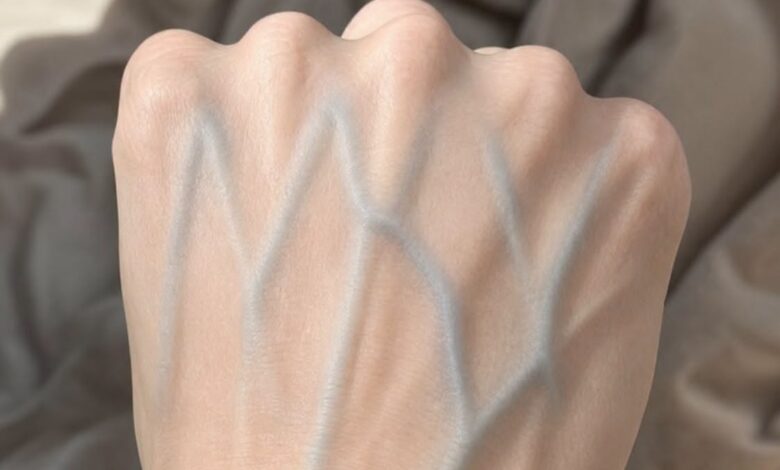
You look down at your hands one morning and notice something different.
The veins seem darker.
More noticeable.
Maybe they’re suddenly standing out along your arms, or perhaps a twisting blue vein has appeared on your leg that you don’t remember seeing before.
For many people, the first reaction is worry.
Why are my veins suddenly showing?
The reassuring answer is that visible veins are often completely normal.
Your veins don’t automatically signal disease simply because you can see them through your skin. Genetics, age, body composition, exercise, temperature and other everyday factors can all affect how prominent they appear.
But sometimes a noticeable change—particularly when accompanied by pain, swelling, warmth, redness or other symptoms—deserves medical attention.
The key is knowing the difference between something worth observing and something that shouldn’t wait.
First, it helps to understand what your veins actually do.
Your circulatory system has an enormous transportation job.
Arteries generally carry oxygen-rich blood away from your heart to tissues throughout the body. Veins carry blood back toward the heart.
In your legs, that return journey has an additional challenge.
Gravity.
Blood has to travel upward.
To help accomplish this, many veins contain one-way valves designed to keep blood moving in the correct direction. Your leg muscles also help squeeze veins as you walk, assisting blood’s journey back toward the heart.
When those valves don’t work effectively, blood can begin pooling in the veins.
Pressure increases.
Veins may enlarge.
They can become twisted or bulging.
This is one mechanism involved in chronic venous insufficiency and the development of varicose veins.
Varicose veins are often recognizable because they may appear enlarged, rope-like or twisted beneath the skin, particularly in the legs.
For some people, they’re mostly a cosmetic concern.
For others, they come with symptoms.
Aching.
Throbbing.
Burning.
Itching.
A feeling of heaviness.
Leg fatigue.
Swelling, particularly around the ankles.
Symptoms may become more noticeable after spending long periods standing.
Over time, significant venous disease can sometimes contribute to skin changes or difficult-to-heal sores.
That’s why persistent symptoms deserve evaluation rather than being dismissed simply as part of getting older.
But here’s where perspective matters:
Seeing veins does not mean you have venous insufficiency.
Some people naturally have extremely visible veins.
If you have lighter or thinner skin, veins may simply be easier to see.
Genetics matter too.
You may notice that several members of your family have prominent veins without significant medical problems.
Body composition can make an enormous difference.
Subcutaneous fat—the fat immediately beneath the skin—can make veins less visible.
Lose some of that tissue and the veins underneath may suddenly become easier to see.
That’s one reason someone who has recently lost weight might look at their arms or hands and think their veins have dramatically changed.
The veins may not have undergone a dangerous transformation at all.
They may simply be less concealed.
Exercise can make veins temporarily more prominent too.
During physical activity, blood flow increases to working muscles. Muscles themselves can become temporarily fuller, and superficial veins may become easier to see.
Anyone who has watched a weightlifter’s arms during a workout has seen this effect.
For many healthy people, increased vascularity during or after exercise is expected.
Temperature can change appearances as well.
When you’re hot, blood vessels near the skin may dilate as your body attempts to release heat.
That can make veins look more obvious.
When you’re cold, they may become less prominent.
Even something as ordinary as a hot shower can temporarily change what you see.
Age also matters.
As skin changes over time and loses some thickness and elasticity, veins can become increasingly visible.
This is particularly noticeable on the hands and arms.
Pregnancy can cause significant changes too.
Blood volume increases during pregnancy, hormones change, and the growing uterus can affect circulation from the legs.
As a result, some pregnant people notice more visible or enlarged veins.
Certain medications and hormonal changes may also influence circulation or how veins appear, which is another reason context matters.
Then there are lifestyle factors.
If your work requires you to stand for long stretches, your legs may feel heavy or swollen by the end of the day.
Long periods of sitting can also affect circulation.
Movement helps the muscles in your legs assist venous return, so being stationary for extended periods can contribute to discomfort or swelling in susceptible people.
None of this means every office worker or cashier with visible veins has a disease.
It means the appearance of veins should be considered alongside the rest of the picture.
And there is one particularly important distinction:
Varicose veins and blood clots are not the same thing.
People sometimes see a prominent vein and immediately fear a clot.
A dangerous deep-vein blood clot, known as deep vein thrombosis or DVT, may not be visible as a bulging vein at all.
Instead, warning signs can include swelling—often affecting one leg—pain or tenderness, warmth and changes in skin color such as redness or discoloration.
Sometimes DVT occurs without obvious symptoms.
What makes it potentially dangerous is what can happen if part of the clot breaks free and travels to the lungs.
That can cause a pulmonary embolism, which is a medical emergency.
Symptoms can include sudden shortness of breath, chest pain, coughing up blood, fainting or severe lightheadedness, or a rapid heartbeat.
If symptoms suggest a pulmonary embolism, seek emergency medical care immediately.
Likewise, sudden significant swelling, pain, warmth or discoloration in one leg warrants prompt medical evaluation, particularly when risk factors for blood clots are present.
Those risk factors can include recent surgery, prolonged immobility, certain cancers, pregnancy and the postpartum period, previous blood clots, and some hormone-containing medications, among others.
The point isn’t to diagnose yourself from a checklist.
It’s to recognize when “I’ll see whether it goes away” isn’t the safest approach.
There are other reasons to make a routine medical appointment even when the situation isn’t an emergency.
Perhaps you’ve developed new bulging veins that hurt regularly.
Maybe your ankles repeatedly swell.
Your legs feel unusually heavy after standing.
The skin around your ankles is changing color.
A sore isn’t healing normally.
Or the veins have progressively worsened and are interfering with your comfort or daily activities.
A healthcare professional can examine the area, review your symptoms and medical history, and determine whether additional testing is appropriate.
Sometimes an ultrasound is used to evaluate blood flow and look for problems within the veins.
Treatment depends entirely on what’s causing the symptoms and how severe they are.
For some people, simple measures may be recommended.
Regular walking and movement can help the leg muscles support circulation.
Avoiding long uninterrupted periods of sitting or standing may help some people.
Elevating the legs can sometimes reduce swelling.
Maintaining a weight appropriate for your health circumstances may also reduce pressure on the veins.
Compression stockings are useful in certain situations, but they’re not something everyone should automatically prescribe themselves. The appropriate type and pressure can depend on your condition, and compression may not be suitable for everyone.
A clinician can tell you whether they’re appropriate.
For more significant varicose veins or venous disease, medical procedures are available.
Modern treatment doesn’t necessarily mean major surgery.
Depending on the problem, specialists may use minimally invasive techniques to close or treat troublesome veins.
Again, the correct approach depends on an actual diagnosis.
That’s perhaps the most important message whenever your body suddenly looks different:
Don’t diagnose yourself from appearance alone.
A photograph online cannot tell you how blood is flowing through your veins.
Neither can a viral post.
And neither can simply comparing your legs with someone else’s.
Instead, ask yourself a few practical questions.
Is this actually new?
Is it affecting one side or both?
Is there pain?
Swelling?
Warmth?
Redness or discoloration?
Has the area become hard or unusually tender?
Are there skin changes or sores?
Did the change happen after weight loss, exercise, pregnancy, hot weather or another understandable circumstance?
Have you recently been immobilized, hospitalized or undergone surgery?
The answers provide much more useful information than “I can suddenly see my veins.”
There’s also no benefit in frightening yourself every time a blue line appears beneath your skin.
Veins are supposed to be there.
For many people, visible veins are simply part of normal anatomy.
The concern is not visibility by itself.
It’s change plus context plus symptoms.
A vein that has always been visible and causes no problems is very different from a leg that suddenly becomes swollen, painful, warm and discolored.
A temporary increase in vascularity after exercise is very different from progressively worsening rope-like veins accompanied by aching and skin changes.
Learning those distinctions allows you to pay attention without turning normal anatomy into a source of constant anxiety.
Your body communicates through changes.
Sometimes the message is harmless:
You exercised.
You’re hot.
You’ve lost weight.
You’re getting older.
Sometimes the message is:
Something deserves to be checked.
And occasionally the message is urgent.
So if your veins suddenly seem more visible, don’t panic.
Look at the whole situation.
If the change is persistent, unexplained, painful or accompanied by swelling or skin changes, arrange a medical evaluation.
If you develop symptoms that could indicate a serious blood clot or pulmonary embolism—particularly sudden shortness of breath, chest pain, fainting, coughing up blood, or significant new one-sided leg swelling and pain—seek urgent or emergency medical care.
The goal isn’t fear.
It’s attention.
Because taking your body’s changes seriously doesn’t mean assuming the worst.
It means knowing when to stop guessing and let a qualified professional determine what those changes actually mean.