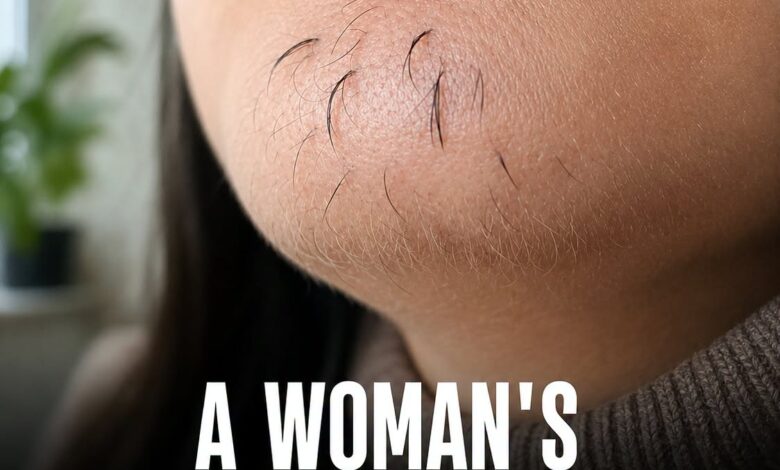
It usually starts with one hair.
You catch it in the bathroom mirror, often only because the light hits your chin at exactly the right angle.
It is darker than the fine hair around it.
Coarser.
Longer.
And somehow it seems to have appeared overnight.
You reach for the tweezers, pull it out, and move on.
Then another one appears.
For many women, that experience is completely ordinary.
A few stray chin hairs do not automatically mean something is wrong with your hormones or your health. Human faces naturally contain hair follicles, and those follicles can respond differently as hormone levels and sensitivity change throughout life.
The important distinction is between a few stubborn hairs that gradually become more noticeable and a sudden or substantial change accompanied by other symptoms.
To understand why chin hair appears, it helps to understand the role of androgens.
Androgens are often casually called “male hormones,” but that description can be misleading. Women naturally produce androgens too, including testosterone, although generally at different levels than men.
Certain hair follicles are particularly sensitive to these hormones.
When androgen activity influences a susceptible follicle, the soft, fine hair that was once barely visible can become what is known as terminal hair—a thicker, darker, coarser strand.
The chin and upper lip are common places for this to happen.
Genetics can play a large role.
If your mother, grandmother, or sisters developed a few coarse facial hairs as they got older, you may notice a similar pattern.
Age matters too.
During perimenopause and menopause, the balance among reproductive hormones changes. Estrogen levels decline, and the relative influence of androgens can become more noticeable.
That does not necessarily mean the body has suddenly started producing enormous quantities of testosterone.
Sometimes the hormonal balance has simply shifted enough for previously inconspicuous follicles to become more active.
The result might be only a handful of hairs.
Annoying?
Perhaps.
Dangerous?
Usually not.
For someone who has had the same two or three chin hairs for years, routine removal may be all that is needed.
Tweezing is convenient for isolated hairs.
Threading or waxing can remove larger areas.
Shaving is also an option, despite the persistent myth that shaving causes hair to grow back thicker.
It does not change the follicle or increase the number of hairs. A shaved hair can temporarily feel coarser because the strand has been cut bluntly rather than naturally tapering at the end.
The best removal method is therefore largely a matter of comfort, skin sensitivity, cost, and how much hair is involved.
But there is another side to the conversation.
Sometimes facial hair is not merely a cosmetic change.
Sometimes it is information.
The key is to pay attention to the pattern.
If you have gradually developed a few coarse hairs over many years and otherwise feel well, that is very different from suddenly developing substantial new facial or body hair over a relatively short period.
It becomes especially worth discussing with a healthcare professional when increased hair growth occurs alongside other changes.
Irregular or absent menstrual periods.
Significant acne.
Scalp hair thinning.
Unexpected changes in weight.
Difficulty becoming pregnant.
Or other signs suggesting that androgen activity may be higher than expected.
One possible explanation is polycystic ovary syndrome, commonly called PCOS.
PCOS is a hormonal and metabolic condition that can affect menstrual cycles, ovulation, androgen-related symptoms, and other aspects of health. Some people with PCOS develop increased facial or body hair, while others do not.
And importantly, having chin hair does not mean someone automatically has PCOS.
That is why looking at the whole pattern matters more than focusing on a single symptom.
Other hormonal or medical conditions can sometimes contribute to excessive hair growth as well, and medications may occasionally play a role.
A clinician can review when the change began, how quickly it developed, menstrual history, medications, family patterns, and other symptoms. Depending on the situation, testing may be appropriate.
The goal is not to turn every stray hair into a medical emergency.
It is to recognize when the body has changed enough to deserve an explanation.
Speed can be particularly informative.
A few additional hairs appearing gradually around menopause generally tell a very different story from coarse facial or body hair developing rapidly over several months, especially if accompanied by other significant physical changes.
That is a reason to seek medical evaluation rather than simply increasing the frequency of waxing appointments.
Once the cause is better understood, there may be several ways to manage the hair if it bothers you.
Temporary methods remain perfectly reasonable.
Tweezing.
Threading.
Waxing.
Shaving.
Depilatory products can work for some people as well, although they may irritate sensitive skin and should be used according to their instructions.
For longer-term reduction, laser hair removal may be considered.
Laser treatment works by targeting pigment in the hair and damaging follicles to reduce future growth. Results vary with factors including hair color, skin tone, equipment, treatment technique, and the hormonal cause of the growth. Multiple sessions are generally required, and maintenance treatments may sometimes be necessary.
Electrolysis takes another approach, treating individual follicles using electrical energy. Because follicles are addressed one at a time, the process can require considerable time when larger areas are involved.
Medical treatment may also be appropriate when excess hair growth is connected to an underlying hormonal condition.
Depending on the individual and the cause, clinicians may discuss medications that regulate hormonal activity or treatments intended to slow unwanted facial-hair growth.
These decisions should be individualized because medications can have contraindications, side effects, and pregnancy-related considerations.
There is also an emotional piece that deserves attention.
Facial hair on women is often treated as something embarrassing or somehow unfeminine.
That judgment can make a completely ordinary biological change feel like a personal failure.
It isn’t.
Hair follicles do not know beauty standards.
They respond to genetics, hormones, age, and biology.
Some women remove every visible chin hair because they prefer the way their skin looks without it.
Some shave regularly.
Some pursue laser treatment.
Some pluck the occasional stubborn strand while standing at a red light after discovering it in the car mirror.
And some decide they simply do not care.
None of those choices determines femininity.
The useful question is not:
“Should I be embarrassed?”
It is:
“Has something meaningfully changed?”
If the answer is no—if these are the same few hairs that have appeared gradually with age—there may be very little mystery to solve.
Remove them if you want.
Leave them if you want.
But if the growth suddenly becomes more pronounced, particularly alongside menstrual changes, significant acne, scalp thinning, or other new symptoms, do not let embarrassment prevent you from mentioning it to a healthcare professional.
Your chin may simply be responding to the ordinary hormonal shifts of life.
Or it may be offering one small clue about something happening beneath the surface.
Either way, information is more useful than shame.
Because sometimes a chin hair is just a chin hair.
And sometimes a changing pattern is your body’s quiet way of saying:
Pay attention.