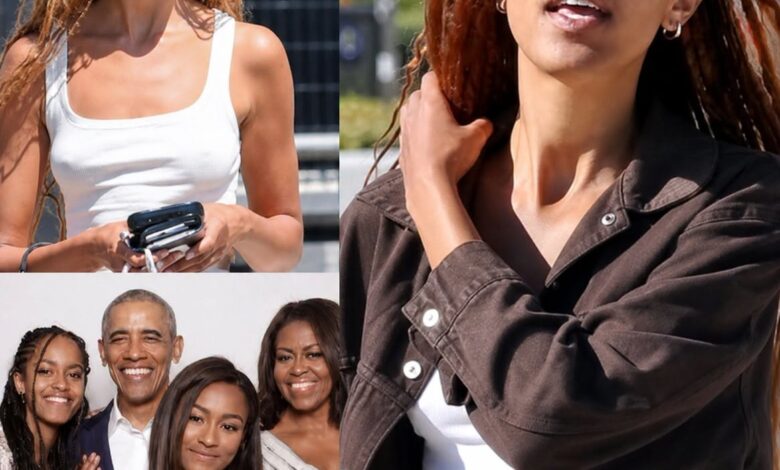
For much of her childhood, Malia Obama had almost no control over who was watching her.
Cameras waited outside.
Photographers documented family trips.
Commentators analyzed her clothes, expressions, friendships, and ordinary teenage moments as though they carried political meaning.
Millions of strangers watched her grow up simply because her father happened to occupy the most famous political office in America.
Now, as an adult, Malia appears to be making an intriguing reversal.
Instead of remaining the person everyone watches, she is increasingly interested in deciding what other people will watch.
Not from behind a podium.
From behind the camera.
Her gradual move into writing, television, and film represents something more interesting than another famous child entering entertainment. It suggests an attempt to build an identity around craft rather than inheritance—a career where the Obama name may open doors or attract attention, but cannot actually do the work for her.
For someone raised inside one of America’s most recognizable political families, that distinction matters.
Malia was only 10 years old when Barack Obama won the 2008 presidential election.
Her childhood changed almost overnight.
The White House became home.
Secret Service agents became part of everyday life.
Family outings became news.
Growing up is difficult enough when mistakes are witnessed by classmates, parents, and friends. Malia and her younger sister, Sasha, had to navigate adolescence knowing that an awkward photograph could travel around the world.
Their parents understood the danger.
Barack and Michelle Obama repeatedly tried to protect their daughters’ privacy and give them something resembling a normal childhood despite circumstances that made normality nearly impossible.
But protection could only go so far.
The girls were still public figures without ever choosing to become public figures.
That makes Malia’s adult career especially revealing.
She could easily have chosen visibility.
She inherited a surname recognized almost everywhere.
A conventional path for someone with that degree of access might have involved public speaking, political advocacy, brand partnerships, media appearances, or an obvious role within the enormous ecosystem surrounding her parents.
Instead, Malia became interested in storytelling.
And importantly, she began learning the parts of storytelling that aren’t particularly glamorous.
Before establishing herself professionally, she pursued internships connected to film and television, gaining exposure to the machinery behind what audiences eventually see on screen.
That meant sets.
Scripts.
Production schedules.
Writers.
Editors.
Assistants.
The enormous collaborative process hidden behind a finished movie or television episode.
After attending Harvard University, where she graduated in 2021, Malia continued moving toward entertainment rather than electoral politics.
One of the most significant early steps came when she joined the writing staff of Swarm, the television series created by Janine Nabers and Donald Glover.
It was exactly the kind of opportunity that could test whether she wanted to be adjacent to entertainment or actually participate in making it.
A writers’ room is not built around a famous surname.
Ideas have to survive.
Characters have to work.
Scenes have to move.
Dialogue has to sound convincing.
Notes have to be accepted.
Material gets rewritten.
Then rewritten again.
The audience ultimately doesn’t care who sat around the table.
It cares whether the story holds attention.
That kind of environment offered Malia something fame rarely provides:
the opportunity to contribute without making herself the product.
Donald Glover spoke publicly about treating her as a writer rather than allowing her family background to shield her from criticism.
That approach may have been particularly valuable.
Children of powerful families face an unusual professional problem.
If they succeed, people say the family name handed them everything.
If they fail, people treat the failure as proof that they never deserved the opportunity.
If colleagues praise them, outsiders may assume the compliments are strategic.
If they receive an impressive job, critics immediately ask who made the phone call.
Privilege is real, and pretending Malia Obama entered the entertainment industry with the same access as an unknown graduate would be absurd.
She didn’t.
Her family connections, education, financial security, and cultural proximity gave her advantages most aspiring filmmakers could only imagine.
But access and accomplishment are not identical.
A door can be opened for someone.
It cannot write a good screenplay for them.
It cannot create an interesting character.
It cannot direct actors effectively.
It cannot develop taste.
It cannot manufacture a distinctive artistic voice.
Those things require practice.
Malia’s challenge, therefore, isn’t proving she has no privilege.
It is demonstrating what she can build with the opportunities she has.
Her movement from television writing into filmmaking made that question even more interesting.
She wrote and directed the short film The Heart, a project that brought her work before festival audiences and allowed her to step more visibly into the role of filmmaker.
Then came a small but symbolically enormous decision.
She used the professional name Malia Ann.
The choice immediately attracted attention.
Why not Obama?
Was she distancing herself from her family?
Was she trying to avoid accusations of nepotism?
Was it branding?
Was it independence?
The fascination revealed exactly the problem she faces.
Even removing “Obama” from a credit became a story about being an Obama.
But there is another, simpler way to interpret it.
Malia may want the work to have some space before the surname enters the room.
“Ann” is her middle name, so the identity isn’t artificial.
It is hers.
And using Malia Ann professionally creates at least a small separation between the filmmaker and the political dynasty everyone already knows.
That doesn’t make her anonymous.
Realistically, anonymity is no longer available to her.
But privacy and anonymity are different things.
A person can be recognizable while still deciding how much access the public receives.
Malia appears to understand that distinction.
She hasn’t built her adult identity around constant interviews.
She doesn’t narrate every professional development on social media.
She isn’t relentlessly explaining herself.
Instead, projects appear.
Credits accumulate.
Occasional public appearances provide glimpses.
Then she returns to the work.
That restraint is striking in an era when young creatives are often encouraged to turn themselves into brands before they’ve had enough time to discover what they actually want to create.
Malia could generate attention almost effortlessly.
But attention is the one resource she has never lacked.
Privacy is rarer.
Perhaps that explains why a behind-the-scenes career makes so much psychological sense.
For most of her early life, other people constructed narratives around her.
She was “the president’s daughter.”
Then “the former president’s daughter.”
A photograph of her could become a political argument despite having nothing to do with politics.
A facial expression could be interpreted by strangers.
A normal youthful choice could trigger headlines.
She was observed before she had the vocabulary to object to being observed.
Storytelling changes that relationship.
A writer chooses what information the audience receives.
A director chooses where the camera points.
A filmmaker decides what stays outside the frame.
That is an extraordinary reversal for someone whose childhood was defined by cameras she didn’t control.
She is moving from subject to author.
From being framed to creating the frame.
And there may be something deeply liberating in that.
Her career also challenges the assumption that children of presidents should somehow inherit political responsibility.
Political dynasties create strange expectations.
A famous surname can begin to feel like a family occupation.
Kennedys enter politics.
Bushes enter politics.
Clintons remain politically visible.
The public begins wondering whether the next generation will continue the story.
But children don’t inherit their parents’ obligations.
Barack Obama’s presidency belongs to Barack Obama.
Michelle Obama’s public career belongs to Michelle Obama.
Malia is allowed to want something else.
And what she appears to want is creative authorship.
That path may change.
She is still young enough that treating every current project as evidence of a permanent destination would be premature.
She could become primarily a screenwriter.
A director.
A producer.
She could move between film and television.
She could eventually step into completely different work.
Careers rarely unfold as neatly as biographies make them appear afterward.
That’s especially true in creative industries, where one project can redirect everything.
What matters now is the pattern.
Malia is accumulating experience rather than simply visibility.
She has moved through internships, education, writers’ rooms, production environments, and her own filmmaking.
Each step places greater responsibility on her creative judgment.
And with each step, the question becomes slightly less about Barack Obama’s daughter and slightly more about Malia Ann’s work.
That transition will never be complete.
The surname will always follow her, even when it isn’t printed in the credits.
People will remain curious.
Every major project will probably produce another round of commentary about privilege, family connections, and whether she has “earned” her place.
Some of that scrutiny is fair.
Some will inevitably become excessive.
The only meaningful answer she can provide is the work itself.
Not a speech explaining why she deserves to be there.
Not an attempt to pretend her background doesn’t matter.
Work.
More scripts.
More sets.
More stories.
More opportunities to fail, learn, improve, and eventually develop something unmistakably her own.
There is a quiet irony in where Malia Obama seems to be heading.
As a child, she lived inside perhaps the most intensely documented home in America.
Every major public moment was photographed.
Every appearance was watched.
Millions of people knew her face without knowing her.
Now she is choosing a profession built around deciding what an audience gets to see.
Maybe that isn’t coincidence.
Maybe after spending years inside other people’s frame, Malia became interested in controlling one herself.
The world may always look at her and see an Obama first.
But every time “Malia Ann” appears on another script or film credit, she seems to be answering that expectation without arguing with it.
She isn’t asking people to forget where she came from.
She is simply creating somewhere new to go.
For the first chapter of her life, Malia Obama was part of a story the entire world watched.
The next chapter may be about the stories she chooses to tell us.