When I was a child, I used to notice a small scar high on my mother’s arm.
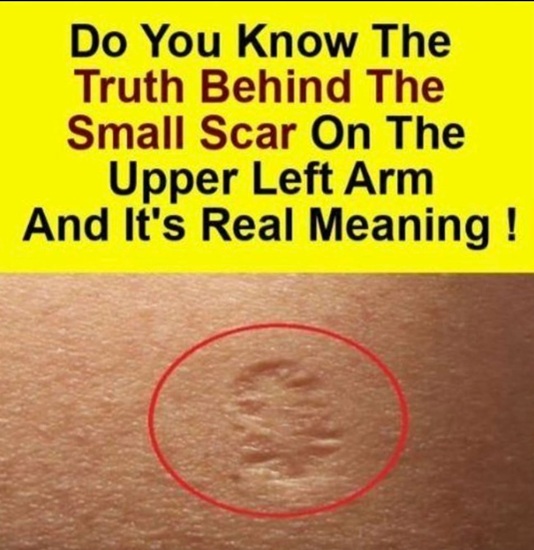
It sat near her shoulder, round and unusual, made up of tiny indents around a larger mark in the center. I didn’t know what it was, but for some reason, it always caught my attention.
Children notice strange things.
A crack in a sidewalk.
A mark on someone’s hand.
A scar they don’t yet understand.
To me, that scar was simply part of my mother, like the sound of her voice or the way she moved through the house. I remember staring at it once or twice, curious but not curious enough to hold onto the answer if she gave me one.
Years passed.
The scar stayed exactly where it was.
But I stopped seeing it.
Not because it disappeared, but because familiar things often become invisible. The more often we see them, the less we question them. That small circle on my mother’s arm became one of those quiet details buried beneath ordinary life.
Then, many years later, the memory returned without warning.
I was on a train one summer when I helped an elderly woman step down onto the platform. As I reached out to steady her, her sleeve shifted slightly, revealing a mark high on her upper arm.
I froze for a second.
It looked almost exactly like my mother’s scar.
Same placement.
Same shape.
Same strange circular pattern.
The train was already preparing to leave, and there was no time to ask her about it. She thanked me, smiled politely, and disappeared into the crowd.
But the image stayed with me.
That old childhood curiosity came rushing back.
Later that day, I called my mother and asked her about the scar.
She laughed softly and told me she had explained it before, more than once.
Apparently, I had simply forgotten.
Then she gave me the answer.
It was from the smallpox vaccine.
Suddenly, a mystery I had carried since childhood made sense.
Smallpox was once one of the most feared diseases in the world. It spread easily, caused high fever and painful skin rashes, and killed millions over the centuries. Many who survived were left with permanent scars.
Before modern generations knew it only as history, smallpox was a real threat.
Families feared it.
Doctors fought it.
Communities organized against it.
And vaccination became one of humanity’s greatest defenses.
The smallpox vaccine was not given the way most vaccines are today. Instead of a simple injection, doctors used a special two-pronged needle to puncture the skin several times. The vaccine entered the skin and triggered an immune response.
Afterward, the site changed.
A bump formed.
Then a blister.
Then a scab.
When the scab finally healed, it left behind the familiar round scar that so many people from earlier generations still carry.
That was the mark I had seen on my mother’s arm.
Not a random scar.
Not an old injury.
A sign of protection.
A tiny piece of medical history written into her skin.
By the 1970s, routine smallpox vaccination had ended in many places because the disease had been brought under control and eventually eradicated worldwide. That achievement remains one of the greatest victories in public health.
But for people like my mother, the proof of that era never fully disappeared.
It remained quietly on the arm.
A small circle.
A permanent reminder.
What I once saw as a strange childhood detail became something much larger. That scar connected my mother to a time when disease shaped daily life in ways many of us can barely imagine now.
It represented fear.
Science.
Protection.
Survival.
And the collective effort that helped remove one of history’s deadliest diseases from the world.
In the end, the mark on my mother’s arm was never just a scar.
It was a story.
A story shared by millions of people from her generation.
A story about how ordinary bodies can carry extraordinary history.
And a reminder that sometimes the smallest marks hold the biggest meaning.