The Hospital Door Opened, And The Man Who Thought I Was Powerless Finally Saw Who Had Been Watching..

I woke beneath hospital lights so bright and cold they made the ceiling look endless.
Machines beeped beside me in slow, steady rhythms, counting breaths I was no longer sure my body wanted to take. Every inhale burned through my ribs like shattered glass. My legs were trapped inside heavy casts, my left arm tethered to an IV line, and the room smelled like disinfectant, plastic tubing, and fear.
Nobody writes fear in medical charts.
But it lives there anyway.
A nurse leaned over me with gentle eyes and explained that a car had struck me in a crosswalk outside the grocery store. She said I was lucky to be alive.
Lucky.
The word felt strange inside a body that could barely move.
My name is Amy Carter, and at forty-five years old, I had become an expert at staying quiet. Silence kept the peace in my marriage. Silence prevented arguments. Silence stopped Henry from slamming doors or spending days punishing me with cold, suffocating anger.
I had once been loud in different ways.
I loved accounting, spreadsheets, numbers that balanced cleanly and honestly. Before marriage, I had my own clients, my own office key, my own money. Back then, people described me as capable. Independent. Sharp.
Then slowly, over years, Henry taught me another version of myself.
One that existed mainly to avoid upsetting him.
Our daughter Emily visited every afternoon with my parents. She carried drawings folded carefully against her chest as if crayons and paper could somehow repair broken bones. She smiled because children try desperately to make adults feel safe, even when they themselves are terrified.
My parents handled everything Henry should have handled.
Insurance forms.
Doctor updates.
Emily’s questions.
Medication schedules.
Calls from specialists.
Henry didn’t visit once during those first three weeks.
Not once.
He never called to ask whether I could sleep through the pain.
Never asked whether Emily was frightened.
Never asked whether I needed clean clothes, comfort, or even proof that I still mattered.
And still, every time the hospital door opened, I hoped it was him.
That is the humiliating truth people rarely understand about emotionally abusive marriages:
cruelty does not automatically kill longing.
You can spend years being diminished by someone and still ache for the smallest kindness from them because hope becomes a survival instinct. You keep waiting for the person they pretended to be at the beginning to return.
Henry had once seemed charming enough to silence every concern anyone raised about him.
When we met, he called me brilliant.
Said my mind impressed him.
Said any company would be lucky to have me.
After marriage, the compliments changed shape.
He said a good mother should stay home.
Said Emily needed me more than accounting firms did.
Said his income made my paycheck unnecessary.
At first, it sounded loving.
That was how control entered quietly.
He wrapped restrictions in the language of devotion.
If I wore makeup, he asked who I wanted attention from.
If I met a friend for coffee, he questioned why I needed anyone besides him.
If Emily spilled juice accidentally, he called her careless.
If I defended her, he called me dramatic.
Dramatic became his favorite word.
Dramatic when I cried.
Dramatic when I was tired.
Dramatic when I asked him to stand up to his mother.
Dramatic when I wondered why love always required my obedience.
By the time the accident happened, I had already been shrinking emotionally for years.
The car did not destroy my life.
It simply exposed how broken it already was.
On the twenty-first day of my hospitalization, Henry finally arrived.
No flowers.
No apology.
No visible concern.
He walked into the room looking irritated rather than worried, arms folded tightly while his eyes skimmed over the machines beside me like they were expensive inconveniences.
I waited for softness.
For guilt.
For some glimpse of the man I once believed I married.
Instead, he looked directly at me and said:
“You’ve become a burden.”
For a second, I genuinely thought the medication distorted his words.
Then he stepped closer.
“My mother’s birthday is this weekend,” he said coldly. “You need to come home and cook.”
The monitor beside my bed beeped steadily, almost absurdly, like it was trying to remind him I was still a patient recovering from trauma.
I stared at him.
“Henry,” I whispered, because even talking hurt. “I was hit by a car.”
He rolled his eyes.
“You’ve been lying here for three weeks while everyone rearranges their lives around you,” he snapped. “My mother already invited guests. I’m not canceling because you want attention.”
Something shifted inside me then.
Not physically.
Emotionally.
A part of me I thought had died years earlier suddenly moved.
“I can’t walk,” I said quietly.
Henry’s face hardened instantly.
Facts always irritated him when they interrupted his expectations.
“Then learn,” he replied. “Or sell some jewelry and pay these hospital bills yourself because I’m done wasting money on your drama.”
The room suddenly felt too small for his voice.
I thought about my old accounting certificate hidden in a closet.
About Emily flinching whenever he raised his voice.
About years spent apologizing for things that were never my fault.
“You’re my husband,” I said. “You’re supposed to help me.”
He laughed sharply.
“Help you? Amy, you’re useless right now.”
Useless.
Not injured.
Not recovering.
Not frightened.
Useless.
That word hurt more than the fractures.
But for the first time in years, I didn’t collapse inward beneath it.
“I gave up my career because you told me our family needed me home,” I said. “I raised our daughter while you called parenting my responsibility and your paycheck your sacrifice.”
His face turned red.
I recognized that color immediately.
It was the color that always came before slammed cabinets, accusations, or long stretches of punishment disguised as silence.
“You think this hospital bed makes you brave?” he asked.
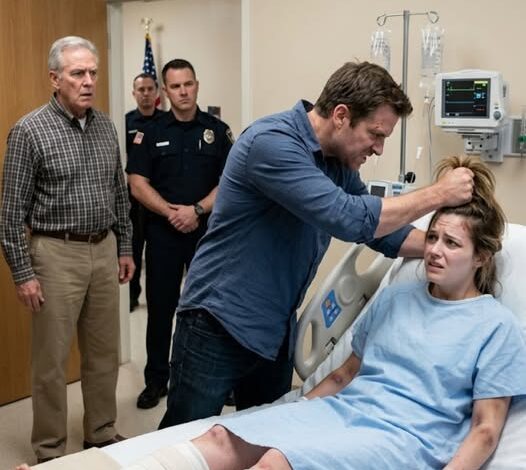
Then he grabbed my arm.
Hard.
Pain exploded through my ribs so violently my vision blurred white. My casts scraped against the sheets as he yanked me forward. The IV line tugged painfully against my skin.
“Henry, stop,” I gasped.
He pulled harder.
A nurse froze near the doorway.
An aide covered her mouth in shock.
Someone passing in the hallway stopped walking entirely.
For one impossible moment, the entire room seemed trapped inside the same disbelief.
Henry leaned close enough for me to smell coffee on his breath.
“You are not embarrassing me,” he hissed. “You are getting out of this bed.”
I could have screamed.
But years of surviving him had taught me silence before resistance.
Then the door opened behind him.
Everything changed instantly.
My father stood there.
Beside him was hospital security.
Behind them were two police officers.
My father didn’t look shocked.
He looked prepared.
That frightened Henry more than anything else.
Not the uniforms.
Not the witnesses.
Not even the nurse already staring at the red marks forming on my arm.
It was my father’s expression.
Calm.
Controlled.
Finished hoping.
“Let go of my daughter,” he said.
Henry released me immediately.
For years, Henry controlled rooms through intimidation. In that hospital room, suddenly his anger had nowhere left to hide.
Security glanced toward the nurse, who picked up a clipboard from the floor with shaking hands.
The form on top read:
Patient Safety Incident Report.
Time stamped.
Signed.
Witnessed.
Henry saw it and changed instantly.
His rage folded neatly into performance.
“Amy,” he said softly, using the voice he reserved for public audiences. “Tell them this is all a misunderstanding.”
That was his gift.
Private cruelty.
Public reasonableness.
Before I could respond, my mother entered holding Emily’s hand.
Emily clutched her stuffed rabbit against her chest. Her face looked pale and terrified.
Then she saw my arm.
The IV line.
The bruises.
My expression.
“Mommy,” she whispered.
Her voice shook.
“Did Daddy hurt you?”
Every adult in the room stopped breathing.
Henry opened his mouth immediately, probably preparing to explain, minimize, redirect, blame.
But Emily wasn’t looking at him.
She was looking at me.
And suddenly I saw everything clearly:
Every time I smoothed over his cruelty.
Every forced apology.
Every dinner where I pretended tension was normal.
Every lesson my silence had accidentally taught my daughter about love.
My father’s voice broke quietly.
“Amy,” he said. “Tell them the truth.”
So I did.
I told the officers Henry grabbed me.
Tried pulling me from the hospital bed.
Called me useless.
Demanded I cook for his mother while barely able to breathe without pain.
I told them I was frightened of him.
Henry immediately insisted I was medicated and emotional.
The nurse interrupted before I could.
“She’s fully alert,” she said firmly.
The aide admitted she witnessed him pulling me.
A visitor from across the hallway confirmed hearing him demand I leave the bed.
And slowly, sentence by sentence, Henry became smaller.
That is the weakness abusers never prepare for:
witnesses.
One officer asked Henry to step into the hallway.
Instead, he glared at my father.
“You turned her against me,” he snapped.
My father answered quietly.
“No. You did that yourself every day you thought nobody was paying attention.”
Then my father opened the folder he’d carried for weeks.
Inside were screenshots.
Bank records.
Insurance documents.
Messages Henry ignored.
Statements from neighbors.
Evidence of years spent controlling money and isolating me.
While I lay recovering, my father had been documenting everything I was too ashamed or exhausted to gather myself.
After Henry was escorted out, the room finally felt safe for the first time in years.
Not peaceful.
Just safe.
My father sat beside me carefully and held my hand.
“You never have to go back,” he said.
And for the first time since the accident, I cried without trying to hide it.
Not dramatically.
Not loudly.
Just the exhausted tears of a woman finally believed.
The next morning, a hospital social worker asked careful questions:
Did Henry control finances?
Did he isolate me?
Did Emily witness intimidation?
Did I feel safe returning home?
Every answer felt like opening locked doors inside myself.
By evening, my parents had arranged a lawyer.
Henry’s mother called repeatedly.
At first angry.
Then manipulative.
Then pleading.
She said I ruined her birthday.
Said husbands lose patience sometimes.
Said marriage requires forgiveness.
Years earlier, I would have listened.
This time, I handed the phone to my mother.
“My daughter was nearly killed by a car,” my mother said calmly. “And your son tried dragging her out of a hospital bed.”
Then she hung up.
The story eventually became public after Henry’s mother posted online accusing me of destroying the family over “a misunderstanding.”
She expected sympathy.
Instead, people exploded.
Women shared stories about being called dramatic while sick or exhausted.
Men admitted growing up watching fathers treat mothers like servants.
Daughters wrote about realizing too late that their mothers were trapped, not weak.
And one question kept echoing through everything:
“Did Daddy hurt you?”
That question followed me everywhere afterward.
Through physical therapy.
Court hearings.
The first night Emily and I slept safely at my parents’ house.
Months later, I walked into court using a cane while Emily waited outside wearing a yellow cardigan she called her “brave sweater.”
The judge reviewed the reports carefully.
Then Henry’s lawyer described the hospital incident as “an emotional misunderstanding.”
The judge looked over her glasses and said something people would later repeat online endlessly:
“Dragging an injured patient from a hospital bed is not communication. It is conduct.”
That sentence mattered because it cut through years of excuses women are taught to accept.
Stress is not love.
Control is not protection.
Fear is not normal marriage tension.
Eventually, I returned to accounting part-time.
My first paycheck wasn’t large, but I stared at it for nearly ten minutes anyway.
Emily asked why I was crying.
I told her sometimes people cry when they finally remember who they are again.
She hugged me carefully and whispered:
“I like when you sound like you.”
That became the real ending.
Not the courtroom.
Not Henry’s humiliation.
Not public outrage.
The real ending was hearing my daughter recognize my voice without fear hiding inside it.
People still argue about my story online.
Some say I should have left sooner.
Some blame Henry’s mother.
Some blame me for staying too long.
Maybe everyone is partly right.
But leaving isn’t always one dramatic decision.
Sometimes leaving begins in a hospital room.
Sometimes in a child’s question.
Sometimes when someone finally opens the door before your silence closes over you forever.
I am not grateful for the accident.
I am not grateful for broken ribs, casts, or fear.
But I am grateful that when Henry finally showed the world who he truly was, witnesses were standing in the room beside me.
He thought I was too weak to resist him.
Too isolated to leave.
Too broken to tell the truth.
He was wrong.
And when Emily asked whether Daddy hurt me, I finally gave her the answer every child deserves to hear:
“Yes.
But he does not get to hurt us anymore.”