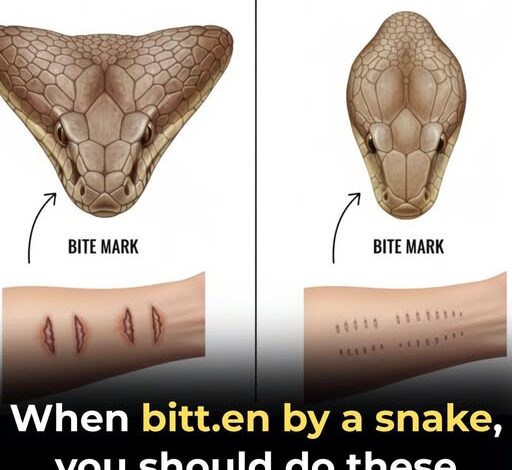
Most people never imagine a snakebite happening during an ordinary day.
Not while carrying laundry from the clothesline.
Not while pulling weeds near the fence.
Not while stepping into the garage to grab a toolbox or walking barefoot across a backyard they have crossed a thousand times before.
Yet that is exactly how many snakebites happen.
Not during dramatic hikes through remote wilderness.
Not while deliberately handling wildlife.
But during routine moments when attention drifts because life feels familiar and safe.
A hand reaches into stacked firewood.
A boot brushes through tall grass.
Someone bends beside a garden bed without seeing what was already hidden there.
Then comes the strike.
Fast.
Silent.
Instinctive.
For a split second, many victims do not even understand what happened. Some describe feeling only a sharp sting or sudden pressure before spotting movement disappearing into bushes, under decking, or behind storage sheds. Others never see the snake at all.
That uncertainty alone can trigger overwhelming panic.
And panic is one of the most dangerous things that can happen after a snakebite.
In countries like Australia, where venomous snakes are relatively common, thousands of people are bitten every year. Many incidents happen surprisingly close to home — in suburban gardens, farmyards, hiking trails, and rural properties where humans and wildlife constantly overlap.
The frightening reality is that snakes do not need dramatic environments to survive.
They need shelter.
Warmth.
Food.
Protection from disturbance.
Unfortunately, many ordinary residential properties provide exactly that without people realizing it.
Long grass becomes cover.
Wood piles attract rodents.
Bird feeders spill seed that draws mice.
Gaps beneath sheds create cool hiding spaces during heat.
A yard can slowly become ideal snake habitat while still looking completely harmless to the family living there.
That is why prevention matters so much.
Snake safety rarely depends on eliminating every possible risk entirely — because nature does not operate with perfect guarantees. Instead, safety comes from reducing opportunity:
fewer hiding places,
fewer food sources,
fewer accidental encounters.
Simple habits make a tremendous difference. Keeping grass trimmed short improves visibility dramatically. Removing piles of scrap metal, timber, or dense garden debris limits hiding areas. Sealing gaps beneath homes, garages, and sheds reduces cool shelter spaces where snakes may rest unnoticed during hot weather.
Rodent control matters too because rodents attract snakes naturally. If mice thrive around a property, predators eventually notice.
Even something as simple as storing pet food properly or cleaning up fallen fruit can indirectly reduce snake activity by disrupting the small ecological chain that draws wildlife closer to human spaces.
Protective clothing also plays a larger role than many people realize.
Boots,
thick socks,
long pants,
gardening gloves.
They may feel inconvenient in hot weather, but they create valuable physical barriers during accidental encounters. Many snakebites occur on lower legs, ankles, hands, and feet — areas exposed while gardening, walking through vegetation, or moving outdoor materials.
People often underestimate how defensive, rather than aggressive, snakes actually are.
Most snakes do not “hunt” humans.
They strike when startled,
cornered,
stepped on,
or threatened.
In many cases, the snake itself is attempting escape while the human unknowingly moves directly into danger.
That distinction matters because understanding snake behavior encourages caution instead of hysteria.
Still, even when people take precautions, bites can happen.
And in those moments, knowledge becomes lifesaving.
The first emotional response after a snakebite is usually fear. Sometimes overwhelming fear. Victims may begin shaking immediately. Family members panic. Adrenaline floods the body. People instinctively want to run for help, scream, wash the wound, or attempt dangerous “first aid” myths they have seen online or heard through generations.
But snakebite survival often depends on doing the opposite of instinct.
Staying still can save a life.
Movement spreads venom faster through the lymphatic system. Running, pacing, or panicking increases circulation and can accelerate the body’s absorption of toxins dramatically.
That is why emergency protocols emphasize calm immobilization so strongly.
Treat every snakebite as potentially venomous.
Even if the snake seemed small.
Even if symptoms have not appeared yet.
Even if the bite “doesn’t look serious.”
Some venom effects develop gradually, and early underreaction can become deadly.
The correct response begins with calling emergency services immediately. Then the person should remain as still and calm as possible while help arrives.
A firm pressure immobilization bandage should be applied over the bite area and wrapped upward along the entire affected limb if possible. The goal is not to cut off blood flow like a tourniquet — which can cause serious damage — but to slow lymphatic movement.
After bandaging, the limb should be immobilized completely using a splint or sling if available.
And importantly:
do not wash the wound.
That surprises many people.
But venom traces left on the skin can help medical professionals identify the snake species later through testing. Washing the bite may remove critical evidence needed for treatment decisions.
Other common myths can be dangerous too.
Do not cut the bite.
Do not attempt to suck out venom.
Do not apply ice.
Do not give alcohol.
Do not attempt to capture or kill the snake unless it can be done with absolute safety.
Photographs from a distance may help identification, but survival matters far more than proving what kind of snake caused the bite.
Modern medicine has dramatically improved snakebite survival rates in many countries. Antivenom treatments, emergency response systems, and advanced supportive care mean many victims recover fully — especially when first aid is handled correctly and treatment arrives quickly.
That is an important truth because fear surrounding snakes often becomes exaggerated into hopelessness.
Snakebites are serious.
Potentially deadly.
But not automatically fatal.
Preparedness changes outcomes.
And preparedness begins long before a bite ever occurs.
It begins with education.
With awareness.
With slowing down outdoors instead of assuming every familiar space is automatically safe.
Children especially benefit from learning calm, practical snake safety early:
never reaching blindly into holes or wood piles,
wearing shoes outside,
telling adults immediately if a snake is spotted,
keeping distance instead of trying to touch or kill wildlife.
Fear alone is not effective education.
Understanding is.
Many wildlife experts emphasize that coexistence, not eradication, creates safer communities overall. Snakes play important ecological roles controlling rodent populations and maintaining balance within natural systems. Most encounters end harmlessly when people recognize signs early and give animals space to retreat.
The real danger often emerges from surprise.
A hidden snake.
A rushed movement.
A panicked response afterward.
That is why calmness repeatedly appears at the center of survival stories.
Again and again, people who survive severe bites describe someone nearby taking control calmly:
a spouse wrapping the bandage correctly,
a neighbor calling emergency services immediately,
a parent keeping a child still and reassured until paramedics arrived.
Those small, informed actions matter enormously.
Because in emergencies, humans borrow emotional stability from each other.
A calm voice can slow panic.
A clear instruction can prevent fatal mistakes.
Knowledge can interrupt fear long enough for help to arrive.
And perhaps that is the most important lesson hidden inside snakebite awareness:
survival often depends less on eliminating danger completely and more on respecting reality without surrendering to terror.
Nature is not malicious.
But it is indifferent.
Snakes do not hate humans.
They react.
Defend.
Survive.
Understanding that truth encourages caution without paranoia.
Most people who walk through grass, work in gardens, or collect firewood will never experience a snakebite.
But preparation matters because emergencies rarely announce themselves in advance.
They appear suddenly during ordinary afternoons,
ordinary chores,
ordinary routines.
And when they do, the difference between tragedy and relief may come down to a few critical decisions made in the first moments after fear arrives.
Stay still.
Stay calm.
Call for help.
Apply pressure.
Protect the limb.
Do not panic.
Simple actions.
Life-saving consequences.
Because even terrifying moments do not have to become fatal ones when knowledge arrives faster than fear.