For a few strange seconds, millions of people were convinced the puzzle had to be wrong.
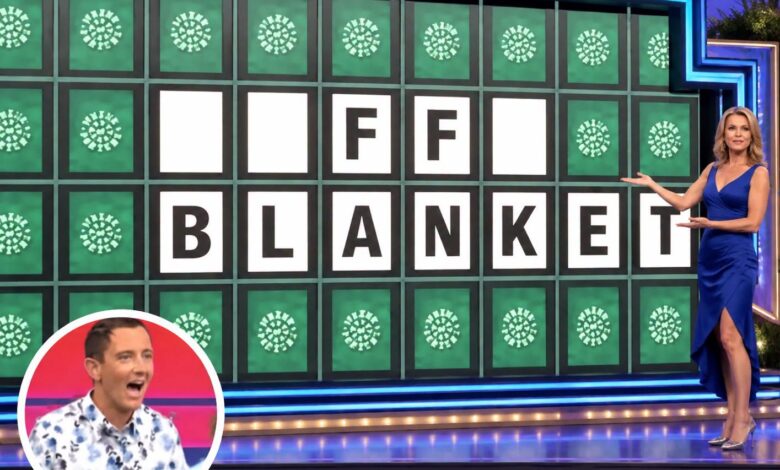
The board appeared to read:
COFFE BLANKET.
People watching from home stared at their televisions.
Coffee blanket?
Was that a thing?
Had someone made a mistake?
Online, viewers began doing what viewers do best when something looks impossible: confidently announcing that the problem was obviously somewhere else.
The board was broken.
A letter was missing.
The category must be misleading.
The contestant was doomed.
But the person standing beneath the studio lights didn’t have the luxury of joining the debate.
There were no comment sections to consult.
No replay button.
No time to photograph the board and send it to a group chat with, “WHAT IS THIS?”
There were only seconds.
And somewhere inside that visual mess, the contestant saw something everyone else was struggling to see.
COFFEE TABLET.
It looked awkward.
It felt awkward.
The letters didn’t settle naturally into the phrase the way the brain wanted them to.
That was precisely what made the moment so fascinating.
Because our brains don’t really read one letter at a time.
Most experienced readers recognize patterns.
We anticipate words.
We use context.
We see the beginning of something and predict how it should end.
Usually, that ability makes reading remarkably efficient.
Sometimes it betrays us.
Once the mind sees “BLANKET,” it can become surprisingly difficult to stop seeing it.
The incorrect interpretation begins controlling the evidence.
Instead of asking, What does this actually say? the brain starts asking, How can I make what I’m seeing fit what I’ve already decided?
That tiny difference explains why visual puzzles can feel almost insulting after someone reveals the answer.
Before the reveal:
Impossible.
Afterward:
Obviously.
Nothing on the board changed.
Only the interpretation did.
The contestant, however, had another problem.
Even after seeing “COFFEE TABLET,” there was still the terrifying possibility of being wrong.
Imagine standing there with money on the line while your brain offers an answer that doesn’t feel completely comfortable.
You look again.
Coffee tablet?
Really?
The dangerous instinct is to keep searching.
Maybe there’s something better.
Maybe you’ve missed a letter.
Maybe the obvious answer is a trap.
Maybe you should wait.
And that is where thinking can quietly transform into overthinking.
The first thought solves the puzzle.
The next ten thoughts try to talk you out of it.
Under pressure, certainty becomes seductive.
We want the answer to feel perfect before we say it.
But sometimes certainty arrives only after the decision.
The contestant didn’t have enough time to build a courtroom case.
There was no opportunity to gather evidence, consult experts, or conduct a three-stage review of coffee-related vocabulary.
A decision had to be made.
So they committed.
“COFFEE TABLET.”
For one fraction of a second, the words simply hung there.
Then the board confirmed it.
Correct.
The studio erupted.
Applause.
Relief.
Disbelief.
And when the total reached $74,000, the moment became the kind of game-show clip people immediately replay.
At first, the money seems like the entire story.
Seventy-four thousand dollars is the number everyone remembers.
But the more interesting part happened just before the celebration.
It was the decision to trust an answer before fear could dismantle it.
That’s why people watching at home became so invested.
They weren’t merely solving a word puzzle.
They were experiencing one of the mind’s strangest little conflicts in real time.
Recognition versus doubt.
Instinct versus analysis.
Decision versus hesitation.
And almost everyone knows that conflict.
Maybe not beneath studio lights.
Maybe not with $74,000 at stake.
But we’ve felt it.
You know you should apply for the job.
Then you read the requirements again.
And again.
Soon you’re listing every reason somebody else would be more qualified.
You think about speaking during the meeting.
The thought is clear.
Then you wait.
Someone else says almost exactly the same thing thirty seconds later.
Everyone loves it.
You want to call someone.
Apologize.
Leave.
Begin.
Say yes.
Say no.
Ask the question.
Set the boundary.
Take the opportunity.
For one brief moment, the answer inside you feels uncomplicated.
Then the committee arrives.
What if you’re wrong?
What if they laugh?
What if you fail?
What if people misunderstand?
What if you regret it?
What if you wait?
What if you think about it tomorrow?
Sometimes those questions are useful.
Instinct isn’t magic.
Our first impressions can be wrong, biased, impulsive, or poorly informed. Important decisions involving health, money, safety, law, or other people’s lives often deserve careful thought.
“Trust your gut” is terrible advice if it means “ignore evidence.”
But there is another kind of hesitation.
Not wisdom.
Fear disguised as analysis.
You already have enough information.
You already understand the choice.
You aren’t learning anything new by thinking about it for another hour.
You’re simply searching for a level of certainty life rarely provides.
That’s when overthinking becomes a hiding place.
The puzzle demonstrated that beautifully.
Everyone wanted the letters to become more comfortable before committing to them.
But the contestant couldn’t wait for comfort.
They had to decide with the information available.
And sometimes that is all confidence actually is.
Not knowing you’re right.
Being willing to act before you’ve eliminated every possibility of being wrong.
That distinction matters.
Confident people aren’t necessarily walking around experiencing perfect certainty.
They may hear the same internal objections everyone else hears.
They’ve simply learned that doubt doesn’t automatically deserve veto power.
The internet, naturally, kept replaying the puzzle.
People paused the frame.
Zoomed in.
Argued about why “BLANKET” seemed so convincing.
Some insisted they saw the correct phrase immediately.
Others admitted they could stare at it repeatedly and still feel their brains pulling toward the wrong interpretation.
That became part of the entertainment.
But hidden beneath the laughter was something more recognizable.
How often do we do this outside puzzles?
How often does the mind become attached to the first wrong interpretation and then defend it?
We decide someone doesn’t like us, then reinterpret everything they do as evidence.
We decide we’re bad at something and treat every mistake as confirmation.
We decide an opportunity is beyond us before applying.
We decide we’re trapped because we’ve spent so long staring at the same arrangement of circumstances that we can no longer imagine another reading.
Sometimes the board isn’t broken.
Sometimes we simply need to look again.
And sometimes the opposite is true.
We see the answer immediately, then stare so long that we convince ourselves it cannot possibly be right.
That’s what makes the winning moment larger than a quirky phrase or a game-show prize.
For a few seconds, a contestant stood between recognition and doubt.
One path said:
Trust what you saw.
The other said:
Keep questioning until time runs out.
They chose.
The answer lit up.
The room exploded.
And somewhere at home, someone watching probably laughed at how close they had come to talking themselves out of the exact same answer.
Maybe that’s why clips like this survive after the prize money stops feeling astonishing.
They leave behind a question no game board can answer for us:
How many opportunities have we lost not because we didn’t know what to do, but because we kept demanding certainty after we already knew?
Sometimes wisdom means slowing down.
Sometimes it means gathering more information.
Sometimes it means admitting your first impression was completely wrong.
But every once in a while, the board is already giving you everything you need.
The answer appears.
You recognize it.
Fear begins rearranging the letters.
And before it succeeds, you have to speak.