For a few seconds, it was just a game-show puzzle.
Then it became the kind of television moment viewers immediately began arguing about as though something personal had happened to them.
That is the peculiar power of Wheel of Fortune. From the sofa, everything looks obvious. The letters are enormous. The pressure is invisible. Nobody at home has studio lights in their eyes, a clock running down or thousands of dollars depending on what comes out of their mouth next.
So viewers play with an enormous advantage.
And on this particular episode, they used it.
The first controversy arrived with a puzzle connected to the phrase “Seeing the green flash.”
For some viewers, the wording immediately felt strange.
The green flash is a rare optical phenomenon that can sometimes be seen near the horizon around sunrise or sunset when atmospheric conditions cooperate. It is fleeting, unpredictable and dependent on circumstances far beyond anyone’s control.
So when the puzzle’s framing appeared to treat seeing it almost like an ordinary “event,” some fans bristled.
Was that really the right category?
Was the show stretching its own definitions?
The debate might seem trivial to anyone who does not watch game shows closely.
To devoted viewers, it was anything but.
These games depend on rules that feel consistent. Categories are part of the logic contestants use to solve puzzles. If a clue or classification seems awkward, audiences notice because they are not merely watching.
They are playing.
From their couches, viewers scrutinize every letter, every category and every decision.
That first puzzle therefore changed the atmosphere.
People were already questioning the show’s wording.
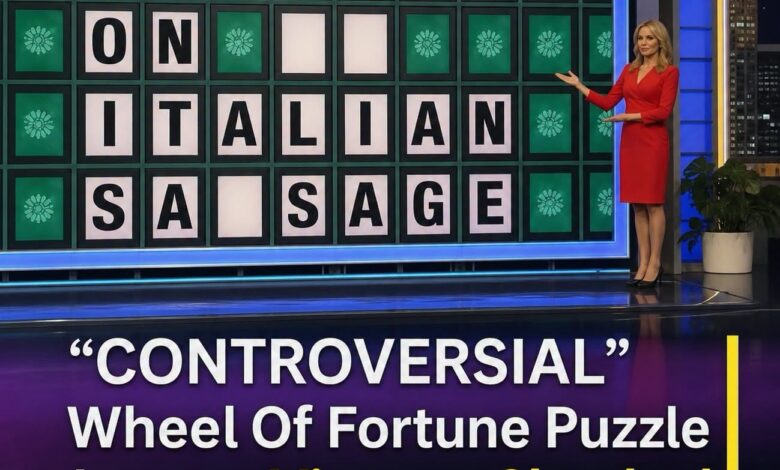
Then Stephen Sporer reached the Bonus Round.
And suddenly the argument about categories seemed almost gentle.
The puzzle was:
“ON OUR WAY.”
With $40,000 hanging in the balance, the answer appeared agonizingly close.
At home, viewers saw it.
Or at least many later insisted they did.
That’s another strange ritual surrounding televised game shows. Once the solution becomes apparent, everybody remembers themselves as having known it instantly.
“I was screaming it at the TV!”
“How could he not see that?”
“It was right there!”
But Stephen was not sitting on a couch.
He was standing onstage.
The lights were on him.
The clock was moving.
And a life-changing amount of money was attached to a handful of letters.
For a brief moment, he hesitated.
That hesitation became the episode.
You could almost feel thousands of viewers leaning toward their televisions at once.
Come on.
Say it.
ON OUR WAY.
It feels painfully simple once you know it.
That is what makes these moments so brutal.
The solution does not appear difficult afterward.
It appears inevitable.
But puzzles are experienced differently before and after recognition. Before the brain makes the connection, incomplete letters can remain stubbornly meaningless. Then one association clicks and suddenly the entire phrase seems so obvious that it becomes difficult to understand how you ever failed to see it.
Pressure makes that gap worse.
A few seconds on television can compress excitement, fear, calculation and self-consciousness into one tiny window.
The contestant knows money is at stake.
He knows the audience is watching.
He knows the host is waiting.
He knows time is disappearing.
And the more desperately someone thinks, I have to get this, the less cooperative the mind can become.
Then time expires.
That is when viewers experience the strange secondhand heartbreak of the Bonus Round.
The answer is revealed.
The envelope is opened.
And suddenly everyone learns exactly what those missing seconds were worth.
Forty thousand dollars.
Not imaginary points.
Not bragging rights.
Real money.
Enough to change plans, erase a debt, create savings, fund a dream or simply make ordinary life easier.
That is why the reaction becomes so emotional.
People are not merely watching someone miss a phrase.
They are watching possibility disappear.
And because they can see the answer from home, frustration mixes almost instantly with empathy.
Some people laugh.
Some make memes.
Some criticize.
Others defend the contestant because they recognize an uncomfortable truth:
Most of us have experienced a smaller version of that moment.
The answer that comes five seconds after the conversation ends.
The name we cannot remember until someone says it.
The perfect response we think of after walking away.
The obvious solution that becomes obvious only after the pressure disappears.
Stephen’s version simply happened on television with $40,000 attached.
That is what makes game shows unexpectedly human.
They appear to be about knowledge, luck and puzzles.
But underneath, they are often about what pressure does to ordinary people.
We like imagining ourselves in the contestant’s place when the outcome is good.
We solve along.
We celebrate.
We announce that we would have chosen the right letters or made the smarter decision.
But when someone freezes, television creates an illusion of distance.
The viewer has information without consequences.
Stephen had consequences without distance.
That difference matters.
It does not mean viewers cannot criticize a strange category or groan when an answer seems obvious. That reaction is part of the fun.
But it explains why this episode lingered.
The “green flash” debate gave people something technical to argue about.
Stephen’s Bonus Round gave them something emotional to feel.
Together, the moments created exactly the kind of episode that survives beyond its broadcast.
People replay it.
They pause the screen.
They argue over the clue.
They insist they solved the final phrase immediately.
They imagine what they would have done with the money.
And somewhere underneath all that certainty is recognition of how easily they might have frozen too.
That may be why near-wins are sometimes more memorable than victories.
A clean win gives closure.
A near-win leaves the mind trying to repair the ending.
One more second.
One different thought.
One word arriving slightly sooner.
That’s all it would have taken.
But television does not give the moment back.
The clock stops.
The answer appears.
The money remains out of reach.
And everybody watching is left staring at the tiny distance between knowing and knowing in time.
The episode began with viewers debating whether “Seeing the green flash” properly belonged where the show placed it.
It ended with something far less technical.
A man stood beneath studio lights with “ON OUR WAY” almost within reach, and thousands of people experienced the peculiar agony of seeing an answer that he could not quite reach before the clock did.
From the couch, it was easy.
On that stage, with $40,000 waiting on the other side of a few words, easy became something else entirely.
That is why people kept talking about it.
Not because Stephen failed to solve a puzzle.
Because everyone watching understood the terrifying possibility that, under enough pressure, they might have done exactly the same thing.
And once the answer appeared, there was nothing left to do but say the three words television had made painfully ironic:
“On our way.”
Except this time, the money wasn’t going with him.