The first thing I noticed was the silence.
Not the peaceful kind.
The uneasy kind that settles over a house when something important has gone missing.
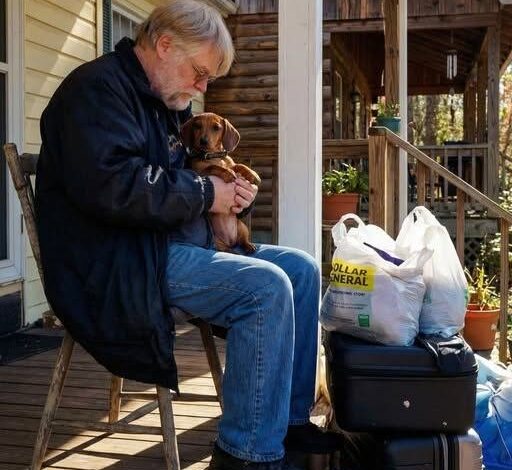
I pulled into my grandfather’s driveway expecting an ordinary weekend visit. Instead, I found him sitting alone on the front porch.
A worn suitcase rested beside his chair.
Two black trash bags sat near his feet.
And curled against his chest was a tiny brown-and-white puppy with one bandaged leg.
For a moment, I thought I had misunderstood what I was seeing.
My grandfather was eighty-six years old.
This was his house.
Yet somehow he looked like a man waiting for a ride to somewhere he didn’t want to go.
“Granddad?” I asked.
He looked up and smiled.
It was the kind of smile people wear when they’ve already accepted something painful.
“Hello, sweetheart.”
The puppy lifted her head and blinked at me.
I walked onto the porch and sat beside him.
“What happened?”
He gently stroked the puppy’s ears.
“Her name is Penny.”
I waited.
After losing my grandmother two years earlier, Granddad had become quieter.
Not bitter.
Just quieter.
Grief had settled around him like a heavy coat he couldn’t remove.
When my father and stepmother, Linda, moved into the house shortly after Grandma passed away, everyone called it a practical arrangement.
“They’ll help him.”
“He shouldn’t be alone.”
“It’s what’s best.”
At first, it sounded reasonable.
Then things started disappearing.
Grandma’s photographs vanished from the living room.
The quilt she kept folded across the couch disappeared.
The floral curtains she had sewn by hand were replaced with plain gray ones.
Her china was packed into boxes.
The house slowly stopped looking like the place she had built over forty years.
Whenever I asked Granddad about it, he always shrugged.
“Just making room.”
But I knew better.
Making room and erasing someone are not the same thing.
Then Penny appeared.
According to Granddad, he found her near the cemetery one rainy evening while visiting Grandma’s grave.
The puppy had been injured and abandoned.
One back leg was hurt.
She was thin, frightened, and trembling.
Granddad took her home.
Then to the veterinarian.
Then into his heart.
The change was immediate.
For months afterward, my phone filled with pictures.
Penny wrapped in blankets.
Penny sleeping in his recliner.
Penny chasing leaves across the yard.
Penny resting her head on his knee.
For the first time since Grandma died, Granddad laughed again.
Really laughed.
Which made what happened next feel unforgivable.
Linda hated the dog.
At first, she complained about the fur.
Then the vet bills.
Then the inconvenience.
Eventually she gave Granddad an ultimatum.
The puppy goes.
Or you do.
He chose Penny.
The fact that he never hesitated told me everything.
Now he sat on the porch with his suitcase.
Not angry.
Not dramatic.
Just determined.
“I couldn’t leave her,” he said quietly.
Penny pressed closer against him.
My throat tightened.
“You shouldn’t have had to.”
That night I checked both of them into a pet-friendly hotel.
Penny immediately fell asleep on a blanket near the bed.
Granddad sat in a chair watching her.
“She’s just a little thing,” he said.
“Sometimes little things matter most.”
The next morning I started making calls.
Unlike Linda, I enjoyed paperwork.
Paper tells the truth when people refuse to.
The county records confirmed what I suspected.
The house belonged solely to my grandfather.
Always had.
No transfer.
No shared ownership.
No legal authority whatsoever.
Linda had exactly as much right to remove him as she did to evict the mailman.
A friend of mine worked for a local media outlet and agreed to help document the situation.
Not to create a spectacle.
To create accountability.
Later that day, I returned to the house.
Linda greeted me with visible irritation.
“What are you doing here?”
“I wanted to talk.”
She folded her arms.
“Your grandfather is being unreasonable.”
“How so?”
The more she spoke, the more confident she became.
She explained how difficult the dog was.
How disruptive.
How impractical.
How someone needed to make decisions.
Most importantly, she repeatedly spoke as though she controlled the household.
Every word was carefully recorded.
Every assumption preserved.
That evening I invited her to meet us at the hotel restaurant.
She arrived expecting an argument.
Instead she found Granddad sitting quietly beside Penny.
The puppy’s bandaged leg rested across his shoe.
I placed the property documents on the table.
Then I pressed play.
The recording filled the room.
Linda listened to herself describing decisions she had no authority to make.
She listened to herself treating the homeowner like a guest.
She listened to herself explain why his wishes no longer mattered.
By the time the recording ended, she looked pale.
The documents remained in front of her.
The truth is difficult to argue with when it’s written down.
No one raised their voice.
No one insulted anyone.
There was nothing left to debate.
A few weeks later, my father returned from a work trip and learned the full story.
The conversations that followed were painful.
Honest.
Necessary.
Eventually, he and Linda decided to separate.
The reasons belonged to them.
But the consequences belonged to everyone.
Granddad moved back home.
Penny trotted through the front door beside him.
By then her leg had healed.
She explored every room like a tiny inspector reclaiming lost territory.
The house changed too.
The photographs returned.
Grandma’s quilt came back to the couch.
The floral curtains hung in the windows again.
Sunlight seemed brighter somehow.
Or maybe we were.
When I visit now, Penny races to greet me at the door.
Granddad sits in his favorite chair smiling while she circles the room.
Recently, we were sitting on the porch together when he looked down at the dog sleeping at his feet.
“I thought I lost everything when your grandmother died.”
I didn’t say anything.
He smiled softly.
“Turns out life wasn’t finished with me yet.”
Penny lifted her head at the sound of his voice.
He scratched behind her ears.
I looked at the house.
At the photographs in the windows.
At the man who had spent a lifetime caring for everyone around him.
And I realized something.
Sometimes love isn’t grand.
It isn’t dramatic.
Sometimes love is simply refusing to stand by while someone kind is treated as though they no longer matter.
Sometimes it’s protecting the people who spent their lives protecting everyone else.
And sometimes, unexpectedly, it arrives wrapped in fur, weighing only a few pounds, with a bandaged leg and a second chance.
For my grandfather, her name was Penny.
But what she really brought home was hope.