Cassandra Wilson had spent her whole life being praised for responsibility—right up until her family decided to punish her for it.
At thirty-two, she had built the kind of stable life her parents always claimed to admire. She was a senior software engineer in Seattle, lived modestly, drove a used Toyota, and had spent years saving for a down payment on her first home. Nothing about her success had come easily. Scholarships, part-time jobs, cheap dorm rooms, skipped vacations, and careful budgeting had shaped her adult life.
Her younger sister, Allison, had lived by different rules.
When Cassandra needed money, she was told to work harder. When Allison needed money, their parents wrote a check. Allison changed majors, quit jobs, took vacations she couldn’t afford, and ran up credit card debt that Julia and Donald Wilson always found a way to erase.
“She’s more sensitive than you,” their mother would say.
“Not everyone is as naturally responsible as you,” her father added.
Cassandra used to hear those words as a compliment. Eventually, she understood they were a warning.
One April evening, her parents invited her to Sunday dinner. The table was set with good china, her mother’s lasagna was in the oven, and Allison was mysteriously absent.
After dinner, Donald cleared his throat.
“We helped Allison buy a house.”
Cassandra blinked. “A house?”
“In West Hills,” Julia said brightly. “Three bedrooms. Beautiful view.”
Cassandra nearly dropped her fork. West Hills was one of Portland’s most expensive neighborhoods.
“How is Allison affording that?”
Her parents exchanged a glance.
Donald slid a folder across the table. “The mortgage is in our names for now.”
Cassandra opened it and felt her stomach turn. An $800,000 house. A $750,000 loan. Monthly payments over $4,000.
Julia folded her hands. “With retirement coming, we can’t carry it. We need you to take over the payments.”
For a moment, Cassandra thought she had misunderstood.
“You want me to pay for Allison’s house?”
“You have a good job,” Donald said. “You’ve saved money.”
“I saved that money for my own home.”
“Family helps family,” Julia replied.
Cassandra closed the folder and pushed it back.
“It’s funny how that only applies when Allison needs something.”
The argument that followed stripped away years of polite denial. Her parents called her selfish. They said Allison deserved stability. They said Cassandra owed the family because she had done well.
Finally, Donald’s voice hardened.
“If you refuse, you’re not the daughter we raised.”
Cassandra stood, shaking.
“Maybe that’s finally a good thing.”
She left without dessert.
For days, the calls and texts came nonstop. Then Allison appeared at Cassandra’s apartment, tearful and desperate.
“I love that house,” she pleaded. “You’re not even using your money for anything important.”
That was when Cassandra understood.
“You knew they were going to ask me.”
Allison looked away. “We talked about you helping until I got established.”
“You’ve been ‘getting established’ for ten years.”
That night, Cassandra told her parents one final time: no.
A week later, legal papers arrived.
Her parents were suing her for $500,000.
Their claim was outrageous. They alleged Cassandra had promised at eighteen to repay them for “family investments” in her education. They even produced emails she had supposedly written, acknowledging the debt.
Cassandra hired Lawrence Thompson, a family law attorney with thirty years of experience. He read the documents and leaned back in disbelief.
“This is absurd,” he said. “But absurd can still be dangerous.”
Discovery revealed the truth quickly. The emails were fake. The dates didn’t match. The language sounded nothing like Cassandra. Some references mentioned technology that hadn’t even existed when the emails were supposedly written.
“These aren’t just bad evidence,” Lawrence warned. “They’re forgeries.”
The courtroom felt unreal on the morning of the hearing. Cassandra sat across from the parents who had once helped her with homework and attended her graduations. Now they were trying to take everything she had built.
Judge Katherine Martinez studied the file over her glasses.
“Let me understand,” she said. “You are suing your daughter for half a million dollars based on an alleged verbal agreement made when she was eighteen?”
Their attorney nodded. “A family understanding, Your Honor.”
“And there is no signed contract?”
“No, Your Honor.”
The judge’s expression sharpened. “But there are emails the defense claims are fabricated.”
Her parents shifted uncomfortably.
Donald testified first, presenting himself as a sacrificing father. Lawrence calmly introduced scholarship records, work-study documents, and bank statements.
“These records show Cassandra funded nearly all of her own education,” Lawrence said. “Your contribution was approximately $5,000 over four years. Correct?”
Donald’s jaw tightened. “Approximately.”
“And you believe that creates a $500,000 debt?”
“It’s about gratitude,” Donald snapped.
Julia cried through her testimony, insisting Allison had always needed more help. Under questioning, she admitted they had given Allison nearly $375,000 since adulthood while giving Cassandra almost nothing.
Then Allison took the stand.
She spoke about how much the house meant to her, how it was her chance at stability, how Cassandra could help if she stopped being selfish.
Lawrence asked softly, “If you had to choose between keeping the house and repairing your relationship with your sister, which would you choose?”
Allison hesitated.
“That’s unfair.”
“Please answer.”
Her face hardened. “I deserve that house.”
The courtroom went silent.
One week later, Judge Martinez delivered her ruling.
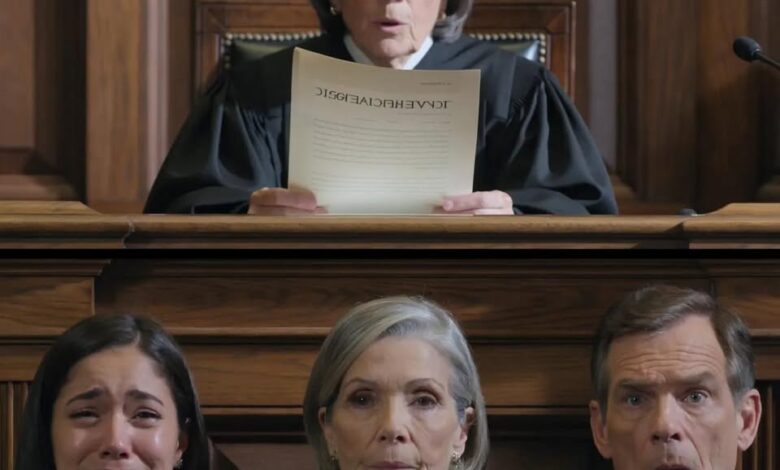
“There is no credible evidence that Cassandra Wilson agreed to repay her parents for anything,” she said. “The documents submitted to support that claim appear to be fabrications. This court does not exist to enforce guilt, entitlement, or family favoritism.”
Julia began to sob.
The judge continued.
“Parenthood is not a financial investment. Children do not owe repayment for being raised. This case is dismissed with prejudice. The plaintiffs will pay the defendant’s legal fees.”
Then she looked directly at Cassandra’s parents.
“Some damage cannot be repaired with apologies alone. Trust is rebuilt choice by choice.”
The gavel fell.
Cassandra was free.
The aftermath was ugly. Her parents nearly bankrupted themselves paying legal fees and covering the mortgage. Allison’s dream house was sold at a loss. Julia took a retail job. Donald became a night security guard. Still, they blamed Cassandra.
Six months later, Allison asked to meet.
She arrived at a coffee shop in jeans and a plain sweater, no designer bag, no practiced tears.
“I’m sorry,” she said. “For all of it.”
Therapy had forced her to confront what years of rescue had done to her. She had a job now, a tiny apartment, and a budget. Then she admitted something worse.
“I broke into your apartment after court. I was angry.”
She handed Cassandra an envelope with $200 inside.
“It’s the first payment for the damage.”
Cassandra didn’t forgive her that day. But she agreed to try.
Her parents never changed. Cassandra did.
Two years later, she owned a modest condo near a park, mentored younger engineers, and filled her home with plants, books, and peace. She built a chosen family from friends and relatives who loved without invoices, threats, or conditions.
The lawsuit meant to break her had done the opposite.
It proved that saying no was not cruelty. It was survival.
Cassandra had once believed being the responsible daughter meant sacrificing herself for everyone else. Now she knew better. Responsibility also meant protecting the life she had earned, even from people who shared her blood.
And the question that changed everything was simple:
Where was the proof?
There was none.
Only years of manipulation dressed up as family duty.
Once that lie collapsed, Cassandra finally understood the truth her parents never wanted her to learn: love without respect is not love at all.