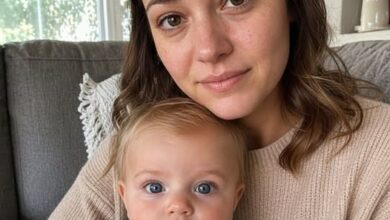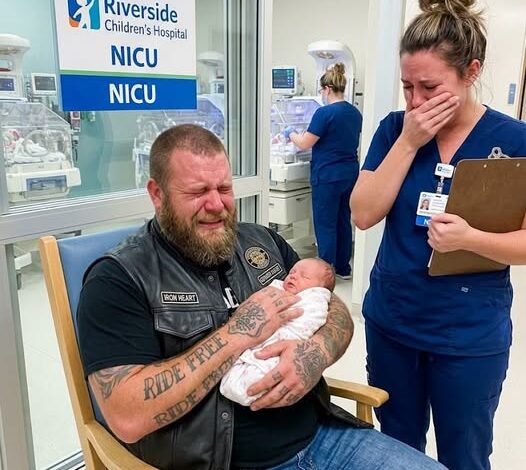
No one in the neonatal intensive care unit expected the quiet man covered in tattoos to become the person a tiny newborn seemed to recognize most.
He wasn’t a doctor.
He wasn’t a nurse.
He wasn’t family.
Yet almost every evening, as the hospital lights dimmed and visiting hours came to an end, he appeared at the same doorway carrying nothing except patience and a heart that had known more loss than most people ever would.
His name was Earl.
With his shaved head, weathered face, and tattooed arms, he looked nothing like the gentle figure the nurses would soon come to rely on. Strangers often judged him before hearing him speak. But inside the NICU, appearances lost their meaning. What mattered was the way he held the babies—with steady hands, quiet breathing, and a tenderness that couldn’t be taught.
There was one infant in particular who captured his heart.
She had arrived far too early, surrounded by tubes, monitors, and machines that worked tirelessly to keep her alive. She weighed barely enough to fill his hands, her tiny fingers curling instinctively around whatever warmth they could find.
For days, her crib remained painfully quiet.
No parents stood beside it.
No grandparents whispered hopeful prayers.
No familiar voices promised that everything would be all right.
The nurses cared for her with extraordinary devotion, but they couldn’t stay beside one baby every minute of every shift. They had dozens of fragile lives depending on them.
Earl noticed the empty chair beside the incubator.
The first night he asked whether he could simply sit with her.
The nurses smiled.
Before long, sitting became holding.
Night after night, he settled into the same chair, carefully lifting the little girl against his chest whenever the medical team said it was safe. The rhythmic beeping of monitors blended with the sound of his heartbeat, creating a calm that seemed to soothe the restless infant.
Something remarkable happened.
Whenever Earl held her, her tiny body relaxed.
Her breathing became steadier.
Her oxygen levels often settled.
The nurses joked that she seemed to know exactly when he walked into the room.
But Earl never believed he was doing anything extraordinary.
He simply knew what loneliness felt like.
Years earlier, he had lost his own daughter, Nora.
Grief had never truly left him. It had settled quietly inside him, changing the way he looked at children, families, and every birthday that should have been. There were questions he would never stop asking and memories he would never stop carrying.
Nothing could bring Nora back.
He knew that.
But somehow, holding a child who had no one at her bedside allowed him to transform a piece of that grief into something useful.
He couldn’t save the past.
He could refuse to let another baby face the present alone.
Weeks passed.
Then one afternoon, everything changed.
A young woman appeared hesitantly at the entrance to the NICU.
Her name was Tessa.
Her face revealed weeks of exhaustion, fear, and guilt long before she spoke a single word. Every step toward the nursery seemed painfully difficult, as though she wasn’t sure she deserved to keep walking.
The nurses welcomed her gently.
No one demanded explanations.
No one greeted her with accusations.
Instead, they quietly guided her toward her daughter’s bedside.
When Tessa reached the crib, she stopped.
Someone else was already holding her baby.
For an instant, confusion crossed her face.
Then she saw Earl looking down at the tiny girl in his arms as though she were the most precious person in the world.
He noticed Tessa immediately.
Without hesitation, he stood and carefully approached her.
“This little one has been waiting for you,” he said softly.
Tessa’s eyes filled with tears.
“I… I don’t know if she’ll even know me.”
Her voice trembled with every word.
“I don’t even know how to hold her.”
The fear in her voice wasn’t about technique.
It was about worthiness.
She feared she had already failed before she had truly begun.
Earl offered a reassuring smile.
“You don’t have to be perfect,” he said.
“You just have to be here.”
Slowly, with guidance from the nurses, he helped Tessa settle into a chair.
Together they carefully transferred the tiny infant into her mother’s waiting arms.
At first, Tessa’s hands shook so badly she worried she might drop her.
Then something incredible happened.
The baby relaxed.
Her tiny fingers wrapped around one of her mother’s.
Tessa lowered her forehead and quietly sobbed.
Weeks of fear, shame, and uncertainty dissolved into one overwhelming moment of connection.
No one in the room interrupted.
Some moments deserve silence.
As her daughter rested peacefully against her chest, Tessa whispered something almost too quietly to hear.
“I think I know her name.”
The nurses looked up.
“So do I,” Earl said with a gentle smile.
Tessa looked at him.
“I want to call her June.”
She hesitated.
“And… Nora.”
For a moment, Earl couldn’t speak.
The room seemed to stand perfectly still.
He hadn’t asked for recognition.
He certainly hadn’t expected to hear his daughter’s name spoken there.
Yet somehow, through an extraordinary twist of fate, two lives had become forever connected.
One little girl had been lost years before.
Another had been given a chance to keep fighting.
June Nora.
The name carried both grief and hope.
It honored the child Earl would always miss while celebrating the child who still had her whole future ahead of her.
Eventually, June grew stronger.
The machines disappeared one by one.
The feeding tubes were removed.
The monitors that had once filled every hour with anxious beeping slowly became unnecessary.
Finally, the day everyone had been waiting for arrived.
June was healthy enough to go home.
The nurses hugged Tessa through happy tears.
She turned to Earl before leaving.
“I don’t know how to thank you.”
He shook his head.
“You already have.”
As Tessa carried June through the hospital doors, Earl watched until they disappeared from view.
Then, the next evening, he returned to the NICU.
Another crib sat quietly in the corner.
Another tiny baby needed someone to sit beside them.
Another family was living through the longest nights of their lives.
So Earl pulled up the familiar chair once more.
He understood something many people never discover.
Redemption doesn’t always arrive with applause or dramatic moments.
Sometimes it begins with showing up when no one expects you.
Sometimes it grows one quiet act of kindness at a time.
And sometimes the greatest legacy we leave isn’t found in the lives we save, but in the lonely moments we refuse to let another human being face alone.
Long after June Nora had gone home to begin her new life, Earl continued walking through those hospital doors, carrying the memory of one daughter while comforting countless others.
Because love doesn’t always erase grief.
Sometimes it gives grief a purpose.
And in that softly lit NICU, where hope and heartbreak lived side by side, one man proved that healing often begins with the simplest promise of all:
I won’t walk away.