At first, it looks almost too small to carry any weight.
A tiny curve.
A dot.
A mark most people learned in school and rarely thought about again.
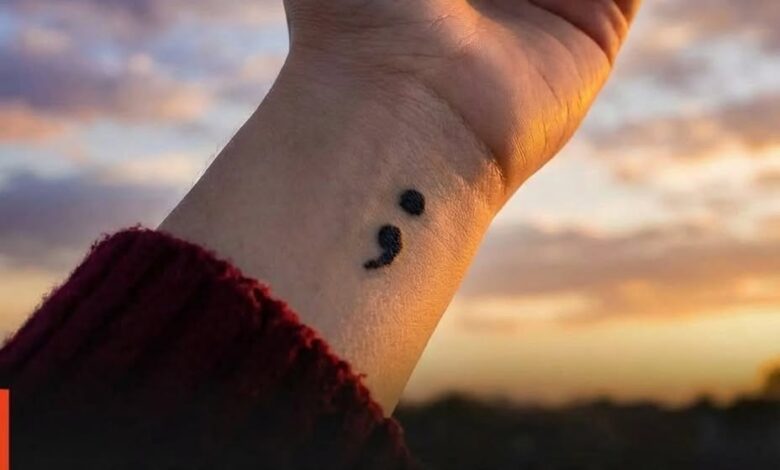
But on someone’s wrist, ankle, shoulder, or behind an ear, the semicolon can mean something entirely different.
For thousands of people, it is not decoration.
It is a decision.
A quiet reminder that a difficult chapter did not become the final one.
Unlike tattoos chosen mainly for appearance, the semicolon often carries a story that may never be obvious to anyone passing by. It can represent survival, grief, recovery, solidarity, or simply the determination to keep moving through a period that once felt impossible.
Its power comes from language.
In writing, a semicolon appears where a sentence could have ended, but the author chooses to continue.
That idea gave the symbol its emotional meaning.
The sentence could stop.
It does not.
There is more to say.
More to write.
More ahead.
That symbolism became especially well known after Project Semicolon launched in 2013. The initiative helped bring broader attention to mental health struggles and encouraged people to speak more openly about experiences that had often been carried in silence.
The semicolon became its central image because it translated something complicated into something immediately understandable.
You are still here.
Your story is still unfolding.
That message resonated with people for many different reasons.
Some had lived through periods of depression.
Others had experienced anxiety, grief, trauma, or emotional crises.
Some chose the tattoo after surviving a particularly dark period.
Others got it to honor someone they loved.
For some, it became a permanent reminder to seek help instead of disappearing into isolation when life became overwhelming.
For others, it simply represented resilience.
That variety is important.
A semicolon tattoo does not tell you everything about the person wearing it.
It is not a diagnosis.
It does not automatically reveal a specific experience.
Like any deeply personal symbol, its meaning belongs first to the person who chose it.
Two people may wear the same mark for completely different reasons.
One may see it as a symbol of recovery.
Another as remembrance.
Another as solidarity.
Another as a private promise.
That is part of what makes the design so powerful.
It is recognizable without demanding explanation.
Someone can carry it openly while still keeping the full story private.
That balance matters.
Mental health experiences can be intensely personal, and not everyone wants to discuss them every time someone notices a tattoo.
The semicolon can communicate without requiring confession.
Sometimes another person sees it and simply understands.
No questions.
No dramatic conversation.
Just recognition.
For people who have felt isolated by emotional struggles, that recognition can matter.
It says that experiences often hidden behind ordinary faces are not as rare as they seem.
The coworker who appears composed may be carrying something difficult.
The student laughing with friends may have fought battles nobody around them knows about.
The parent who seems endlessly dependable may have needed help too.
People are often far more complicated than they look.
The semicolon became one way of making that invisible reality visible.
Not loudly.
Quietly.
That quietness may be why the tattoo spread so widely.
It can be incredibly small.
A few millimeters of ink.
Yet the person wearing it may attach years of meaning to that mark.
A single symbol can contain hospital rooms, therapy sessions, difficult conversations, sleepless nights, losses, recoveries, and mornings when simply getting out of bed felt like an achievement.
To someone else, it may look like punctuation.
To the wearer, it may represent an entire period of life.
There is something beautiful about that contrast.
Modern culture often celebrates strength in dramatic forms.
Winning.
Conquering.
Overcoming.
Standing on a stage and announcing that everything is better now.
Real resilience is often much quieter.
Sometimes strength looks like going to an appointment.
Answering a phone call.
Telling one trusted person the truth.
Taking medication as prescribed.
Returning to therapy.
Leaving a harmful situation.
Resting.
Starting again after a difficult day.
Sometimes it means admitting that surviving is not the same thing as never struggling again.
The semicolon fits that quieter version of strength.
It does not imply that everything after the difficult moment becomes easy.
A semicolon is not a happy ending.
It is continuation.
That difference matters.
Life after hardship can still contain setbacks.
Recovery can be uneven.
People can feel strong one week and overwhelmed the next.
A symbol of perseverance does not erase those realities.
Instead, it can remind someone that a difficult moment does not have to define everything that follows.
There can still be another sentence.
Another page.
Another chapter.
Over time, the semicolon also became part of a wider cultural conversation about mental health.
People began sharing photos of their tattoos alongside personal stories.
Some spoke publicly for the first time about experiences they had hidden for years.
Others used the symbol to show support for friends and relatives.
The conversations helped challenge an old and damaging idea: that emotional suffering should be hidden because speaking about it is embarrassing or weak.
Silence can make people feel uniquely broken.
Conversation reveals how many others have struggled too.
That does not mean every story should be shared publicly.
Privacy is also valuable.
But knowing that it is possible to speak without shame can change the way people understand themselves and one another.
That may be one of the semicolon’s greatest cultural contributions.
It gave people a simple visual language for something that had often been difficult to express.
Not everyone has the words.
Sometimes a symbol comes first.
A tattoo can become the beginning of a conversation someone did not previously know how to start.
“What does that mean?”
And perhaps the answer is detailed.
Perhaps it is simply:
“It reminds me to keep going.”
Either response is enough.
The person wearing it decides.
The symbol has also encouraged empathy.
When people understand that someone’s tattoo may represent a private battle, it can challenge assumptions about what strength looks like.
We often judge others based on the smallest visible pieces of their lives.
A semicolon quietly reminds us how much remains unseen.
The person standing beside you may have survived things you know nothing about.
Kindness becomes more important when you remember that.
Patience too.
Still, it is worth resisting the temptation to romanticize suffering.
Pain does not become beautiful merely because it inspired meaningful art.
Mental illness is not made poetic simply because it can be represented by punctuation.
People deserve support, treatment, community, and serious care when they need it.
A tattoo can be meaningful.
It cannot replace professional help or trusted human connection.
The healthiest interpretation of the semicolon is not that someone must survive entirely through personal strength.
It is that continuing can involve reaching toward support.
Sometimes courage means doing something alone.
Often it means refusing to remain alone.
That distinction gives the symbol greater depth.
The author chooses to continue, yes.
But authors rarely create stories without help.
Editors.
Friends.
Teachers.
People who encourage another page.
Human lives work similarly.
A person may choose to keep going, but that choice can be supported by therapists, doctors, family members, friends, support groups, teachers, coworkers, or even one person willing to listen without judgment.
Strength does not become weaker because it is shared.
If anything, shared strength is often what makes continuation possible.
That is why someone who sees a semicolon tattoo should avoid assuming they understand the entire story behind it.
Recognition can be respectful without becoming intrusive.
You can appreciate the meaning without demanding details.
If the wearer chooses to explain, listen.
If they do not, let the symbol remain theirs.
The mark may represent the most private chapter of their life.
They get to decide who reads it.
And perhaps that is why the semicolon remains such an elegant symbol.
It does not announce victory.
It does not claim perfection.
It does not promise that every future page will be easy.
It simply refuses finality.
A sentence reached a place where it could have stopped.
It continued.
That idea is small enough to fit on a wrist and large enough to hold an entire philosophy of survival.
There will be pauses.
There will be difficult chapters.
There may be moments when the next line is hard to imagine.
But the page is still there.
The story remains unfinished.
And for many people, that tiny punctuation mark has become a permanent reminder of one simple truth:
A pause is not the same thing as an ending.