Why Do Fuel Tanker Trucks Have Chains Hanging From the Back? The Hidden Safety Feature Explained

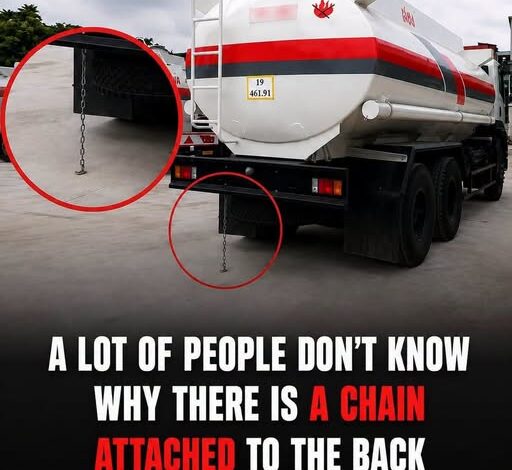
To most people, a fuel tanker rolling down the highway is just another large truck. Few notice the short metal chain dragging along the pavement behind it, and even fewer realize why it’s there. That small detail often sparks curiosity because it looks so simple, yet it hints at a much larger concern: the invisible danger of static electricity when transporting highly flammable fuel.
As a tanker travels, static electrical charges can build naturally. The constant rotation of rubber tires against the road, air flowing rapidly around the vehicle, and thousands of gallons of fuel shifting inside the tank all contribute to the accumulation of electrical energy. Under ordinary circumstances, static electricity is little more than a minor annoyance. Around gasoline vapors, however, even a tiny spark can become a serious hazard.
That is why controlling static electricity is such an important part of fuel transportation.
Many people assume the dragging chain is solely responsible for protecting the tanker by allowing electrical charge to dissipate into the ground. While it has long been associated with static control and remains a familiar symbol of tanker safety, it represents only one small part of a much broader system designed to reduce ignition risks. Modern fuel transport relies on multiple layers of engineering, equipment, and carefully followed procedures rather than any single device.
The most critical safety measures occur during the moments the public rarely witnesses—when fuel is being loaded into the tanker or transferred at its destination.
Before a single drop of fuel begins to flow, workers follow a carefully planned sequence of safety checks. Grounding cables are attached to approved grounding points, and the tanker, hoses, pumps, nozzles, and storage tanks are electrically bonded together. By connecting every component into a shared electrical system, differences in electrical potential are minimized, greatly reducing the likelihood that a spark could occur during fuel transfer.
These precautions may seem routine, but they are essential.
Fuel flowing rapidly through hoses can generate additional static electricity, and without proper bonding and grounding, even a small discharge could ignite flammable vapors under the wrong conditions. By ensuring that every connected piece of equipment remains at the same electrical potential, workers dramatically reduce that risk before fuel transfer even begins.
The process is supported by strict operating procedures developed through decades of experience and safety research. Personnel receive specialized training, equipment is routinely inspected, and fueling operations follow detailed protocols intended to prevent accidents long before they have a chance to develop. Every connection, every checklist, and every verification serves a purpose, even if those steps remain invisible to passing motorists.
In many ways, the chain trailing behind a tanker has become a symbol rather than the entire story. It reminds people that transporting fuel requires constant attention to hazards that cannot be seen with the naked eye. The real protection, however, comes from the combination of modern engineering, disciplined work practices, and multiple overlapping safety systems working together.
It is easy to overlook these quiet routines because, when everything functions correctly, nothing dramatic happens. Tankers arrive, fuel is delivered, and life continues without interruption. Yet that ordinary outcome is the result of countless careful decisions made by drivers, technicians, terminal operators, and safety professionals who understand exactly what is at stake.
Every successful fuel delivery represents far more than moving gasoline from one place to another. It reflects a carefully coordinated process built on preparation, precision, and respect for the risks involved. While the public may notice only the truck passing by, an entire network of safety measures is working behind the scenes to protect workers, nearby communities, and everyone sharing the road.
Sometimes the most important safeguards are also the least visible. A simple chain may catch your attention, but it is the disciplined choreography of grounding, bonding, inspection, and professional expertise that truly keeps static electricity under control. Day after day, those unseen precautions allow fuel to move safely across cities and highways, turning what could be a dangerous operation into one of the many essential services people rarely have to think about.