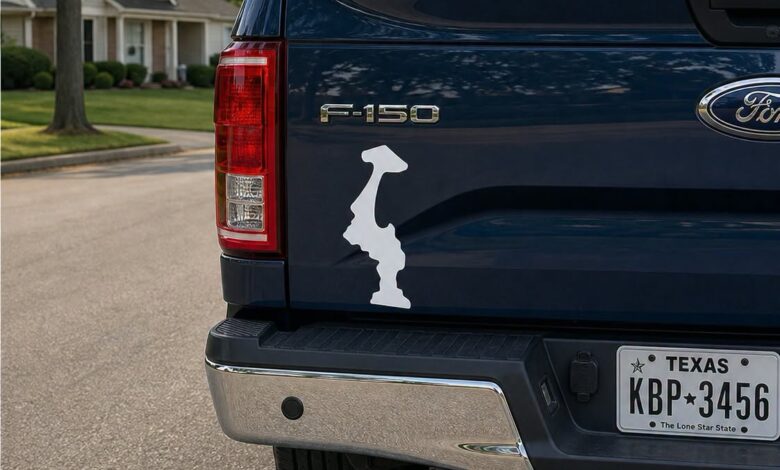
At first glance, it looks like someone made a mistake.
Washington State is there in its familiar outline, except something is wrong.
It’s upside down.
Turned completely on its head.
The first time you notice one of those decals on a bumper, rear window, water bottle, or tailgate, you might stare for a second longer than necessary. Maybe the person applied it incorrectly. Maybe the sticker was printed wrong. Maybe there’s some private joke you’re not in on.
But for many people who recognize what the inverted outline represents, that little piece of vinyl carries something much heavier than a joke.
It carries home.
Not necessarily the home where they live now.
The home they remember.
The home they left.
The home that still appears unexpectedly in the smell of rain, the sight of mountains on a horizon, or the distant cry of gulls somewhere hundreds of miles from Puget Sound.
That’s what makes the upside-down Washington decal so compelling.
It takes an ordinary map and does something memory often does to geography.
It rearranges it.
For someone who has never lived in Washington, the state outline may be little more than a shape learned in school.
For someone who grew up there, it can contain an entire life.
Seattle streets shining beneath rain.
Ferries moving slowly across gray water.
Mount Rainier appearing suddenly between buildings on a clear day.
The Cascades cutting across the horizon.
Evergreen forests darkening beneath low clouds.
Trailheads crowded on summer mornings.
Cold Pacific beaches covered in driftwood.
Coffee carried through wet sidewalks.
Long drives beneath enormous trees.
The peculiar silence that comes after fresh snow.
These things don’t appear on a map.
Yet somehow the outline holds them.
Then life happens.
People leave.
Sometimes because they want to.
Sometimes because they have to.
A job appears somewhere else.
A relationship changes everything.
College pulls someone across the country.
Housing becomes too expensive.
Family needs help.
Military service relocates them.
Opportunity points east or south.
One day, Washington is home.
Then suddenly it’s the place you’re from.
That change sounds small until you experience it.
At first, the new place may feel temporary.
You still say “back home” when talking about Washington.
You still compare everything.
The mountains aren’t the same.
The rain isn’t the same.
The coffee isn’t the same.
People pronounce things differently.
Nobody understands why you’re excited when you spot another Washington license plate.
Then months become years.
You build routines somewhere else.
You learn new roads.
Find a favorite grocery store.
Make friends.
Maybe buy a house.
Perhaps raise children who know Washington mainly through visits and stories.
The new place becomes home too.
But the old one doesn’t disappear.
Instead, you begin carrying two maps.
One tells you where you live.
The other tells you where part of you still belongs.
That is where the upside-down outline starts making emotional sense.
Washington has been flipped.
So has your life.
The geography remains recognizable, but its orientation has changed.
You’re looking at the same place from a different position.
There’s humor in that.
Of course there is.
It is, after all, an upside-down state.
Someone seeing it for the first time might laugh.
“Did you put that on wrong?”
Maybe that’s part of the charm.
The symbol doesn’t need to take itself too seriously.
Homesickness rarely behaves solemnly all the time.
Sometimes nostalgia arrives as an ache.
Sometimes it arrives as a joke.
Sometimes it is hearing someone pronounce “Puyallup” correctly in a place where nobody should know how.
Sometimes it is spotting another Washington decal in a supermarket parking lot thousands of miles away.
You stop.
Look again.
And suddenly there is recognition.
“You’re from Washington?”
That question can open an entire conversation.
“What part?”
And now the map gets smaller.
Tacoma.
Spokane.
Olympia.
Bellingham.
Vancouver.
Yakima.
The Tri-Cities.
Some tiny town the other person somehow knows.
Then come the landmarks.
The ferry routes.
The mountain passes.
The restaurants.
The highways.
The weather.
Someone complains about I-5.
Now you’re practically family.
That’s what symbols can do when they aren’t controlled too tightly.
There is no need for an official organization explaining exactly what an upside-down Washington must mean.
No membership card.
No manifesto.
No rulebook telling someone whether they’re using it correctly.
The ambiguity is part of its power.
One person may see homesickness.
Another sees relocation.
Someone else sees the idea of gaining perspective by literally turning a familiar place around.
Another person may simply think it looks interesting.
All of those meanings can coexist.
Symbols become personal precisely because people are allowed to bring themselves to them.
For one driver, the decal might represent the first time they left Washington.
They packed everything they owned into a car and drove toward a new life, watching familiar forests disappear in the rearview mirror.
For another, it might represent returning.
Years away changed them enough that the place they came back to looked familiar and unfamiliar at once.
For someone else, it may honor parents or grandparents.
Perhaps Washington isn’t where they were born at all.
Maybe it’s where summers happened.
Where grandparents waited at the ferry terminal.
Where childhood smelled like cedar and saltwater.
Where cousins gathered.
Where someone important is buried.
Home has never obeyed residency requirements.
Sometimes a place claims you through repetition.
Sometimes through love.
Sometimes through loss.
And once that happens, geography becomes emotional.
A coastline isn’t just a coastline.
It’s where your father taught you to skip stones.
A mountain isn’t simply elevation.
It’s the shape that appeared beyond the highway during childhood drives.
A ferry isn’t transportation.
It’s standing outside in cold wind because staying inside felt like wasting the crossing.
Rain isn’t weather.
It’s the sound against the bedroom window of a house that no longer belongs to your family.
Those memories are rarely dramatic when they’re being made.
That’s the strange thing.
Nobody stands on a wet sidewalk at seventeen thinking:
I need to remember exactly how this feels because one day I will live somewhere else and desperately miss it.
You complain about the rain.
You complain about traffic.
You complain that the mountain has disappeared behind clouds for the ninth consecutive day.
Then you move.
And suddenly those annoyances acquire tenderness.
Distance is an editor.
It cuts away some frustrations and sharpens certain details.
The ordinary becomes precious because it is no longer available on demand.
That is why a cheap decal can carry surprising emotional weight.
Objects don’t need to be expensive to become meaningful.
Sometimes all they need is recognition.
A tiny outline on a truck can contain decades.
Maybe the owner remembers waking before sunrise for a hike.
Maybe they remember summer evenings when daylight seemed reluctant to leave.
Maybe they remember standing on a ferry deck with freezing hands while city lights receded behind them.
Maybe they remember wet sneakers beside the front door.
Fir needles tracked into the house.
The smell of coffee.
Mountain silhouettes at dusk.
None of that is printed on the sticker.
It doesn’t have to be.
Memory supplies the details.
That’s why the upside-down orientation feels appropriate.
Memory itself is inaccurate in strangely beautiful ways.
It rearranges.
Exaggerates.
Softens.
Preserves one meaningless afternoon while losing entire years.
You remember the color of the sky but not the date.
The sound of someone’s laugh but not what they said.
A particular road but not where you were going.
A kitchen window.
A wet jacket.
A ferry horn.
A mountain appearing through clouds.
Memory doesn’t reproduce a place.
It rebuilds one.
Imperfectly.
Personally.
Upside down, sometimes.
And perhaps that is exactly what happens when people leave home.
The place they carry with them gradually stops being identical to the real place.
Washington continues changing without them.
Neighborhoods develop.
Businesses close.
New buildings rise.
Roads change.
People move.
The restaurant they remember disappears.
The childhood house gets painted another color.
Trees grow.
Someone tears down the old fence.
You return expecting memory and encounter time instead.
That can hurt.
You realize you’ve been carrying a version of Washington that exists partly inside you.
But that doesn’t make it false.
It makes it yours.
The decal represents that version too.
Not Washington as surveyed and bordered.
Washington as remembered.
That’s why seeing one far away can produce such an immediate response.
Imagine driving through Arizona.
Texas.
Florida.
Somewhere where the landscape couldn’t look less like the Pacific Northwest.
Heat rises from the pavement.
The horizon is wrong.
The vegetation is wrong.
Then traffic stops at a light.
On the truck ahead is that shape.
Upside down.
Washington.
For a second, two strangers share something.
You don’t know the driver’s name.
Don’t know where they’re going.
Don’t know why they left.
Maybe they don’t even interpret the sticker the same way you do.
Still, recognition passes between you.
You know that shape.
More importantly, you know what can fit inside it.
That small moment can make distance collapse.
The Cascades suddenly feel closer.
So does the coast.
So does whatever part of yourself you left there.
That is the strange social life of symbols.
They allow people to identify one another without introductions.
A decal becomes a signal.
Not necessarily:
“We believe exactly the same thing.”
Something gentler.
“I know that place too.”
Sometimes that’s enough.
Perhaps you meet at a gas station.
“Hey, I like your Washington sticker.”
The owner smiles.
“You from there?”
“Used to be.”
Two words.
Used to.
They contain an entire migration.
Then come the stories.
Where did you live?
When did you leave?
Do you miss it?
Do you ever go back?
And there it is.
A conversation between strangers created by a piece of vinyl no larger than a hand.
That may be why unofficial symbols often become so durable.
Nobody owns the meaning.
Nobody can tell you that your nostalgia is incorrect.
If the inverted state means displacement to you, then it means displacement.
If it means perspective, fine.
If it means starting over, fine.
If it simply reminds you of home, that’s enough.
Meaning does not always need explanation.
Sometimes recognition happens before language.
You see the outline and feel something.
That is the whole experience.
The heart is strangely resistant to geography.
You can move thousands of miles and still orient yourself according to a place you no longer inhabit.
North and west.
Toward water.
Toward mountains.
Toward rain.
Toward an old address.
Toward people who may no longer live there either.
That doesn’t mean you failed to build a life elsewhere.
Human beings can belong to more than one place.
A new home does not require deleting the old one.
You can love where you are and still miss where you were.
You can build friendships in one state while remembering childhood in another.
You can raise children beneath a completely different sky and still teach them the names of mountains they see only on visits.
Belonging isn’t a limited resource.
Perhaps that is the gentlest meaning of the upside-down Washington.
Your world changed orientation.
You didn’t lose the map.
The decal admits both realities.
Yes, life turned over.
Yes, you went somewhere else.
Yes, the state is upside down.
But you still recognize it immediately.
Home remains home even when viewed from a different direction.
And years later, the details can return with astonishing clarity.
Trailheads.
Ferry rides.
Evergreens.
Wet sidewalks.
Cold beaches.
Clouds moving across mountains.
That peculiar Pacific Northwest light when the sky begins darkening but the horizon still seems illuminated.
Perhaps you didn’t appreciate any of it enough while you were there.
Most people don’t.
We rarely recognize home as something temporary while we’re living inside it.
We assume the familiar will remain available.
Then one day, we’re looking at its outline on someone else’s bumper.
And suddenly a whole landscape returns.
That is a remarkable amount of emotional work for a sticker.
But the sticker itself isn’t really doing it.
You are.
The shape is only a key.
Memory opens the door.
Behind it is Washington as you knew it.
Not the official state.
Not borders on an atlas.
Your Washington.
The road you drove to work.
The lake where summers happened.
The view from someone’s porch.
The ferry you almost missed.
The rain you once complained about.
The mountain that made you stop complaining whenever the clouds finally revealed it.
The people.
Always the people.
Because in the end, that’s usually what we’re homesick for.
Places become meaningful because of who we were while living there and who lived there with us.
Sometimes what we miss isn’t Washington itself.
We miss being twenty-two in Washington.
We miss our parents being younger.
We miss friends before everyone scattered.
We miss children when they were small.
We miss the version of ourselves who still believed certain things would last forever.
No map can show that.
Maybe that’s why turning the map upside down feels so fitting.
The geography was never the whole story.
Life changed.
We changed.
Home changed.
Yet the connection remained.
So the decal travels.
Across highways.
Through unfamiliar cities.
Onto bumpers covered in dust from climates nothing like the Northwest.
It fades in sunlight.
Gets scratched.
Survives rain.
And occasionally someone recognizes it.
They smile.
Maybe they point.
Maybe they ask a question.
Maybe they simply look at it for a moment longer before traffic moves again.
That’s enough.
Because the upside-down Washington isn’t really about getting geography wrong.
It’s about what happens when geography no longer determines belonging.
You can flip the state.
Cross the country.
Build another home.
Live decades somewhere else.
And still feel something pull when you see that familiar border.
The decal is less a map than a mirror.
People look at it and see whatever Washington left inside them.
A mountain.
A coastline.
A childhood.
A person.
A departure.
A return.
A life turned in another direction while some invisible compass continued pointing home.
And perhaps that’s why the little upside-down shape keeps appearing so far from the place it represents.
It doesn’t tell anyone where the driver is going.
It tells you something about where part of them never completely stopped being.
Home, after all, is not always the place beneath your feet.
Sometimes it’s the place that can still find you in a parking lot thousands of miles away.
Sometimes it’s a memory carried down an interstate.
And sometimes it’s Washington turned upside down on the back of a car—geographically wrong, emotionally perfect.