Most people have handled thousands of coins in their lifetime without ever questioning one of their most distinctive features.
You feel it every time a quarter slides across your palm. You notice it when you absentmindedly run your thumb along the edge of a dime. Those tiny grooves seem insignificant—just another design choice made by a mint centuries ago.
But those ridges exist because of a problem so serious that it once threatened entire economies.
Hidden in the edge of a simple coin is a story of theft, innovation, and one of history’s greatest scientific minds stepping in to solve a crisis.
Centuries ago, money was very different from the coins we carry today.
A coin wasn’t merely a symbol of value. It was value.
Gold and silver coins derived their worth directly from the precious metals they contained. Every coin represented a measurable amount of wealth, making it useful not only for trade but also as a store of value.
That created an irresistible opportunity for criminals.
A practice known as coin clipping began spreading across Europe.
The scheme was simple.
Thieves would shave tiny slivers of gold or silver from the edges of coins. Individually, the missing pieces were nearly impossible to notice. The altered coins remained in circulation, passing from person to person as if nothing had changed.
Meanwhile, the clipped metal accumulated.
A little silver from one coin.
A little gold from another.
Over time, those scraps added up to substantial profits.
The consequences reached far beyond simple theft.
As more clipped coins entered circulation, trust in currency began to erode. Merchants became suspicious. Traders questioned the true value of coins they received. Governments worried that weakened confidence could disrupt commerce and destabilize entire economies.
What seemed like a small act of fraud was creating a massive problem.
By the late seventeenth century, the situation had become severe enough to demand a solution.
That solution arrived from an unlikely source.
In 1696, Sir Isaac Newton accepted a position as Warden of the Royal Mint.
Most people remember Newton for discovering gravity and transforming science, but few realize he also played a critical role in protecting Britain’s currency.
The task placed before him was daunting.
Counterfeiting was widespread.
Coin clipping was rampant.
Public confidence in money was deteriorating.
Newton approached the challenge the same way he approached science: with precision, logic, and innovation.
His answer was brilliantly simple.
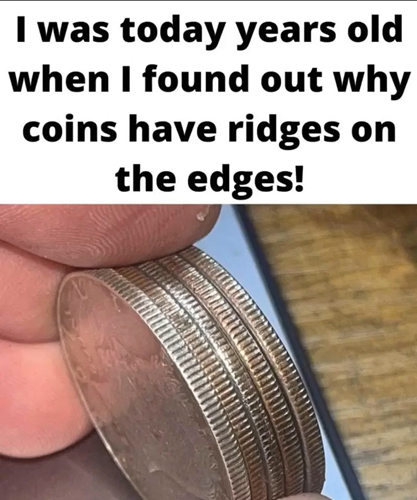
Instead of leaving coin edges smooth, the mint would add carefully milled ridges around the circumference.
Those ridges changed everything.
Suddenly, clipping became obvious.
The moment someone shaved metal from a coin, the pattern would be interrupted. Missing ridges could be spotted immediately, making fraud far easier to detect.
The edge itself became a security feature.
No complicated inspections.
No expensive verification process.
Just a visual and tactile warning system built directly into the coin.
The impact was enormous.
Trust gradually returned.
Currency became more secure.
Other nations quickly adopted similar techniques, recognizing the effectiveness of Newton’s innovation.
What began as a response to a specific economic crisis eventually became one of the most recognizable features of modern coinage.
Fast-forward to today, and an interesting question emerges.
If modern coins aren’t made from valuable gold or silver, why do the ridges still exist?
The answer lies in the multiple roles those tiny grooves now perform.
Security remains one of them.
Although modern quarters, dimes, and half-dollars are composed primarily of base metals, ridged edges continue to help distinguish genuine coins from counterfeit ones.
Modern minting technology produces incredibly precise patterns. Banks, vending machines, transit systems, and coin-counting devices often rely on these specifications when verifying coins.
Even in a digital age, physical security still matters.
The ridges also serve another important purpose that many people never consider.
Accessibility.
For individuals with visual impairments, the edge of a coin provides valuable information.
A smooth-edged nickel feels different from a ridged dime.
A quarter can often be identified by touch alone.
These distinctions help people use currency independently, making everyday transactions easier and more accessible.
What began as an anti-theft measure centuries ago now contributes to inclusivity and usability.
Then there is tradition.
Currency is one of the few objects people interact with every day that maintains a direct connection to centuries of history.
When you hold a quarter today, you’re touching a design feature that traces its roots back more than three hundred years.
The ridges are a reminder that some innovations survive because they continue to serve meaningful purposes long after their original problem has faded.
Interestingly, not every coin received this treatment.
Pennies and nickels retain smooth edges.
The reason is rooted in history.
These coins were never produced from precious metals valuable enough to attract widespread clipping.
There was little incentive for thieves to shave material from them, so ridges were unnecessary.
That distinction remains visible today.
Simply examining the edge of a coin reveals clues about its historical origins and the challenges faced by the society that created it.
Modern manufacturing has transformed the process dramatically.
Where coin edging was once labor-intensive and carefully monitored by hand, today’s minting facilities produce perfectly uniform ridges at extraordinary speeds.
Advanced machinery ensures consistency across millions of coins, preserving both functionality and security.
Yet despite all the technological improvements, the fundamental concept remains unchanged from Newton’s era.
A simple physical feature protects trust.
That idea extends beyond currency itself.
The ridged edge has become a symbol of something larger.
Economic systems function because people believe in them.
Money works because individuals trust that it represents value.
The tiny grooves surrounding a coin serve as a reminder that maintaining that trust often depends on seemingly small details.
They represent centuries of effort to create reliable systems, discourage fraud, and support commerce.
Perhaps that’s what makes the story so fascinating.
Most people never notice the ridges.
They don’t think about economic history while paying for coffee or dropping quarters into a parking meter.
Yet every coin carries evidence of a centuries-old battle against deception.
Every groove reflects a practical solution born from necessity.
And every ridged edge demonstrates how thoughtful design can solve problems that affect entire societies.
Today, as digital payments become increasingly common, physical coins may seem less important than they once were.
But they continue to offer valuable lessons.
They remind us that innovation often emerges from crisis.
That good design can serve multiple purposes at once.
And that even the smallest details can have lasting impact.
The next time a quarter lands in your hand, take a moment to feel its edge.
Those tiny ridges aren’t decoration.
They’re the legacy of an economic crisis, a scientific genius, and centuries of human ingenuity working together to protect something essential: trust.
For such a small feature, that’s an extraordinary story to carry.