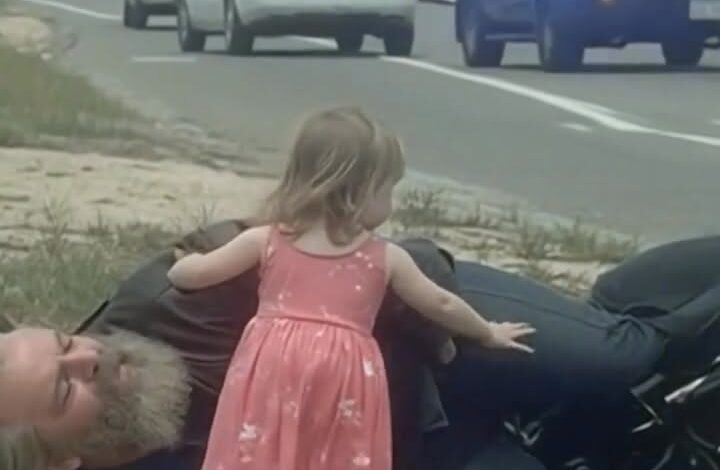
The scream came so suddenly that Helen Maren nearly swerved.
One moment, the late-autumn drive home felt peaceful. The next, panic exploded from the backseat of her silver sedan.
“Stop the car! Mommy, stop the car!”
Helen’s hands tightened around the steering wheel as she glanced into the rearview mirror.
Five-year-old Sophie sat rigid in her car seat, her face drained of color. Tears pooled in her bright blue eyes. The sparkling princess dress she had insisted on wearing after kindergarten shimmered in the fading sunlight, and the tiny lights in her sneakers blinked wildly as she kicked her feet.
“What’s wrong?” Helen asked, her pulse already racing.
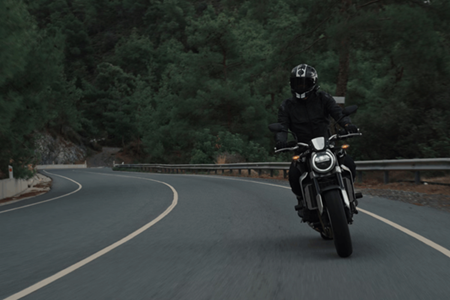
“The motorcycle man!” Sophie cried. “He’s hurt! He’s down there!”
She pointed frantically toward the right side of the highway.
Helen frowned.
Route 27 stretched ahead exactly as it always did—quiet, orderly, uneventful. No emergency vehicles. No flashing lights. No stopped traffic.
Nothing.
But something in Sophie’s voice made Helen hesitate.
This wasn’t a child frightened by shadows or carried away by imagination.
This was fear.
Real fear.
Helen eased off the accelerator and guided the car onto the shoulder, activating her hazard lights.
As she scanned the roadside, something caught her eye.
Beyond the guardrail, hidden among tall grass and brush, a dark metallic shape reflected the setting sun.
Her stomach dropped.
“Stay in your seat,” she told Sophie.
But before she could react, Sophie had already unbuckled herself and pushed open the door.
“Sophie!”
Helen hurried after her.
The embankment was steeper than it looked from above. Gravel shifted beneath their shoes as they carefully climbed down through the weeds.
Then they saw it.
A black motorcycle lay twisted in the grass several yards below.
The windshield was shattered.
One handlebar bent at an unnatural angle.
And beside it lay a man.
Motionless.
For one horrifying second, Helen thought they were too late.
Then she noticed his chest rise.
Barely.
“He’s alive,” she whispered.
The rider appeared badly injured. Blood stained the front of his shirt, and one leg was bent in a way that made Helen instantly look away.
Her hands shook as she grabbed her phone and dialed emergency services.
The dispatcher answered immediately.
Helen explained what they had found while trying to steady her breathing.
Following instructions, she knelt beside the injured man and carefully pressed her scarf against a bleeding wound. She avoided moving his head or neck, terrified of making things worse.
The man groaned softly.
“Help is coming,” Helen said. “Just stay with us.”
To her surprise, Sophie quietly moved closer and sat beside him.
The little girl gently took his hand.
“You’re going to be okay,” she said.
Her voice was calm now.
Steady.
The man’s eyes fluttered, though he couldn’t fully open them.
Minutes crawled by.
Each second felt like an hour.
Then, finally, the distant wail of sirens echoed across the fields.
Relief washed over Helen so powerfully she nearly cried.
Emergency responders arrived quickly.
Paramedics rushed down the embankment carrying equipment while firefighters secured the area around the crash site.
Within moments, they were administering oxygen, stabilizing the rider’s neck, and preparing him for transport.
One paramedic glanced toward Helen while continuing treatment.
“You did exactly the right thing,” he said.
“Getting pressure on that wound may have saved his life.”
Helen looked at Sophie.
The little girl was still standing nearby, clutching her princess skirt with both hands.
As the injured rider was loaded onto a stretcher, his eyes opened briefly.
They found Sophie.
A faint smile appeared on his face.
“Thank you,” he whispered.
Then the ambulance doors closed.
Not long after emergency crews left, several motorcycles pulled onto the shoulder.
Their riders dismounted quickly, expressions tense.
One of them, a tall man with gray at his temples, approached Helen.
“My name’s Jack,” he said. “We’ve been looking for our friend. He got separated from us an hour ago.”
When Helen explained what had happened, the group fell silent.
The injured rider’s name was Jonas Keller.
He was a longtime member of their motorcycle club.
Jack knelt in front of Sophie.
“You found him?”
Sophie nodded.
“He needed help.”
The man’s eyes glistened.
“You’re a very brave young lady.”
Sophie simply shrugged.
To her, it seemed obvious.
Someone was hurt.
You helped.
Two weeks later, Helen and Sophie visited Jonas at a rehabilitation center.
His injuries had been severe, but he was expected to recover.
A cast covered his leg, and bruises still marked his face.
Yet when Sophie entered the room, his entire expression changed.
“There’s my hero,” he said.
Sophie immediately hid behind her mother.
“I just helped,” she mumbled.
Jonas laughed softly.
“Well, your help gave me another chance.”
During that visit, Helen learned something she hadn’t known before.
Several years earlier, Jonas had lost his young daughter, Isla, to leukemia.
The loss had devastated him.
In her memory, his motorcycle club—the Black Hounds—organized annual fundraisers supporting pediatric cancer research.
The revelation hit Helen hard.
Perhaps that was why Jonas seemed so emotional whenever he looked at Sophie.
Something about her reminded him of the child he had lost.
A month later, the Black Hounds hosted a community event honoring both Isla’s memory and Sophie’s courage.
The gathering raised funds for cancer research and launched a small scholarship program recognizing children who displayed unusual kindness and bravery.
They called it the Route 27 Scholarship.
What began as a single moment on the roadside slowly grew into something much larger.
The bikers became part of Sophie’s life.
They attended her school performances.
They showed up at birthday parties.
At one winter recital, parents turned in surprise when a row of leather-clad bikers quietly filled the back of the auditorium.
When Sophie spotted them from the stage, she smiled and waved.
Jonas—still using a cane at the time—applauded louder than anyone.
Months later, Sophie visited his home.
While exploring the backyard, she learned about a tradition Jonas had shared with Isla.
The little girl used to hide handwritten notes around the property for him to discover later.
“Do you think there are any left?” Sophie asked.
Jonas smiled sadly.
“Maybe.”
Together, they searched beneath an old chestnut tree.
After a few minutes, Sophie’s small hand struck metal.
They uncovered a tiny weathered tin box.
Inside was a folded piece of paper.
The handwriting was unmistakably a child’s.
Jonas carefully unfolded it.
His hands trembled.
The note read:
Daddy, don’t be sad when I’m not here. I’ll always love riding with you.
For several moments, neither of them spoke.
Tears filled Jonas’s eyes.
Years had passed since Isla’s death, yet seeing her words again felt like hearing her voice.
Then Sophie wrapped her arms around him.
“She still loves you,” she whispered.
Jonas nodded.
“I know.”
Years later, people throughout the community still talked about what happened on Route 27.
Not because it was dramatic.
Not because it was mysterious.
But because it reminded them how quickly lives can change when someone chooses to pay attention.
Sophie eventually became certified in first aid as a teenager.
Jonas fully recovered and returned to riding.
Yet whenever someone asked what saved his life that evening, his answer never changed.
“A little girl who cared enough to stop.”
And every time he passed mile marker fourteen at sunset, watching the sky glow with shades of gold, orange, and crimson, gratitude filled his heart.
Because his survival had not been the result of luck.
It wasn’t fate.
It wasn’t a miracle.
It was the courage of a child in a sparkling princess dress, wearing blinking sneakers, who saw someone in need and refused to look away.
Sometimes the people who change lives aren’t the strongest, the oldest, or the most experienced.
Sometimes they’re simply the ones willing to stop when everyone else keeps driving.