It catches many homeowners completely off guard.
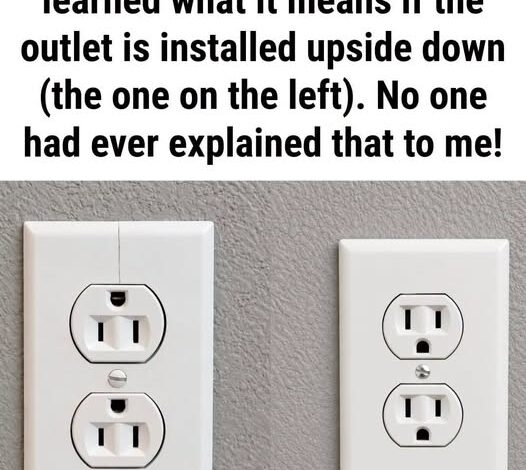
You plug a phone charger into an outlet, and nothing happens. Moments later, you discover that flipping a nearby wall switch suddenly brings the outlet to life. Or perhaps you notice a receptacle installed upside down, with the grounding hole at the top instead of the bottom, and wonder if someone made a mistake.
In many cases, neither is an accident.
They’re remnants of a time when floor and table lamps were often intended to serve as a room’s primary source of lighting.
Before ceiling fixtures became standard in every room, many builders wired a wall switch to control an electrical outlet instead of an overhead light. The idea was simple: plug a lamp into that outlet, walk into the room, flip the switch, and the lamp would illuminate the space without requiring you to reach across the room.
It was a practical solution that remains common in many older homes—and even in some newer ones.
To make those outlets easier to recognize, some electricians adopted a simple visual habit.
They installed the receptacle upside down.
With the grounding slot positioned at the top instead of the bottom, the outlet stood out from the others, offering a subtle clue that it might be connected to a wall switch.
In many homes, only half of the duplex outlet is switch-controlled.
One receptacle is energized only when the wall switch is on, while the other remains permanently powered. That arrangement allows homeowners to plug a lamp into the switched half while leaving the other available for devices that need constant electricity, such as clocks, internet routers, phone chargers, or other electronics.
It’s an elegant design that balances convenience with flexibility.
However, there’s an important detail many people don’t realize.
An upside-down outlet does not automatically mean it’s switch-controlled.
Despite the widespread belief, the National Electrical Code in the United States does not require switched receptacles to be installed upside down. In fact, the code generally does not mandate a specific orientation for standard residential outlets. Electricians may install them with the grounding slot up, down, or sideways, depending on local practice, customer preference, manufacturer recommendations, or the specific circumstances of the installation.
Some electricians prefer the grounding slot on top for entirely different reasons.
If a metal object—such as a picture frame or loose tool—were to fall between a partially unplugged cord and the outlet, the grounding pin could make contact first, potentially reducing the risk of a short circuit. Others simply follow company standards or continue the orientation already present throughout a home.
And sometimes?
The outlet is upside down for no reason beyond personal preference.
A previous homeowner may have installed it that way simply because they liked the appearance.
That’s why appearance alone can be misleading.
The only dependable way to determine whether an outlet is controlled by a switch is to test it.
A small table lamp works especially well because it’s easy to see when power is present. Plug the lamp into the outlet, turn it on, and then flip each nearby wall switch one at a time. If the lamp turns on and off with a switch, you’ve identified a switched receptacle.
If the outlet has two sockets, it’s worth checking both.
Often, only one half is switch-controlled while the other remains continuously powered. Testing each receptacle individually helps eliminate confusion and ensures you know exactly how the outlet functions.
This simple exercise can also solve a surprisingly common household mystery.
Many people assume an outlet has failed when, in reality, the controlling wall switch has simply been turned off. That misunderstanding leads to unnecessary frustration, and sometimes even unnecessary service calls, when nothing is actually broken.
Once you know which outlets respond to switches, you can make much better use of them.
They’re ideal for floor lamps in living rooms, bedside lamps in bedrooms, seasonal decorations, or any lighting you’d like to control conveniently from the doorway. At the same time, you’ll know which receptacles should be reserved for devices that require uninterrupted power.
Understanding your home’s electrical layout offers another advantage.
It helps you troubleshoot problems more confidently.
When something suddenly loses power, you’ll already know whether a wall switch is involved before assuming there’s a wiring issue or tripped breaker.
Of course, if an outlet fails to operate despite testing the switches, or if it shows signs of damage such as discoloration, sparking, unusual warmth, or loose connections, it should be inspected by a qualified electrician. Electrical problems should never be ignored or repaired beyond your level of experience.
In the end, that upside-down outlet isn’t necessarily a mistake.
It may be a quiet reminder of an earlier era of home design, when a simple floor lamp served as the room’s primary light source and thoughtful wiring made everyday living just a little more convenient.
Sometimes it marks a switched receptacle.
Sometimes it reflects an electrician’s safety preference.
Sometimes it’s simply a stylistic choice.
The only way to know for certain is to test it.
And once you do, one of your home’s smallest mysteries suddenly becomes one of its most practical features—a reminder that even the simplest details often have a story behind them.