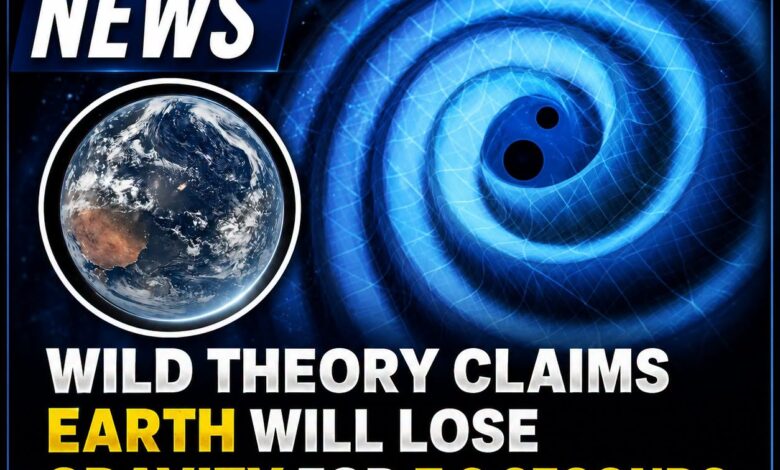
At exactly the predicted moment, millions of people were supposed to leave the ground.
For 7.3 seconds, gravity would supposedly disappear.
Cars would lift from highways.
Furniture would slam into ceilings.
People caught outdoors would float helplessly upward.
Then Earth’s gravity would suddenly return, throwing everything back down.
And according to the viral prophecy, NASA already knew.
That was the part that made the story irresistible.
The posts didn’t merely claim something strange was about to happen. They offered what appeared to be an entire secret history behind it.
There was allegedly a classified NASA operation called “Project Anchor.”
There was supposedly an $89 billion emergency budget.
There were underground shelters prepared for politicians, scientists, military leaders, billionaires, and other carefully selected survivors.
There were fabricated-looking documents filled with technical language.
And there was a countdown.
A precise date.
A precise time.
Even a precise duration:
7.3 seconds.
That decimal point was doing enormous psychological work.
“Gravity might temporarily behave strangely” sounds like nonsense.
“Gravity will fail for exactly 7.3 seconds” sounds, strangely enough, more scientific.
Specificity creates authority.
Add a government logo, technical vocabulary, a few equations, dramatic music, and references to real astronomical phenomena, and an absurd claim can begin to feel disturbingly plausible.
The creators of the story understood that perfectly.
The hoax borrowed words from legitimate physics.
Gravitational waves.
Black holes.
Solar activity.
Orbital alignment.
Space-time.
Relativity.
Then it assembled them into a conclusion that those concepts do not support:
Earth’s gravity was supposedly going to switch off.
That is not how gravity works.
Gravity isn’t a machine hidden beneath the planet with an ON/OFF button.
Earth’s gravitational attraction exists because Earth has mass.
Everything from the oceans beneath us to the rock thousands of kilometers below our feet contributes to the gravitational field surrounding the planet.
For gravity at Earth’s surface to simply vanish, something incomprehensibly more dramatic than an eclipse or passing astronomical event would have to occur.
The planet itself would have to undergo a fundamental physical change.
And if Earth suddenly lost the conditions responsible for its gravitational pull, floating toward the ceiling for seven seconds would be the least of humanity’s problems.
Yet the hoax became persuasive by mixing that impossible premise with real scientific phenomena.
Gravitational waves, for example, genuinely exist.
They are ripples in space-time produced by accelerating massive objects, such as merging black holes or neutron stars.
Their detection was one of modern physics’ great achievements.
But gravitational waves passing through Earth do not temporarily cancel the planet’s gravity.
Likewise, eclipses are real.
They can be spectacular.
They can darken daytime skies, alter temperatures briefly, change animal behavior, and produce some of the most extraordinary sights visible from Earth’s surface.
But an eclipse does not shut down gravity.
The Moon already exerts gravitational influence on Earth.
So does the Sun.
Those forces contribute to phenomena such as tides.
Their positions can change the combined gravitational effects experienced by Earth in measurable ways.
But “measurable” is not the same thing as “people suddenly float into space.”
The difference is enormous.
Still, social media rewarded the frightening version.
Videos appeared explaining how people should prepare.
Some recommended staying indoors.
Others advised avoiding staircases, balconies, glass, or heavy furniture.
A few supposedly helpful posts explained how to secure yourself to pipes or structural supports.
The more ridiculous the claim became, the more elaborate the survival advice grew.
That created another psychological effect.
If people are explaining how to survive something, surely someone has already established that the threat is real.
But repetition isn’t evidence.
Neither is virality.
Neither is a professional-looking document.
And neither is a person speaking confidently into a camera.
The supposed secret budget was another effective ingredient.
A gigantic number suggests gigantic stakes.
Billions of dollars.
Hidden facilities.
Emergency preparations.
Powerful people supposedly knowing something ordinary citizens don’t.
That narrative plugs directly into one of the strongest engines of modern misinformation:
Distrust.
The story wasn’t asking people merely to believe that gravity would disappear.
It was asking them to believe that authorities knew it would happen and were deliberately hiding the truth.
That makes debunking much harder.
If NASA denies the claim, believers can say:
“Of course they deny it.”
If scientists explain why it is physically impossible:
“They’re part of the cover-up.”
If nothing unusual happens:
“They prevented it.”
A conspiracy structured that way becomes almost impossible to disprove to someone determined to preserve it, because every contradiction can be absorbed as additional evidence.
That is why the most important skill isn’t memorizing the correct scientific explanation after every viral hoax.
It is learning how to recognize the architecture of misinformation before panic begins.
Look at the pattern.
An extraordinary threat.
A secret government program.
Anonymous insiders.
An enormous hidden budget.
Technical language most readers won’t independently verify.
An extremely precise countdown.
Claims that mainstream experts are hiding the truth.
Urgent instructions to share the warning “before it gets deleted.”
Those ingredients should immediately raise skepticism.
Real science usually looks much less cinematic.
It contains uncertainty.
Researchers explain limitations.
Probabilities change as evidence improves.
Independent teams examine the same phenomenon.
Data is published.
Predictions can be tested.
Experts sometimes disagree.
Corrections happen.
Reality is frustratingly untidy.
Hoaxes are often cleaner.
They have villains.
Secrets.
Deadlines.
Chosen survivors.
A moment when everything changes.
In other words, they have plots.
And humans love plots.
We are storytelling creatures.
A secret $89 billion operation called Project Anchor feels emotionally satisfying in a way that an astronomer calmly explaining orbital mechanics does not.
One sounds like the opening scene of a disaster film.
The other sounds like homework.
Algorithms don’t necessarily reward whichever explanation is best supported.
They reward attention.
Fear gets attention.
Mystery gets attention.
Outrage gets attention.
The suggestion that powerful people are secretly building bunkers while leaving everyone else to die gets enormous attention.
“The eclipse will occur normally and gravity will continue functioning” does not.
Yet the boring statement has one tremendous advantage.
It matches physics.
During an eclipse, Earth continues moving.
The Moon continues orbiting.
The atmosphere remains where it belongs.
Oceans remain gravitationally bound to the planet.
Buildings remain on their foundations.
Coffee remains inside cups.
And unless you jump, your feet remain firmly on the ground.
No hidden government machine needs to keep gravity running.
No bunker is necessary.
No Project Anchor is waiting to save a chosen few.
The planet simply continues doing what it has done for billions of years.
There is something reassuring about that.
But there is also something worth learning from how easily the false story traveled.
The most interesting part of the “gravity off” prophecy isn’t gravity.
It’s us.
Why did the story feel believable to some people?
Because it arrived in an environment where trust is fragile.
People have seen institutions make mistakes.
Governments sometimes do keep secrets.
Companies sometimes mislead the public.
Experts can be wrong.
Those realities create openings that misinformation exploits.
A good hoax rarely asks you to believe something completely disconnected from your existing fears.
It takes a legitimate concern and stretches it.
Governments classify information.
Therefore, they’re hiding an apocalypse.
NASA studies asteroids and gravitational phenomena.
Therefore, it knows gravity will disappear.
Scientists use probabilities and mathematical models.
Therefore, a decimal number in a viral post must have come from scientists.
The lie wears pieces of truth like camouflage.
That is why skepticism needs to work in both directions.
We shouldn’t believe something merely because an authority says it.
But we also shouldn’t reject every authority simply because someone online tells us the “real truth” is being suppressed.
Healthy skepticism asks for evidence.
Who made the claim?
Where is the original document?
Can its authenticity be established?
Do independent experts agree?
Does the claim fit established physics?
Is the supposed evidence being interpreted correctly?
Could the prediction be tested?
Those questions aren’t as exciting as a countdown.
But they are far more useful.
When the predicted moment arrives, there will be no cinematic silence followed by humanity drifting upward.
No chairs floating.
No terrified crowds grabbing lampposts.
No billionaires waiting underground for gravity to return.
There will simply be Earth.
Massive.
Ancient.
Predictable enough that astronomers can calculate celestial events long before they occur.
The eclipse will come.
The shadow will move.
People will look upward.
Then daylight will return.
And gravity will remain exactly where it was.
Perhaps that’s the best ending the hoax could have given us.
Not proof that nothing frightening can ever happen.
Real dangers exist, and science takes many of them extremely seriously.
But extraordinary claims deserve more than fear.
They deserve examination.
Because in an age when almost anyone can manufacture a convincing document, an authoritative voice, or a frightening video, the ability to distinguish evidence from theater is becoming a survival skill of its own.
The greatest danger in the “gravity off” prophecy was never that people would float away.
It was how quickly certainty could.
And unlike gravity, trust really can disappear in seconds.