The headline was designed to make you finish the story yourself.
That was the trick.
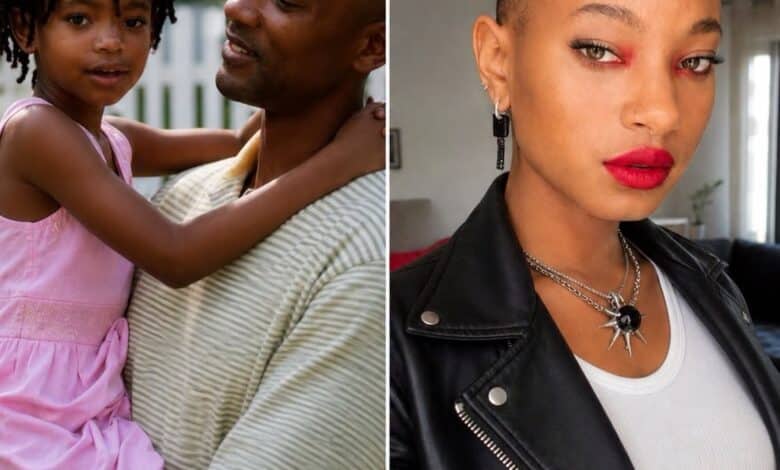
It didn’t need to state clearly what Willow Smith had supposedly revealed. It only needed a few carefully chosen words—confession, finally admits, Will Smith’s child, truth revealed—arranged beside a recognizable photograph.
Then your imagination could do the rest.
Within seconds, uncertainty became implication.
Implication became assumption.
Assumption became something people repeated as fact.
And suddenly Willow Smith was at the center of a deeply personal revelation she had never actually made.
That is what makes this kind of misinformation so effective.
The strongest version does not always tell an enormous, easily disproved lie.
Sometimes it leaves an empty space and encourages the audience to fill it.
A vague headline might technically avoid making the most explosive claim directly. But its wording, photograph, punctuation, and surrounding commentary push readers toward one conclusion.
People click because they want confirmation.
By the time they discover the article contains little evidence—or never open it at all—the emotional transaction has already happened.
Shock.
Curiosity.
Outrage.
Sympathy.
Whatever feeling generates the next click.
Willow Smith is particularly useful to this machinery because she is not a stranger to public conversations about identity, relationships, mental health, creativity, and growing up under extraordinary scrutiny.
She has spoken openly about personal subjects.
Her family has too.
For years, Red Table Talk, hosted by Jada Pinkett Smith, Willow Smith, and Adrienne Banfield-Norris, became known for unusually candid conversations involving family relationships, emotional struggles, sexuality, marriage, and other topics celebrities often avoid discussing publicly.
That history creates familiarity.
And familiarity can be exploited.
A fabricated revelation involving an intensely private subject may feel believable not because evidence supports it, but because the audience thinks:
That sounds like something Willow might talk about.
Notice what happened there.
Possibility quietly replaced proof.
That is one of the most dangerous shortcuts in online information.
Something sounds plausible.
Therefore, perhaps it happened.
Someone has discussed personal subjects before.
Therefore, any new personal claim about them feels possible.
Their family has been unusually public.
Therefore, privacy begins to seem optional.
But openness is not blanket consent.
A person can discuss one intimate subject publicly without giving strangers permission to invent another.
Willow’s previous statements belong to Willow.
They do not provide an empty template onto which the internet can write whatever confession would generate the most engagement.
The same principle applies to every public figure.
Familiarity is not ownership.
Knowing someone’s interviews does not mean knowing their private life.
Following someone for years does not transform speculation into evidence.
And feeling emotionally connected to a celebrity does not give an audience the right to author that person’s identity for them.
That distinction becomes especially important when rumors involve intimate characteristics—gender identity, sexuality, medical information, relationships, pregnancy, trauma, or other deeply personal matters.
Those are not harmless fictional details.
Attach one to a real living person and repetition can turn invention into public memory.
The process can happen frighteningly quickly.
One account posts a provocative headline.
Another reposts a screenshot.
Someone makes a short video summarizing the supposed revelation without checking the original source.
An AI-generated voice narrates it over unrelated photographs.
A commenter writes, “I knew it.”
Someone else asks, “Why is nobody talking about this?”
Soon people are no longer discussing whether the claim happened.
They are debating what it means.
That transition is crucial.
Once an audience begins arguing about the consequences of an event, the event itself starts feeling established.
Evidence has been skipped.
The rumor has advanced directly to interpretation.
And corrections are at a disadvantage.
“Willow Smith makes shocking confession” is emotionally irresistible.
“There is no reliable evidence that Willow Smith made the alleged statement” is responsible but considerably less exciting.
The first creates a question.
The second closes it.
Digital platforms reward questions people cannot resist opening.
That does not mean every platform or every person sharing a rumor is deliberately malicious.
Many people genuinely believe what they repost.
That is part of the problem.
Misinformation does not require millions of liars.
It requires enough people who are willing to repeat something before verifying it.
We often imagine ourselves as skeptical consumers of information.
Then a story appears that perfectly fits something we already believe.
A celebrity we dislike behaves badly.
A celebrity we admire reveals something inspiring.
A politician confirms our worst suspicions.
A famous family produces another scandal.
Suddenly our standards loosen.
The story feels right.
But truth does not become more truthful because it matches our expectations.
A useful test is painfully simple:
Where did the person actually say it?
Not:
Who posted about it?
Not:
How many accounts repeated it?
Not:
Does the headline have quotation marks?
Where is the original statement?
Was it an interview?
A verified post?
A broadcast?
A podcast?
A published memoir?
Is there video containing the actual words?
Have reputable outlets independently reported the statement while linking it to a traceable source?
Reality usually leaves tracks.
A major personal disclosure from someone as famous as Willow Smith would not normally exist only as a vague headline floating through low-quality websites and recycled social posts.
And photographs prove much less than people think.
A genuine image can accompany a false story.
A photograph of Willow at a legitimate event does not verify the caption placed beneath it years later.
A screenshot can be cropped.
Dates can disappear.
Old interviews can be repackaged as breaking news.
Quotes can lose the sentences that originally surrounded them.
And increasingly, synthetic images, cloned voices, and AI-generated video make visual familiarity an even weaker substitute for verification.
The lesson isn’t to distrust everything.
Permanent suspicion is not media literacy.
The goal is proportion.
Extraordinary or intensely personal claims deserve stronger evidence than ordinary ones.
If someone supposedly announced something life-changing, find the announcement.
If a headline seems deliberately coy about what happened, become more cautious, not more curious.
If the article repeatedly promises a revelation without showing where it occurred, notice that.
And perhaps most importantly, ask yourself whether you would demand more evidence if the claim involved someone you liked.
Our biases are often easiest to see when the target changes.
There is also a human cost beneath all this.
Willow Smith is famous.
That does not make her fictional.
Neither does being Will Smith and Jada Pinkett Smith’s daughter.
A person raised in public can become so familiar to audiences that people forget there is still a boundary between public biography and private selfhood.
The Smith family has chosen to share unusually personal parts of its life.
People are free to respond to what family members actually say.
They can agree.
Disagree.
Criticize.
Question.
Discuss.
But criticism of real statements is fundamentally different from manufacturing new ones.
The distinction should be obvious.
Online, it increasingly isn’t.
Perhaps the most revealing thing about a fabricated Willow Smith “confession,” then, isn’t whatever the headline wants us to believe about Willow.
It is what the headline reveals about us.
How quickly did we click?
How quickly did we decide?
Did we look for the original source?
Did we share before checking?
Did the possibility of witnessing something intimate make us less careful with another person’s dignity?
There is nothing wrong with curiosity.
Curiosity is how we learn.
But curiosity without restraint can become entitlement.
And in an information economy where attention is money, somebody is always willing to monetize that entitlement.
The defense is almost embarrassingly ordinary.
Slow down.
Open the article.
Check the date.
Find the source.
Look for the actual statement.
Distinguish what someone said from what a headline implies they said.
And when the evidence isn’t there, allow the story to remain unshared.
Sometimes the most responsible thing we can say about a celebrity’s supposed confession is also the least exciting:
It didn’t happen.
Willow Smith does not owe the internet a revelation merely because a headline promised one.
And we do not have to turn a real person into a fictional character simply because somebody discovered that our curiosity was profitable.