Woman reunites with her emotional support dog who was missing for 2 years: “Not a dry eye in the room”

The call came from a number Samantha didn’t recognize.
She almost ignored it.
Two years had passed since Loki disappeared, and somewhere during those two years, she had trained herself not to believe that unexpected phone calls carried miracles.
But she answered.
“Is this Samantha?”
“Yes.”
There was a pause.
Then a sentence she had imagined so many times that hearing it spoken by a real person didn’t immediately make sense.
“We think we found your dog.”
Samantha stopped breathing.
Not metaphorically.
For several seconds, she simply stood there with the phone pressed against her ear, unable to pull enough air into her lungs to answer.
“What?”
The shelter worker repeated it.
A stray dog had been brought in.
They had scanned him for a microchip.
A number appeared.
That number led to an old registration.
That registration led to Samantha.
And suddenly, after two years of silence, Loki existed again.
Not in a photograph.
Not in a dream.
Not in another desperate late-night search through lost-pet pages.
Alive.
Waiting.
Two years earlier, losing him had happened with terrifying simplicity.
Samantha had left Loki with a friend.
She trusted the arrangement.
There was no dramatic warning, no sense that she was about to enter one of the worst periods of her life.
Then Loki slipped away.
A gate.
A door.
A moment of distraction.
That was all it took.
By the time Samantha learned what had happened, he was gone.
At first, panic felt useful.
Panic created action.
She searched streets.
Called shelters.
Posted photographs.
Contacted people.
Checked neighborhoods.
Asked strangers whether they had seen him.
Every dog in the distance became a possibility.
Every notification made her heart jump.
Every phone call from an unknown number became:
Maybe.
The first nights were the worst.
She imagined Loki frightened and wandering.
Hungry.
Cold.
Trying to find his way back.
She pictured him hearing her voice somewhere in his memory and not understanding why she wasn’t coming.
That thought destroyed her.
Because Loki wasn’t simply a dog she happened to own.
He had become part of the structure of her life.
When everything else felt unstable, Loki was predictable.
He didn’t need explanations.
He didn’t ask her to justify why she was having a difficult day.
He didn’t become uncomfortable when she went quiet.
He simply came closer.
On nights when Samantha felt overwhelmed, Loki would curl against her chest.
His warmth.
His breathing.
The weight of his body.
Small things, perhaps, to anyone watching from the outside.
To Samantha, they mattered.
Animals sometimes become anchors without anyone formally deciding they will.
You feed them.
Walk them.
Clean up after them.
Complain when they steal your spot.
Then one day you realize your entire routine has quietly grown around another heartbeat.
Morning means paws on the floor.
Coming home means someone waiting.
Going to bed means making room.
Bad days end with fur beneath your hand.
Then suddenly the house is silent.
After Loki disappeared, Samantha kept expecting to hear him.
A sound in another room.
A movement near the door.
For half a second, her brain would restore the old world.
Then reality returned.
He’s gone.
She searched anyway.
Days became weeks.
She checked shelters repeatedly.
She scrolled through photographs of found dogs until every similar face made her pulse race.
Wrong markings.
Wrong age.
Wrong dog.
Again.
Again.
Again.
People sent her posts.
“Could this be Loki?”
She would open them immediately.
For one glorious second, hope would return.
Then collapse.
No.
Not him.
At first, people asked constantly.
“Any news?”
Then less often.
Eventually almost nobody asked.
Not because they stopped caring.
Life simply continued.
That’s one of the loneliest parts of losing an animal without knowing what happened.
There is no clear ending.
If a pet dies, grief is devastating, but reality has an edge.
You know.
When a pet disappears, hope and grief occupy the same room.
You don’t know whether to mourn.
You don’t know whether to keep searching.
You don’t know whether moving forward feels like betrayal.
Months passed.
Samantha continued checking.
But hope changed.
It stopped being the bright certainty that Loki would come home tomorrow.
It became quieter.
More defensive.
Something she carried privately because saying it aloud began sounding impossible.
Maybe somebody found him.
Maybe they kept him.
Maybe he was safe.
Maybe he was loved.
Maybe one day someone would scan his chip.
That last possibility remained.
A microchip is almost absurdly small compared with what people ask it to do.
It doesn’t track a dog like GPS.
It doesn’t send the owner a map.
It simply waits.
Silent beneath the skin.
A number.
A connection.
A tiny piece of information capable of saying:
This animal belongs to someone.
For two years, that information traveled wherever Loki traveled.
Samantha had no idea.
Nobody could tell her where he slept.
Who fed him.
Whether someone called him another name.
Whether he spent months with a family.
Whether he wandered from place to place.
Whether he ever searched familiar faces for hers.
There were no photographs explaining the missing chapter.
Only absence.
Then, two years later, someone did exactly what every lost-pet owner hopes someone will do.
They scanned him.
The machine detected the chip.
The number connected to the database.
And Samantha’s name appeared.
Imagine reducing two years of grief to that moment.
A scanner passes over a dog’s body.
A beep.
A number.
A phone call.
Suddenly the impossible becomes logistical.
“How soon can you get here?”
Samantha didn’t need time to think.
On the journey to the shelter, hope became frightening again.
What if there had been a mistake?
What if the chip information was wrong?
What if Loki didn’t recognize her?
Two years is a long time.
Dogs change.
People change.
Maybe he had another family now.
Maybe she had spent years imagining a reunion that would mean more to her than it did to him.
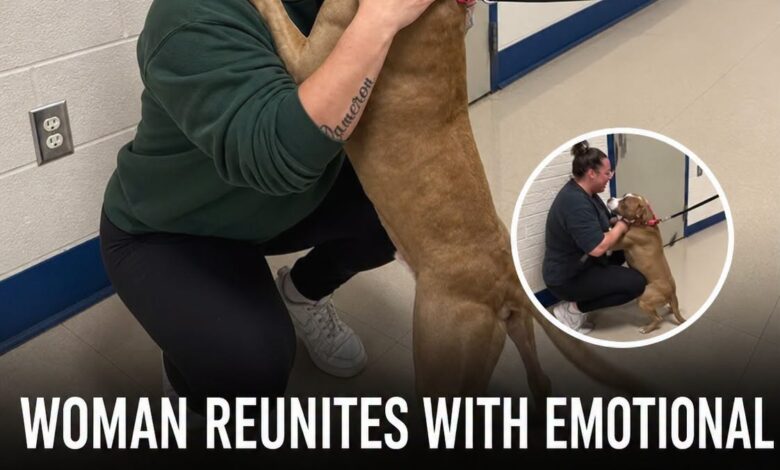
Then she saw him.
There are reunions that begin cautiously.
This wasn’t one of them.
Recognition seemed to travel through Loki’s entire body.
He moved toward her with an urgency that made the missing years disappear.
He jumped.
Trembled.
Pressed himself against her.
Samantha dropped down to him.
Hands everywhere.
Fur.
Ears.
Face.
Checking him as though touch could prove what her eyes couldn’t quite believe.
“Loki.”
His name came out through tears.
“Loki.”
Again.
As if saying it enough times could stitch the last two years closed.
He couldn’t explain where he’d been.
He couldn’t tell her who had cared for him.
He couldn’t describe how many doors he’d slept behind or how many people had touched his head.
But his condition offered one comfort.
Somewhere along the way, someone appeared to have cared for him.
That mattered.
Because among all the terrible possibilities Samantha had imagined, there had also been one hopeful possibility:
Maybe Loki wasn’t suffering.
Maybe someone thought he was theirs.
Maybe while Samantha was grieving him, another person was feeding him dinner and calling him inside at night.
That possibility couldn’t return the missing time.
But it softened it.
Then came the strangest part.
Going home.
The same ordinary act Samantha had once performed countless times with Loki suddenly felt ceremonial.
He was in the car again.
Alive.
Close enough to touch.
She could glance over and see him.
For two years, she’d lived with memories.
Now the memory was breathing beside her.
Home had changed during his absence.
So had Samantha.
Two years cannot simply be removed from a life.
There were experiences Loki hadn’t witnessed.
Nights when she had needed him and he wasn’t there.
Days when she had forced herself forward.
Moments when she had begun accepting that she might never know what happened.
Now he was back.
Not as a replacement for those lost years.
As a continuation.
That distinction matters.
Happy endings don’t erase what came before them.
Finding Loki didn’t retroactively make the searching painless.
It didn’t return every night Samantha had spent wondering.
It didn’t restore the birthdays, seasons, walks, or quiet evenings they had missed.
But it gave all that uncertainty an ending.
Alive.
That word was enough.
The reunion also carried a lesson hidden beneath the emotion.
Microchips matter.
But a microchip is only as useful as the information connected to it.
Phone numbers change.
People move.
Email addresses disappear.
Years pass.
Owners forget that the registration they completed long ago still contains an old address.
So when a pet is microchipped, registration and updated contact information are crucial.
The chip itself is only the bridge.
Someone still needs to be reachable on the other side.
Collars and identification tags matter too.
A visible tag can help someone return a lost pet without even needing a shelter visit.
Microchips provide another layer of identification when collars are lost or removed.
Neither requires believing your pet will run away.
Most people who lose pets probably never expected it to happen.
That’s the point.
Doors are left open.
Gates fail.
Fireworks frighten animals.
Leashes slip.
Visitors make mistakes.
Accidents require only seconds.
Preparation exists for the seconds nobody planned.
Loki became proof of that.
For two years, the chip did nothing dramatic.
It didn’t rescue him.
It didn’t call Samantha.
It simply stayed with him.
Waiting for the right person to ask the right question:
“Does this dog belong to someone?”
The answer had been there all along.
Yes.
He belongs to Samantha.
After Loki returned, people naturally wanted to know where he had been.
That question may never have a complete answer.
Perhaps someone will eventually recognize him.
Perhaps pieces of the story will emerge.
Perhaps they won’t.
But animals live differently from humans.
Samantha carried the missing years as a story.
Loki carried whatever happened as experience.
And once he was home, he did what dogs do remarkably well.
He inhabited the present.
Food.
Familiar smells.
A comfortable place to sleep.
A voice he remembered.
A person he loved.
Maybe that was the final thing Samantha needed to learn from him.
She had spent two years trapped between yesterday and possibility.
Loki came home and seemed interested primarily in now.
There was no accusation.
No explanation required.
No accounting of who had failed whom.
Just recognition.
You’re here.
I’m here.
Let’s go home.
Eventually, perhaps, he curled against her again.
Maybe not exactly as before.
Both of them were older.
Both carried years the other hadn’t witnessed.
But the familiar weight returned.
His breathing.
His warmth.
That quiet pressure against her body.
The thing Samantha had once believed was gone forever.
There are moments when an animal’s presence becomes almost embarrassingly meaningful.
To someone else, it is simply a dog sleeping.
To the person who loves that dog, it can feel like the universe has corrected something.
For Samantha, Loki’s return could not fix every difficult part of her life.
He was never supposed to.
Pets aren’t medicine.
They aren’t therapists.
They cannot solve every human problem.
But companionship can still be profoundly stabilizing.
Routine can matter.
Touch can matter.
Being greeted can matter.
Having another living creature trust that you will wake up tomorrow and feed him breakfast can matter.
Loki had once been part of that rhythm.
Then he vanished.
Now he was back.
The miracle wasn’t that everything suddenly became perfect.
It was much smaller.
And therefore much bigger.
The leash was needed again.
Food had to be bought.
Walks had to be taken.
Dog hair would appear where it wasn’t wanted.
The ordinary inconveniences returned.
What beautiful inconveniences they must have been.
For two years, Samantha would have given almost anything to complain about them.
Now she could.
That is what reunion really gives people.
Not simply the dramatic embrace everyone photographs.
It gives back the mundane future.
Tomorrow morning.
Next week’s walk.
Another winter.
Another nap on the couch.
Another chance to say the name you had almost trained yourself not to call.
Loki.
A tiny microchip carried that name through two missing years.
A shelter worker took the time to scan.
A database still held a connection.
A phone rang.
Samantha answered.
And suddenly a story that had spent two years refusing to end finally knew where it was going.
Home.
Perhaps there will always be questions.
Where was he?
Who cared for him?
Did he remember Samantha during those years?
Did he ever try to find her?
Nobody can ask Loki for the missing pages.
Maybe they don’t need them.
The ending says enough.
He survived.
Someone helped him survive.
His identification survived with him.
And when Samantha appeared, something inside him apparently knew exactly who she was.
Two years had passed.
The world had moved forward.
But recognition remained.
That may be the most extraordinary part.
Love did not preserve time.
It preserved familiarity.
A voice.
A scent.
A touch.
A person.
Samantha thought she had lost Loki.
In reality, somewhere beyond her sight, the connection between them was still traveling.
Quietly.
Patiently.
Carried beneath his skin in a chip no bigger than a grain of rice and, perhaps, somewhere deeper in the memory of a dog who had not forgotten where home felt like.
When Loki pressed himself against her again, Samantha didn’t get those two years back.
She got something better than an explanation.
She got the chance to begin the next ones.
Together.