Wrinkled Fingers After Water Exposure: The Shocking Biological Truth Behind Your Skin’s Creepy Reaction

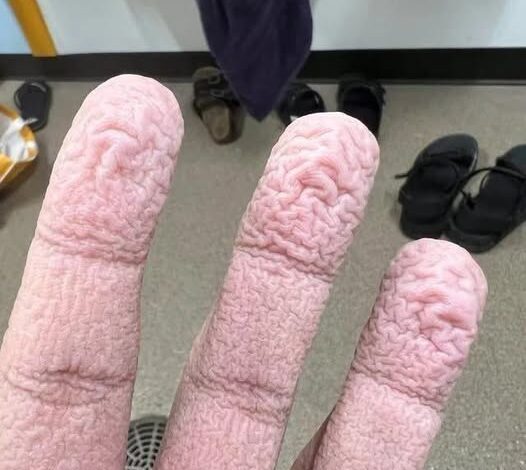
It happens so often that most people never stop to question it. You step out of the shower, glance at your hands, and notice the familiar pattern of pale, wrinkled fingertips staring back at you. For generations, people believed this was simply skin swelling after soaking up water. The explanation seemed logical—until scientists discovered something far more remarkable.
Those tiny ridges aren’t the result of your skin becoming waterlogged. They’re the product of an intricate response orchestrated by your nervous system.
The moment your hands or feet remain submerged for several minutes, your body begins making microscopic adjustments beneath the surface. Blood vessels in your fingertips gradually tighten, reducing the volume beneath the skin. As the tissue underneath shrinks, the outer layer folds into the distinctive network of wrinkles everyone recognizes.
It’s an astonishingly precise biological process—one that your body activates automatically without a single conscious thought.
But why would evolution preserve such an odd feature?
Researchers believe the answer lies in survival.
Long before paved roads, rubber soles, and modern tools, our ancestors constantly navigated wet environments. Rain soaked the forests they crossed. Riverbanks became slick with mud. Moss-covered rocks, damp tree branches, and slippery plants created hazards that could mean the difference between securing food and falling empty-handed.
In those conditions, grip mattered.
Experiments have shown that wrinkled fingers perform much like the tread on a car tire. The grooves channel water away from the surface, increasing friction between your skin and wet objects. Whether grasping smooth stones, climbing over damp terrain, or collecting food after a storm, those tiny folds likely provided a meaningful advantage.
The improvement isn’t dramatic enough to notice during everyday life, but over thousands of generations, even small survival advantages can shape human biology.
Once your hands dry, the process quietly reverses itself.
Blood vessels relax.
Normal circulation returns.
The wrinkles gradually disappear as your fingertips regain their usual smooth appearance, leaving almost no evidence that anything unusual ever happened. It’s a seamless cycle your body has repeated countless times throughout your life.
For most people, that’s the end of the story.
However, there are occasions when those wrinkles become more than an interesting biological curiosity.
Sometimes they arrive unusually fast.
Sometimes they linger long after your skin is dry.
And sometimes they’re accompanied by symptoms that deserve closer attention.
If your fingers wrinkle almost immediately after touching water, remain pruned for an unusually long time, or are accompanied by pain, burning sensations, itching, swelling, or noticeable color changes, your body may be signaling that something else is happening beneath the surface.
One condition linked to unusually rapid or excessive wrinkling is cystic fibrosis. People with cystic fibrosis—and in some cases individuals who carry a single altered CFTR gene—can develop dramatic wrinkling after only brief exposure to water. Doctors sometimes refer to this as aquagenic wrinkling, and although it isn’t enough to diagnose the condition on its own, it can serve as an important clue during medical evaluation.
Certain medications may also play a role.
Some prescription drugs alter the balance of salt and water in the skin or affect the way nerves regulate blood vessels, making wrinkling appear more quickly or more intensely than expected. If this change develops after starting a new medication, it’s worth discussing with your healthcare provider rather than simply assuming it’s harmless.
Nerve health can influence the process as well.
Because fingertip wrinkling depends on proper communication between your nervous system and your blood vessels, damage to those nerves may change the response entirely. Conditions affecting the autonomic nervous system—the network responsible for regulating involuntary body functions—can sometimes reduce wrinkling or prevent it from occurring altogether.
Surprisingly, the absence of wrinkles after prolonged soaking may be just as meaningful as excessive wrinkling in certain medical situations. While most people never notice whether their fingers wrinkle “normally,” physicians occasionally use this response as one small piece of a broader neurological assessment.
Your skin itself also plays a role.
Frequent handwashing, harsh soaps, cleaning chemicals, and prolonged exposure to water can weaken the skin’s protective barrier. When that barrier becomes damaged, irritation, dryness, cracking, and unusual wrinkling may become more noticeable. In these cases, the issue isn’t necessarily your nerves but your skin’s reduced ability to retain moisture and protect itself.
Fortunately, protecting your hands is often simple.
Applying a quality moisturizer after washing helps restore the skin barrier. Wearing protective gloves while cleaning or handling irritating chemicals reduces repeated damage. Choosing gentler soaps and avoiding unnecessarily prolonged exposure to water can also help keep your skin healthy and resilient.
These small habits don’t just improve comfort—they support one of your body’s first lines of defense against the outside world.
Most importantly, pay attention to changes that persist.
If wrinkling suddenly becomes unusually severe, appears almost instantly with water exposure, refuses to disappear, or is accompanied by numbness, burning, discoloration, swelling, or persistent discomfort, it’s worth seeking medical advice. While these symptoms often have straightforward explanations, they occasionally point to underlying conditions that benefit from early evaluation.
Our bodies communicate constantly, but not always with pain or obvious illness. Sometimes they rely on subtle changes that seem too ordinary to matter.
Wrinkled fingertips are usually one of the most fascinating examples of the body’s quiet intelligence—a sophisticated adaptation refined over countless generations to help humans interact more safely with a wet world. Yet under the right circumstances, those same wrinkles can become an early signal that something deeper deserves attention.
So the next time you step out of the bath or shower and notice those familiar ridges across your fingertips, remember that you’re witnessing more than a simple reaction to water. You’re seeing your nervous system, your circulation, and millions of years of human evolution working together in perfect coordination. And if that pattern ever changes in a way that feels unusual, don’t ignore it. Sometimes the smallest details are the first clues your body offers that it’s asking you to listen.