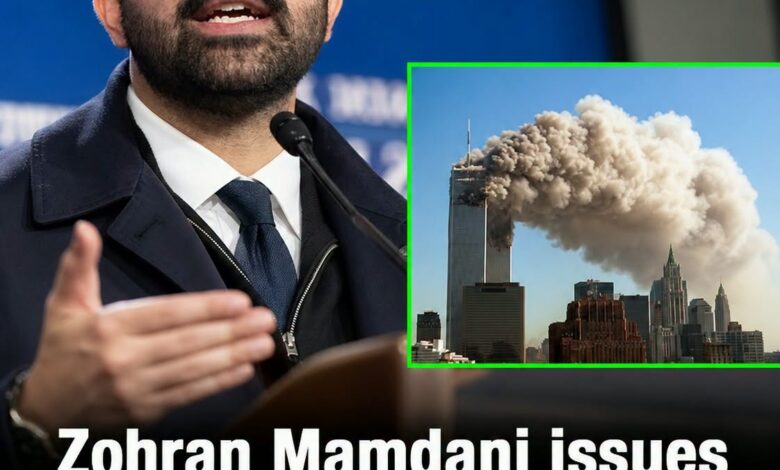
Zohran Mamdani issues bombshell claim to New Yorkers after release of thousands of 9/11 records

For twenty-five years, thousands of people who breathed the air around Ground Zero have lived with a question that never belonged in the past.
What did the government know?
On September 8, 2026, New York City opened a door that survivors, first responders, residents, advocates and families had spent years trying to force open.
Mayor Zohran Mamdani’s administration released more than 170,000 pages of previously unavailable city records concerning air quality, contamination, health risks and the government’s response after the September 11 attacks.
It was only the first release.
More records are expected over the coming year.
The scale is almost impossible to absorb.
Reports.
Emails.
Testing records.
Internal correspondence.
Environmental measurements.
Documents discussing asbestos.
Documents discussing potential liability.
Boxes of records that had remained inaccessible even as people who worked, lived and went to school in Lower Manhattan became sick.
For most New Yorkers, 170,000 pages sounds like an archive.
For some families, it sounds more like a missing medical history.
Because September 11 did not end when the fires stopped appearing on television.
The towers collapsed into an extraordinary mixture of pulverized building materials, glass, metals, combustion products and other contaminants. First responders worked in that environment. Construction workers entered it. Residents returned downtown. Office workers came back. Children returned to schools.
And people wanted desperately to believe that returning meant safety.
Government officials faced an almost unimaginable crisis. Lower Manhattan had to be searched, secured, cleaned and eventually reopened. Families were looking for missing loved ones. The city was wounded economically and psychologically.
Officials were trying to keep New York functioning.
That context matters.
But so does another fact:
Reassurance carries consequences when people use it to decide whether they can safely breathe.
The newly released records add detail to long-running questions about what city officials knew regarding contamination and health risks, when they knew it, and how those concerns were communicated publicly.
Among the material are records concerning asbestos and other hazardous substances, as well as the frequently discussed Harding Memo, an internal document addressing environmental conditions and potential legal exposure.
Some records indicate that asbestos contamination persisted in areas around the World Trade Center site well after the attacks.
The documents do not reduce twenty-five years of decisions across multiple city and federal agencies into one simple sentence.
They deserve careful examination.
But they make one thing impossible to dismiss:
Serious concerns existed inside government while members of the public were trying to determine whether returning downtown was safe.
At City Hall, Mamdani put the issue in stark terms.
He accused previous leaders of having told New Yorkers they were safe when they were breathing toxic air, arguing that people became sick because officials they trusted had misled them.
It was a powerful accusation.
It should also be examined with the same rigor being demanded of the historical record.
Asked who specifically he believed had lied and exactly what those lies were, Mamdani did not identify a single individual answer that resolved the question.
That distinction matters.
Accountability is strongest when it is specific.
The aftermath of September 11 involved overlapping city, state and federal responsibilities. Public reassurances about air quality came from multiple levels of government, including the Environmental Protection Agency. Decisions changed over time. Knowledge evolved. Different agencies possessed different information.
The documents can help determine who knew what.
They should not become permission to decide the answer before reading them.
That is precisely why their release matters.
The archive allows evidence to replace assumption.
For survivors and advocates, however, this isn’t merely an argument about historical administration.
Bodies carried the consequences.
Respiratory illnesses emerged.
Cancers appeared.
People who had rushed toward the disaster spent subsequent years navigating hospitals, compensation systems and government programs.
Families buried people whose names were never included among those killed on September 11 itself but whose illnesses were associated with exposure to the toxic aftermath.
For them, a memo from 2001 is not just a memo.
A measurement isn’t simply a number.
An internal discussion about asbestos or liability may sit beside memories of a cough that wouldn’t disappear, a diagnosis delivered years later or a spouse wondering whether returning downtown had been safe.
That is what makes the new public portal more than an exercise in transparency.
It gives ordinary people access to records that previously required prolonged legal fights to obtain.
The release followed years of pressure and litigation involving 9/11 Health Watch and advocates who argued that these materials belonged in public view.
The Mamdani administration settled two lawsuits connected to access to the records and committed substantial city funding to building and maintaining the portal.
The administration also says the initial release is only the beginning.
That point is important.
September 8 was not the day the entire truth became known.
It was the day considerably more evidence became available.
Those are not the same thing.
Journalists will examine it.
Researchers will examine it.
Lawyers will examine it.
Health advocates will search names, buildings, dates and contaminants.
Families may search for documents connected to places where their loved ones worked.
Some records may prove enormously significant.
Others may add context without changing what is already understood.
Some may raise new questions.
And documents that appear damning in isolation may require surrounding correspondence or technical interpretation before their meaning is clear.
Transparency does not eliminate the need for careful reading.
It makes careful reading possible.
That may be the most meaningful form of accountability available twenty-five years later.
The past cannot be repaired by releasing a PDF.
No archive can restore someone’s lungs.
No newly discovered memo can return a parent to a child.
No public portal can give a responder back the years spent undergoing treatment.
But records can establish timelines.
They can reveal decisions.
They can help people document exposure.
They can assist those seeking access to health and compensation programs.
And they can teach future governments something that should never require another catastrophe to learn:
In a crisis, reassurance is not harmless.
People make decisions based on it.
They return home.
They reopen businesses.
They send children back to school.
They remove masks.
They breathe.
That is why uncertainty must be communicated honestly, especially when leaders are under immense pressure to project stability.
There is no shame in saying, “We don’t know yet.”
There can be terrible consequences in pretending certainty exists when it doesn’t.
Twenty-five years after the towers fell, New York is still living with two histories of September 11.
One is the history everyone saw.
The impact.
The collapse.
The smoke.
The missing posters.
The funerals.
The names read aloud each anniversary.
The other unfolded slowly.
Doctor’s appointments.
Respiratory problems.
Cancer diagnoses.
Compensation claims.
Families fighting to prove where someone worked or what they had been exposed to.
People asking whether someone, somewhere, had known more than they were told.
The release of these records does not finish that second history.
It finally gives the public more of the documents needed to examine it.
On the twenty-fifth anniversary, remembrance remains essential.
So does restraint.
So does evidence.
And so does accountability.
“Never forget” cannot mean remembering only what happened on the morning of September 11.
It must also mean remembering what happened to the people who survived it.
The firefighters.
The police officers.
The construction workers.
The cleanup crews.
The office workers.
The residents.
The students.
The families who watched illnesses arrive years after the cameras had gone.
Their questions were never footnotes to September 11.
They were part of the story.
Now, after twenty-five years, more of the record finally belongs to them.