At First, I Thought the 7-Year-Old Was Just Afraid of the Dentist — Then I Noticed Something Strange About the Clicking Sound in Her Teeth


The pediatric dental clinic had always carried a strange contradiction within its walls. To adults, it looked cheerful almost to the point of absurdity — bright murals painted with smiling cartoon animals, jars of colorful toothbrushes lining the counters, tiny treasure chests filled with stickers and plastic rings waiting beside the receptionist’s desk. But to children, especially frightened children, the place often felt completely different.
The fluorescent lights hummed softly overhead.
Metal instruments clicked against trays.
The faint scent of disinfectant lingered beneath bubblegum-flavored fluoride and mint polish.
For many children, those details blurred into a single overwhelming experience:
uncertainty.
After more than fifteen years working in pediatric dentistry, I had learned that fear rarely announces itself directly in children. Adults expect children to say things plainly:
“I’m scared.”
“I don’t want to be here.”
“I’m nervous.”
But children often communicate distress sideways.
Some become loud and hyperactive, talking endlessly because silence makes them anxious. Others cry before anyone even touches an instrument. Some refuse eye contact entirely, while others cling to parents so tightly their small hands shake visibly against fabric sleeves.
And then there are children like Maya.
The quiet ones.
The children whose silence feels too controlled to belong to ordinary nervousness.
Maya arrived on a rainy Thursday afternoon during one of the slower clinic hours. Outside, cold rain streaked down the windows in soft uneven lines while traffic hissed along wet streets beyond the parking lot. The waiting room television played an animated movie quietly in the background, though hardly anyone was watching it.
The appointment itself seemed routine on paper:
new patient,
routine dental evaluation,
recent relocation,
guardian accompanying child.
Nothing initially appeared alarming.
The man who arrived with Maya carried himself with practiced calm. He smiled politely at the receptionist, answered intake questions quickly, and volunteered details before staff even finished asking. He explained that Maya had been shy since the move. That she disliked medical environments. That she had always struggled with strangers.
His tone was smooth.
Prepared.
At the time, nothing he said directly contradicted concern.
Yet Maya herself drew my attention almost immediately.
She stood half-hidden behind him while he handled paperwork, her oversized gray coat hanging nearly to her knees despite the heated building. Her sleeves extended far past her hands so completely that only the tips of her fingers occasionally appeared before retreating again into fabric.
Most children in the waiting room eventually drift toward the toys or books scattered around the clinic. Even nervous children usually glance curiously at the colorful murals painted across the walls or the fish tank bubbling near the receptionist’s desk.
Maya did none of that.
She remained perfectly still.
Not frozen exactly.
Controlled.
That difference mattered.
Her eyes moved constantly, quietly tracking the room without drawing attention to themselves. Every time another patient laughed too loudly or a dental tool buzzed somewhere deeper in the clinic, her shoulders tightened almost imperceptibly beneath the coat.
Fear has textures in pediatric medicine.
And hers felt old.
When I introduced myself, kneeling slightly to soften the interaction, she looked up only briefly before lowering her eyes again. “Hi, Maya,” I said gently. “I’m Dr. Reynolds. We’re just going to count your teeth today and make sure everything looks healthy.”
She didn’t answer verbally.
The man beside her smiled apologetically. “She gets nervous around new people.”
Maya nodded immediately after he spoke, almost reflexively.
That detail lodged somewhere quietly in my mind.
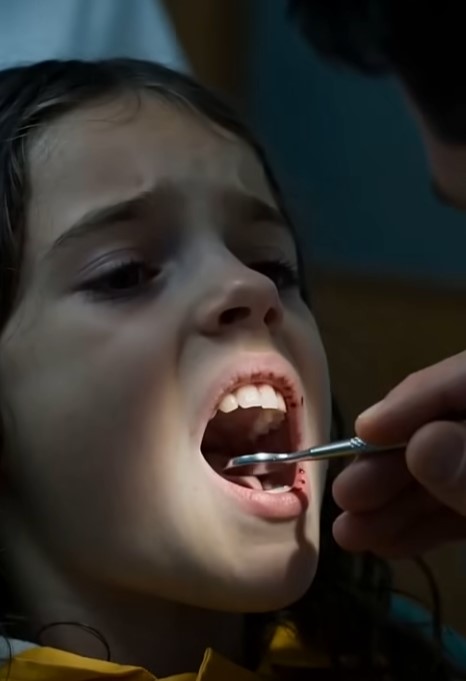
Inside the examination room, the atmosphere remained calm. Pediatric dental staff are trained carefully to reduce unpredictability because predictability creates emotional safety for children. I explained every instrument before using it. I let her hear the suction tool before bringing it near her mouth. I described each step slowly.
She complied with everything perfectly.
Too perfectly.
Some children wiggle.
Some resist.
Some ask endless questions.
Maya moved like someone who had learned long ago that cooperation prevented consequences.
Her breathing stayed shallow throughout the exam. Her hands remained hidden tightly inside her sleeves. And despite the room temperature, she never removed her coat.
At one point, while I examined her molars, I noticed a faint clicking sound.
Tap.
Tap-tap.
Pause.
Tap.
Initially I assumed her teeth were chattering from anxiety or cold. But the rhythm repeated again.
And again.
Structured.
Consistent.
Not random.
I slowed my movements slightly, listening more carefully while pretending to focus on charting notes. The tapping continued in uneven but intentional intervals against her teeth.
Something about it stirred an old memory from specialized pediatric training years earlier — discussions about nonverbal communication patterns sometimes used by severely withdrawn or traumatized children.
The realization unsettled me immediately, though I forced myself not to react outwardly.
Healthcare professionals are trained rigorously not to jump to conclusions, especially involving child welfare. Assumptions can damage trust, traumatize families, and create enormous consequences when wrong.
But we are also trained not to ignore instinct entirely when behavior falls outside ordinary developmental patterns.
Maya’s silence no longer felt like shyness.
It felt rehearsed.
I continued the exam calmly while documenting routine observations. Then, keeping my tone casual, I told the guardian I wanted additional imaging “just to double-check positioning on a few developing teeth.”
He agreed easily.
Too easily.
Once he stepped briefly with another staff member toward radiology intake, I quietly asked one of our senior nurses to observe Maya while I contacted the clinic’s pediatric safety coordinator.
Nothing dramatic happened next.
No accusations.
No confrontation.
Real pediatric safeguarding almost never looks cinematic.
It looks careful.
Measured conversations behind closed doors.
Quiet coordination.
Professionals asking themselves repeatedly whether concern is evidence-based or emotional.
The safety coordinator arrived within minutes and observed Maya discreetly through routine interaction. She noticed the same things:
the rigid posture,
the hypervigilance,
the coat,
the silence,
the tapping.
Meanwhile, Maya watched every adult movement in the clinic with exhausting attentiveness, as though constantly calculating whether situations remained emotionally safe.
Children living in chronic fear often develop that kind of environmental scanning. Their nervous systems stop expecting safety and instead become trained to anticipate danger continuously.
That awareness changes the body physically.
Muscles tighten.
Breathing shortens.
Sleep fragments.
Speech narrows.
Trust disappears.
Eventually, after consultation with pediatric social services attached to the hospital network, arrangements were made for further evaluation under established child welfare protocols. The transition was handled carefully to avoid frightening Maya further or escalating tension unnecessarily.
Through all of it, she remained silent.
But not disengaged.
Her eyes followed every interaction with desperate concentration.
At the pediatric care unit later that evening, the atmosphere changed entirely. Unlike the dental clinic’s bright artificial cheerfulness, the pediatric behavioral wing focused on softness and consistency. Lighting remained warm instead of harsh. Hallways stayed quiet. Staff moved slowly and spoke in lower tones.
Children recovering from emotional trauma often respond intensely to environmental predictability.
Chaos exhausts them.
Safety confuses them at first.
Maya received clean clothes, regular meals, medical evaluation, and eventually a private room overlooking a small hospital garden. Throughout those first days, she spoke almost not at all.
Yet she listened constantly.
The assigned child psychologist, Dr. Elena Park, understood immediately that forcing verbal disclosure too early would likely worsen withdrawal. Children who survive emotionally unsafe environments often associate direct questioning with punishment, disbelief, or danger.
So instead of interrogating Maya, the staff built routine.
Breakfast at the same time every morning.
Quiet check-ins.
Consistent caregivers.
Predictable schedules.
Healing, especially in children, often begins long before language returns.
Several days later, the pediatric comfort program introduced Artie, a certified therapy dog who regularly visited children recovering from surgery, grief, trauma, or prolonged hospitalization.
Artie was old enough to move slowly.
That mattered.
Some frightened children become overwhelmed by energetic animals, but Artie understood hospitals instinctively. He entered rooms gently, lay down quietly, and waited without demanding interaction.
When he first entered Maya’s room, she barely reacted outwardly. She sat curled near the window beneath a blanket, eyes distant and unreadable.
Artie simply rested several feet away.
No pressure.
No expectation.
Minutes passed quietly.
Then Maya looked at him.
Not the quick fearful glances she usually gave adults.
A real look.
Artie thumped his tail once against the floor without approaching.
That tiny sound seemed to break something open emotionally inside the room.
Slowly — painfully slowly — Maya extended one sleeve-covered hand toward him. Her movement carried the uncertainty of someone expecting kindness to disappear suddenly if trusted too quickly.
But Artie stayed exactly where he was.
Steady.
Patient.
Safe.
When her fingers finally touched his fur, her shoulders lowered for the first time since arriving at the hospital.
Only slightly.
But enough for everyone watching to notice.
Children often trust animals before humans because animals do not interrogate pain. They do not demand explanations or force eye contact or ask difficult questions before offering comfort.
Artie became part of Maya’s recovery rhythm afterward.
During reading sessions, he rested beside her bed.
During difficult evaluations, he stayed nearby quietly.
Sometimes she simply sat beside him in silence while absentmindedly running her fingers through his fur.
And gradually, tiny changes appeared.
She began making more eye contact.
Her breathing normalized.
She no longer startled visibly at ordinary hallway sounds.
Dr. Park introduced visual communication cards and simple tapping-response exercises to help Maya communicate without pressure. The tapping patterns expanded slowly into meaningful yes-or-no responses.
Trust developed in fragments.
That is how real healing usually happens.
Not dramatic breakthroughs.
Not movie speeches.
Fragments.
One extra sentence.
One longer glance.
One moment without flinching when someone walks past too quickly.
Art therapy became another doorway. Maya filled pages with forests, rivers, sunlight through trees, and animals resting peacefully beneath open skies.
No dark monsters.
No explicit trauma.
Just safety.
Children often draw not only what they remember, but what they long for.
Weeks passed.
The oversized coat eventually disappeared.
Then the hidden hands.
Then some of the silence.
One afternoon, I visited the hospital garden during my lunch break after hearing Maya had spent more time outside recently. She sat quietly on a bench beneath swaying trees while Artie rested beside her in the grass.
The rain had finally stopped after days of gray weather. Sunlight filtered softly through moving branches, warming the stone pathways.
Maya looked different.
Not transformed dramatically.
Just lighter somehow.
Less compressed inside herself.
We sat together quietly for several minutes without speaking. I had learned by then not to fill silence too quickly around her. Silence no longer felt empty. It felt careful.
Then she looked down at Artie, hesitated, and took a slow breath.
Her voice, when it came, sounded fragile from disuse.
“Hi, Artie,” she whispered softly.
Three simple syllables.
Yet every nurse, therapist, and pediatric specialist involved in her care understood immediately why the moment mattered so much.
Because speech itself was never the real milestone.
Safety was.
Those words meant she no longer felt entirely trapped inside vigilance.
No longer believed silence was the only protection available to her.
No longer expected every connection to become dangerous eventually.
Recovery in children is rarely loud.
It arrives quietly:
through routine,
through patience,
through noticing what others dismiss,
through adults choosing gentleness repeatedly until fear slowly loses its authority.
Maya’s story never became about one dramatic rescue moment.
It became about accumulation.
One observant provider listening carefully.
One hospital choosing caution over dismissal.
One therapy dog lying patiently beside a frightened child.
One small sentence spoken freely after weeks of silence.
And perhaps that is what pediatric caregivers eventually learn above all else:
children rarely heal because someone demands it from them.
They heal because, somewhere along the way, they finally begin believing they no longer have to survive every moment alone.