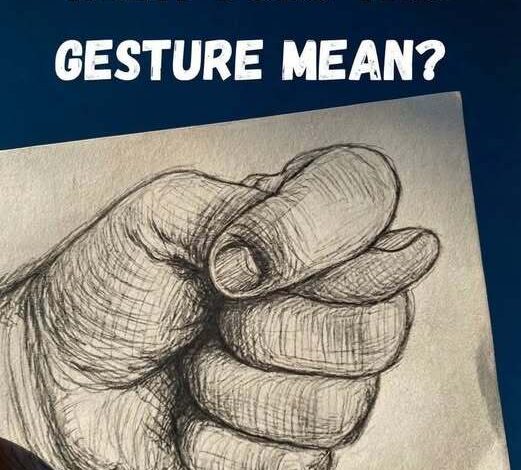
The human hand has always carried meanings far deeper than most people realize. Long before smartphones reduced emotion into tiny icons and abbreviated reactions, people relied on gestures to communicate defiance, affection, warning, humor, and protection without speaking a single word. Among the oldest and most misunderstood of these gestures is the tucked-thumb fist known across Europe and the Mediterranean as the fig gesture, or mano fica. At first glance, it appears strange, almost childish—a clenched fist with the thumb pressed tightly between the index and middle fingers. Yet hidden inside that small motion is a remarkable history of resistance, superstition, survival, and human resilience.
To understand why such a small hand movement carried so much power, it helps to imagine life in 19th-century Europe. Villages were tightly controlled social worlds where hierarchy governed nearly every interaction. Wealthy landowners, tax collectors, religious authorities, and local officials held enormous influence over ordinary people, many of whom had little legal or social protection. Speaking openly against authority could lead to punishment, humiliation, or exclusion from the community itself.
In such an environment, silence became both necessity and strategy.
People learned to communicate indirectly. Humor, body language, coded phrases, and symbolic gestures became tools for surviving systems where direct confrontation was dangerous. The fig gesture thrived in precisely this atmosphere. It functioned as a silent act of refusal—a subtle but unmistakable declaration of “absolutely not” delivered without spoken insult. A peasant facing an unreasonable demand from a landlord might flash the sign briefly out of sight. A merchant pressured unfairly during negotiations could respond with the gesture while maintaining outward politeness.
That subtlety was the key to its power.
Unlike open aggression, the fig allowed people to preserve plausible deniability. To outsiders unfamiliar with its meaning, it looked harmless or meaningless. To those who understood the cultural code, however, it carried a sharp edge of resistance. In many ways, it became the underdog’s language: a way for ordinary people to reclaim dignity without openly risking destruction.
Yet the gesture’s significance extended far beyond social defiance.
Across Italy, Greece, Slavic regions, and parts of the Mediterranean world, the tucked thumb also functioned as a protective charm against the evil eye—known in some cultures as malocchio. For centuries, many communities believed envy itself possessed spiritual power. A jealous glance, a curse, or malicious attention from another person could supposedly bring illness, misfortune, infertility, or bad luck upon a household.
The fig gesture was believed to interrupt or repel that dangerous energy.
Its symbolism varied depending on region and tradition. Some associated the shape with fertility and life-giving power. Others viewed the hidden thumb as representing something protected and concealed from harmful forces. Whatever the interpretation, the gesture became deeply woven into folk spirituality. Mothers taught children to hide their thumbs this way while passing strangers rumored to possess dark intentions. Travelers performed the gesture quietly while entering unfamiliar places. In moments of fear or uncertainty, the hand itself became a kind of shield.
What makes this especially fascinating is how seamlessly the gesture moved between different emotional worlds.
In one moment, it could express defiance.
In another, protection.
In another still, affection or humor.
As Europe moved into the 20th century, the fig gesture slowly softened inside domestic life. It migrated away from tense public conflict and became something more playful within families. Grandparents teased grandchildren with it. Parents used it jokingly during playful negotiations over candy, chores, or bedtime. Like “I’ve got your nose” or other childhood games, the gesture evolved into a thread connecting generations through nonverbal familiarity.
That transformation says something important about human culture.
Symbols rarely stay fixed forever. Over time, gestures absorb new emotional meanings depending on how communities continue using them. The fig lost some of its harsher edge and became associated with quiet stubbornness, teasing affection, and emotional resilience. Elders passed it down almost unconsciously, preserving fragments of ancient communication long after many people forgot its deeper origins.
Still, traces of its protective symbolism remained especially during moments of emotional intensity.
Historical accounts describe fathers using the gesture silently while sons departed for military service. Travelers carried it into dangerous journeys. During separations, crises, and uncertain transitions, the tucked thumb became a message without words:
Stay strong.
Protect yourself.
Hold firm.
There is something deeply moving about that idea.
In an era before instant communication, before text messages or video calls, people relied heavily on gestures capable of conveying layered emotional meaning instantly. One look at a familiar hand sign could communicate reassurance, warning, love, or solidarity across crowded train stations and noisy streets. The body itself functioned as language.
And perhaps that is what feels most distant today.
Modern communication increasingly prioritizes speed and explicitness. We now rely on direct text, emojis, reaction buttons, and algorithm-friendly shorthand. When we want to signal support, we send a heart. When we feel angry, we use an angry face. The complexity of physical gestures—the subtle choreography of eyes, posture, and hands—has slowly receded from daily life.
The fig gesture survives mostly as an obscure curiosity now, occasionally misunderstood or stripped entirely of historical context.
Yet its disappearance raises an important cultural question:
What do we lose when communication becomes less physical and less layered?
Ancient gestures required presence. They depended on shared cultural understanding and human attention. A tucked thumb meant nothing unless another person recognized its significance. That shared recognition created intimacy and community. The meaning existed not inside the hand alone, but inside collective memory.
Digital communication, for all its convenience, often lacks that texture.
A screen cannot fully replicate the emotional weight of a quiet glance paired with a subtle gesture understood across generations. The fig represented more than refusal or superstition. It embodied the human ability to communicate complexity silently:
humor mixed with resistance,
fear softened through ritual,
defiance wrapped in ambiguity.
In many ways, it reflected a more patient form of communication altogether.
And perhaps the gesture still carries relevance precisely because modern life often feels overwhelmingly loud and direct. Public discourse today rewards outrage, spectacle, and relentless visibility. Everything is announced immediately and aggressively. In contrast, the fig reminds us that resistance does not always need volume to possess power.
Sometimes the quietest gestures endure longest.
The tucked thumb symbolized boundaries set without screaming.
Protection maintained without violence.
A “no” expressed with wit rather than destruction.
That emotional wisdom feels surprisingly modern despite the gesture’s ancient roots.
Because even now, people still search for ways to defend their inner peace gracefully. They still navigate power imbalances, social pressure, and emotional vulnerability. The forms change, but the underlying human struggle remains remarkably consistent across centuries.
That is ultimately why the history of the fig gesture matters.
It is not merely a strange relic of folk culture.
It is evidence of humanity’s endless creativity under pressure. Ordinary people, denied open power, invented subtle languages of survival using the body itself. A small hand movement became:
a protest,
a shield,
a joke,
a comfort,
a declaration of selfhood.
And perhaps there is something comforting in knowing that even in the most restrictive societies, people still found ways to speak truth quietly.
The hand remained a storyteller.
A weapon of humor.
A vessel of memory.
All these centuries later, the tucked thumb still whispers the same ancient lesson:
human beings will always find ways to communicate courage—even when the world demands silence.