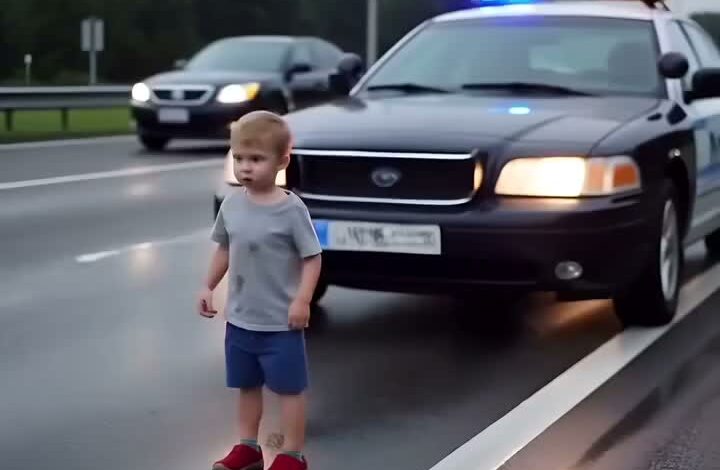
Officer Daniel Ramirez had worked highway patrol long enough to recognize the difference between ordinary roadside situations and the kind of moment that changes lives forever.
Most days blurred together in predictable patterns:
speeding tickets,
disabled vehicles,
drivers distracted by phones,
occasional accidents caused by impatience or exhaustion.
But the moment he spotted the child walking near the shoulder of Interstate 47, every instinct inside him shifted instantly from routine enforcement to emergency response.
At first, he thought he was seeing something impossible.
The afternoon traffic moved at full highway speed, semitrucks roaring past hard enough to shake the guardrails, while heat shimmered above the asphalt in waves. People simply did not walk there. Certainly not children.
And definitely not alone.
But as Ramirez slowed the patrol car, the image sharpened into something far worse than confusion.
A little boy.
Tiny.
Filthy.
Barely steady on his feet.
No older than three.
The child wandered dangerously close to the edge of traffic with the strange, slow movements of someone operating beyond exhaustion. His oversized shirt hung crookedly from one shoulder, stiff with dirt. Tiny scratches covered his hands and knees. His shoes looked half destroyed, one sole nearly detached completely. Even from several yards away, Ramirez could see the grime layered across the boy’s face and arms, the kind that does not come from one bad afternoon outside but from prolonged neglect and exposure.
Cars screamed past without slowing.
Some drivers probably never noticed him at all.
Others may have seen something small near the roadside and convinced themselves it was someone else’s responsibility.
That realization hit Ramirez almost as hard as the sight of the child itself.
Because a toddler standing beside a highway should stop the world instantly.
Instead, traffic continued moving around him as if vulnerability had somehow become invisible.
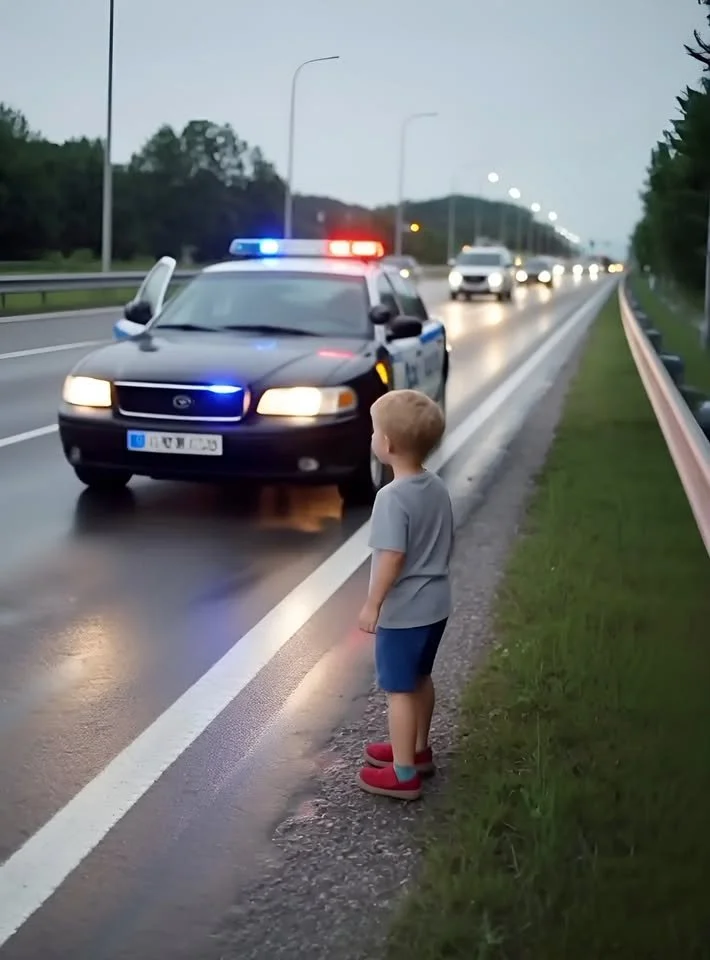
Ramirez pulled over so abruptly gravel sprayed beneath the patrol car tires. The moment he stepped out, the full danger of the situation became horrifyingly clear. Wind currents from passing trucks rocked the child sideways each time they thundered by. One stumble in the wrong direction would be fatal.
The boy did not even seem to react anymore.
That frightened Ramirez most.
Children normally fear highways instinctively:
the noise,
the movement,
the chaos.
But this little boy looked emotionally dulled by exhaustion, as though survival itself had become his entire focus.
Ramirez approached slowly, lowering his voice immediately.
Police training taught officers many things about crisis response, but trauma involving children required something different entirely. Sudden movement, loud voices, or visible urgency could frighten already traumatized children into panic or withdrawal.
So Ramirez crouched several feet away and spoke gently.
“Hey, buddy,” he said softly. “What’s your name?”
The boy stopped walking.
For a second, he simply stared.
And Ramirez would later say those eyes haunted him long after the rescue ended.
Because they did not look like a toddler’s eyes.
They looked ancient.
Not literally old, of course, but emotionally exhausted in a way no child should ever be. There was fear there, yes. Confusion too. But underneath both sat something worse:
wariness.
The boy looked at Ramirez the way abused or abandoned children often look at adults who approach them unexpectedly—not with automatic trust, but cautious calculation.
As if experience had already taught him adults could become dangerous without warning.
“Where are your parents?” Ramirez asked carefully.
No answer.
The child lowered his eyes toward the pavement.
Ramirez noticed then how thin he was. The oversized shirt hid it partially, but not completely. His wrists looked impossibly small. His legs trembled slightly from fatigue.
The officer’s chest tightened.
“How long have you been out here?” he asked, though he already suspected the child might not answer at all.
The little boy’s lips trembled.
Then suddenly, without warning, he began crying.
Not loud tantrum crying.
Not dramatic screaming.
Just exhausted, collapsing tears.
The kind that come when someone has been frightened for far too long and finally realizes they might no longer have to survive alone.
Ramirez moved immediately then, closing the remaining distance and carefully lifting the child into his arms.
The boy weighed almost nothing.
“Easy,” Ramirez whispered instinctively. “I’ve got you now.”
And to the officer’s surprise, the child clung to him instantly.
Tiny dirty fingers gripping the front of his uniform with desperate force.
That simple reaction told Ramirez everything he needed to know before any medical report ever arrived:
this child had not been held safely in a very long time.
Inside the patrol car, the boy curled against the warmth almost immediately while Ramirez radioed dispatch with a voice far tighter than usual. Child services. Medical assistance. Missing child reports. Emergency welfare response.
Every available system suddenly activated at once.
At the station, the reality of the boy’s condition became even more devastating.
Medical staff documented signs of prolonged neglect:
malnutrition,
dehydration,
minor infections,
exposure injuries,
and developmental concerns linked to chronic instability.
As nurses carefully cleaned layers of dirt from his skin, a completely different child slowly emerged underneath the grime:
soft brown hair,
wide expressive eyes,
a small face that should have belonged to someone worrying about cartoons and bedtime stories instead of survival.
Yet even while silent, the child remained hyper-alert.
Trauma often teaches children to monitor rooms constantly. Every new adult entering the station made his shoulders tense. Sudden noises startled him badly. He flinched whenever anyone moved too quickly nearby.
Still, despite all of it, the nurses noticed something else too:
resilience.
Children possess astonishing survival instincts. Even after severe neglect, many still reach instinctively toward safety once they encounter it consistently enough.
Ramirez stayed nearby throughout the entire examination.
Technically, he did not have to.
But leaving felt impossible.
The child—still unidentified at that point—watched him continuously, as though terrified the one safe adult who appeared might suddenly disappear too.
So Ramirez stayed.
He brought juice.
A blanket.
Eventually a stuffed dinosaur from the station’s donation shelf.
The boy held the dinosaur tightly against his chest for nearly an hour without speaking.
Meanwhile, investigators worked frantically to identify him.
Photographs were circulated.
Missing-child databases checked.
Local alerts issued.
Then someone made the decision to release the child’s image publicly through social media channels.
Within hours, the story exploded across the region.
Thousands shared the photograph:
the tiny boy wrapped in a police blanket,
dark eyes staring uncertainly toward the camera,
scratches visible along his small hands.
Comments flooded in from horrified strangers demanding answers.
Then the phone call came.
A woman named Maria.
Crying before dispatch even finished confirming details.
“That’s my nephew,” she said.
Her name triggered immediate follow-up investigation, and slowly the horrifying story began surfacing piece by piece.
The child’s name was Liam.
Three years old.
His parents had become deeply involved in criminal operations that turned their home into a center for illegal activity. According to Maria, Liam had spent months living inside escalating chaos while adults prioritized drugs, money, and criminal survival over basic parenting responsibilities.
Then came the revelation that stunned even seasoned investigators:
during a police raid connected to his parents’ arrest, Liam had somehow been overlooked entirely.
Lost inside the collapse.
While authorities focused on suspects, evidence, and arrests, a three-year-old child had effectively slipped through the cracks unnoticed.
By the time anyone realized he was missing, he had already been surviving alone for days.
Maybe longer.
Maria arrived at the station trembling.
The moment Liam heard her voice saying his name, something extraordinary happened.
The frightened silence broke instantly.
“Auntie,” he whispered.
Then he ran to her.
Everyone in the room watched the reunion quietly as Maria dropped to her knees sobbing, wrapping him into her arms while Liam buried his face against her shoulder with exhausted relief.
Ramirez looked away briefly then.
Not because protocol required it.
Because sometimes even experienced officers need a second to recover emotionally from witnessing both devastation and healing at the same time.
Maria later explained she had already been trying to gain custody before everything collapsed completely. She knew Liam’s home life had become dangerous but lacked the legal authority and financial resources to intervene fully.
Now suddenly the choice had been made for everyone through catastrophe.
The state moved quickly afterward.
Emergency custody.
Medical stabilization.
Trauma counseling.
Protective oversight.
But perhaps the most important part of Liam’s recovery happened through consistency.
Maria provided structure:
meals,
clean clothes,
bedtime routines,
safety.
And Ramirez kept visiting.
At first officially.
Then personally.
He brought books.
Toy cars.
Coloring supplies.
Slowly, Liam changed.
Children recovering from trauma often emerge gradually, almost cautiously, like someone stepping back into sunlight after surviving underground too long. His appetite improved first. Then his sleep. Then language.
And eventually:
laughter.
The first time Ramirez heard Liam laugh fully, the officer reportedly sat in stunned silence afterward realizing he had never heard the child sound like an actual toddler before that moment.
Trauma had aged him prematurely.
Safety slowly gave him childhood back.
The story spread far beyond the local community because it forced people to confront uncomfortable truths about neglect, responsibility, and invisible suffering.
Children do not simply “end up” wandering highways alone.
Many warning signs usually appear long before catastrophe:
chaotic homes,
substance abuse,
criminal activity,
food insecurity,
emotional withdrawal,
system failures,
neighbors looking away.
Liam survived partly because one officer refused to assume someone else would intervene.
That decision mattered.
Because highways move fast.
Because neglect escalates quietly.
Because vulnerable children cannot rescue themselves.
And perhaps that is the most haunting lesson buried inside Liam’s story:
for days, maybe weeks, a three-year-old child had been surviving in a world designed entirely by adults who failed him.
Then finally, one adult stopped the car.
Looked closely.
And chose not to drive past.