You’ve probably wrapped yourself in a bath towel thousands of times without giving one particular detail a second thought.
But look closely.
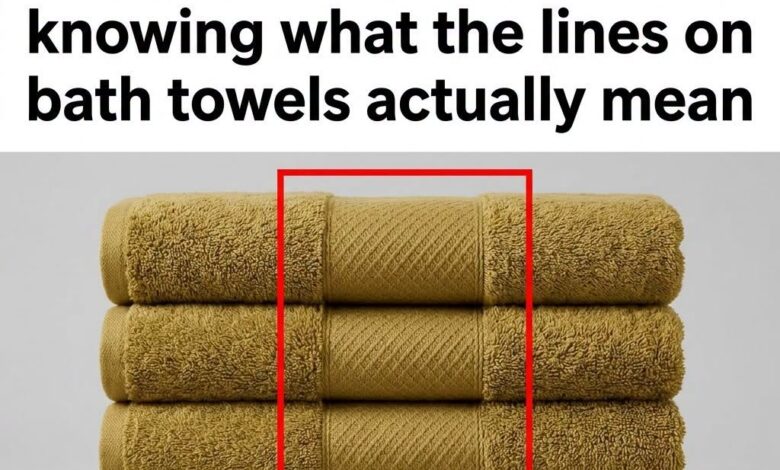
Near each end of many towels is a strange, flat strip with almost none of the soft loops covering the rest of the fabric.
It looks decorative.
Maybe you’ve assumed it’s there to make the towel prettier.
Perhaps you’ve even wondered why manufacturers would deliberately remove the fluffiest part of a towel.
But that seemingly pointless strip has a name—and a job.
It’s commonly called a dobby border.
And while it can certainly be decorative, there’s more going on than appearance alone.
To understand why, look at the rest of the towel.
Most bath towels get their softness and absorbency from thousands of tiny loops of yarn known as terry loops.
Those loops create a large surface area capable of soaking up water.
They’re the reason a good towel can pull moisture from your skin so efficiently.
But there’s a trade-off.
Those raised loops can be vulnerable to snagging, stretching, and wear.
And towels live surprisingly rough lives.
They get soaked.
Twisted.
Pulled.
Dropped on floors.
Stuffed into laundry baskets.
Washed repeatedly.
Tumbled around inside dryers.
Then the whole process starts again.
Over dozens or hundreds of laundry cycles, all of that mechanical stress can affect the fabric.
That’s where the flatter woven sections can help.
Unlike the plush terry surface, the dobby area is created with a different weave.
It is typically flatter, denser, and more structured.
Think of it as a transition zone within the towel.
The fluffy terry portion is designed primarily for absorbency and softness.
The border can contribute structure while also providing a clean decorative finish.
That combination is why the strip feels so different when you run your fingers across it.
You’re literally touching a different textile structure.
And manufacturers can use that structure creatively.
A dobby border might contain simple horizontal lines.
It might feature geometric patterns.
On expensive towels, it can become surprisingly elaborate.
Hotels may incorporate distinctive designs or branding.
Luxury manufacturers sometimes use the border to create visual contrast that makes an otherwise plain towel appear more refined.
In other words, the strip can perform practical and aesthetic roles at the same time.
But there’s another reason borders matter:
Edges are vulnerable.
Fabric doesn’t usually unravel dramatically from the middle.
Damage often begins where threads terminate, seams weaken, or repeated friction concentrates.
That’s why the ends of towels require careful finishing.
The woven border and hem construction work together to create a stronger, cleaner termination for the textile.
Without proper finishing, repeated washing could cause deterioration much more quickly.
This doesn’t mean the dobby border single-handedly holds your entire towel together.
The hem and overall construction matter enormously too.
But the flatter woven section is part of a design that balances absorbency, durability, structure, and appearance.
Interestingly, you’ve probably encountered similar design logic on other household textiles.
Dish towels frequently have flatter woven bands.
Decorative hand towels may use elaborate borders.
Hotel linens often incorporate woven patterns rather than printed decoration.
Textile manufacturers have spent generations figuring out how different weaves behave under repeated use.
What looks like decoration may therefore have originated partly from practical construction.
There is one downside, though.
Have you ever owned a towel where the decorative band seemed to shrink differently from the rest?
Suddenly the towel puckered around the border.
That can happen because different weave structures can react differently to washing, drying, heat, and tension.
The plush terry section and tightly woven border aren’t necessarily going to behave identically.
Quality manufacturing attempts to account for this.
Poorly constructed towels may reveal the difference after repeated laundering.
It’s one reason two towels that look nearly identical in a store can age very differently.
Fiber quality matters.
Weave density matters.
Hem construction matters.
Manufacturing consistency matters.
Even laundry habits matter.
Excessive heat and harsh washing can accelerate wear.
Fabric softeners can also affect towel performance because they may leave coatings on fibers that reduce absorbency over time.
A well-made towel, cared for properly, can survive an impressive number of trips through the washing machine.
And throughout all those cycles, that little flat band remains quietly in place.
There’s something oddly satisfying about discovering the purpose behind objects we’ve ignored for years.
The tiny hole in a spaghetti spoon.
The extra eyelets on sneakers.
The little arrow beside the fuel-pump symbol in many cars.
And now:
That strange strip across your towel.
Once you know what it is, you’ll probably notice it every time you step out of the shower.
You’ll see the soft terry loops covering most of the towel.
Then the texture suddenly changes.
The loops disappear.
The fabric becomes flatter and more structured.
That’s the dobby border.
Part decoration.
Part textile engineering.
Part finishing detail.
And proof that even something as ordinary as a bath towel contains design decisions most of us never notice.
So the next time you grab a towel, don’t assume that strange smooth band is wasted space.
The plush loops are doing the obvious job—absorbing water and keeping you comfortable.
The quieter woven details help give the towel its finished structure and distinctive appearance.
Not bad for a strip of fabric most of us have spent our entire lives ignoring.