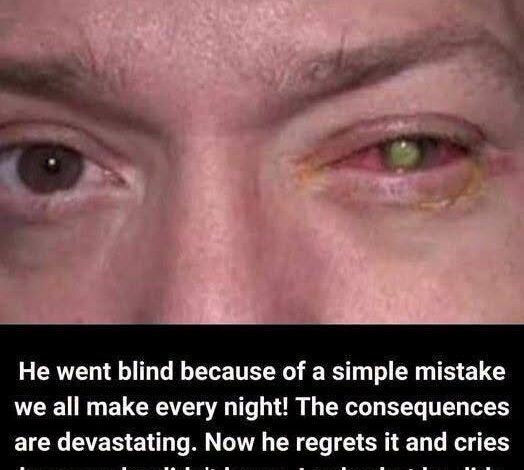
He went to sleep wearing contact lenses and woke up believing he had a mildly irritated eye.
Within days, doctors were fighting to save his sight.
The man was only 39, a business owner with responsibilities, customers, and the kind of schedule that made small inconveniences easy to ignore. So when one eye felt scratchy and looked a little red, he wasn’t immediately frightened.
He’d experienced irritation before.
Contact lenses could become dry.
Eyes could become tired.
Maybe he’d rubbed it while sleeping.
There were plenty of ordinary explanations.
So he waited.
That decision would soon become terrifying.
The irritation didn’t disappear.
Instead, the discomfort became pain.
The redness worsened.
Then his vision began changing.
What had initially felt like something irritating his eye became increasingly difficult to ignore. The world through the affected eye started becoming cloudy and distorted.
That’s when annoyance gave way to fear.
Something was seriously wrong.
And by the time specialists examined him, this was no longer a routine case of contact-lens irritation.
His cornea—the transparent front surface of the eye responsible for helping focus light—was in danger.
The suspected culprit was frighteningly small:
Pseudomonas bacteria.
Pseudomonas aeruginosa can cause severe bacterial keratitis, an infection of the cornea. Contact-lens wear is a recognized risk factor, and these infections can progress rapidly enough to threaten vision.
Suddenly, the man’s everyday habit of sleeping in his contacts looked completely different.
A contact lens seems harmless.
It’s tiny.
Flexible.
Nearly weightless.
Millions of people use lenses safely.
But a lens sits directly on the surface of the eye, and that means hygiene and wearing habits matter enormously.
Sleeping in contact lenses can increase the risk of microbial keratitis. Closed eyelids already reduce oxygen reaching the cornea during sleep, and a contact lens can alter the eye’s normal environment further.
That doesn’t mean everyone who accidentally falls asleep wearing contacts will develop a devastating infection.
Most won’t.
But the potential consequences are serious enough that the risk shouldn’t be casually dismissed.
For this man, the infection had already begun damaging the cornea.
Now doctors weren’t simply discussing antibiotic drops and sending him home.
The conversations became much more frightening.
Scarring.
Permanent vision loss.
Corneal transplantation.
Imagine hearing those words after initially believing you had a scratchy eye.
The cornea needs to remain clear for good vision. A severe infection can produce ulcers, inflammation, tissue destruction, and eventually scarring.
Once significant scarring occurs in the central visual axis, simply eliminating the infection may not restore normal sight.
Doctors can defeat the bacteria.
They cannot always undo the damage the bacteria already caused.
That was the nightmare he was suddenly facing.
Treatment became urgent.
Powerful medications were used to control the infection while specialists monitored his eye.
The casual routines of ordinary life disappeared.
Work became difficult.
Driving, reading, concentrating, and navigating everyday surroundings could no longer be taken for granted.
His restoration and design business had to take a back seat while protecting his vision became the priority.
Recovery wasn’t measured in a weekend.
It stretched across months.
Nearly a year later, the experience was still affecting his life.
And the possibility of a corneal transplant demonstrated just how far the situation had traveled from that first seemingly harmless morning.
What disturbed him most was that he hadn’t thought he was doing something extraordinarily reckless.
He had believed sleeping in his contacts was acceptable.
And that’s where his story becomes important for anyone who wears lenses.
Some contact lenses are specifically approved for extended or overnight wear, but approval doesn’t mean zero risk. The safest wearing schedule depends on the lens, the individual eye, and guidance from an eye-care professional.
For lenses not intended for overnight use, sleeping in them should be avoided.
Even with extended-wear lenses, sleeping in contacts carries a greater infection risk than removing them before bed.
Convenience can make that easy to forget.
You’re exhausted.
You lie down for a minute.
You don’t want to walk back to the bathroom.
You tell yourself:
I’ll take them out tomorrow.
Most mornings, perhaps nothing dramatic happens.
And that’s exactly how risky habits become normalized.
When nothing happens the first ten times, we begin assuming nothing can happen the eleventh.
But biology doesn’t work that way.
Risk isn’t a guarantee of disaster.
It’s a probability.
And when the possible consequence involves permanent damage to your eyesight, even an uncommon outcome deserves respect.
Sleeping in contacts isn’t the only concern.
Contact lenses require clean handling.
Hands should be washed and dried before touching them.
Reusable lenses need to be cleaned and stored according to professional and manufacturer instructions.
Old solution shouldn’t simply be “topped off” indefinitely.
Cases need appropriate care and replacement.
And unless a lens is specifically designed for it and your eye-care professional has advised otherwise, water and contact lenses generally shouldn’t mix.
That includes swimming, showering, or rinsing lenses with tap water.
Water can contain microorganisms capable of causing serious eye infections.
Another common mistake is stretching lenses beyond their intended replacement schedule.
A daily disposable isn’t meant to become a three-day lens because it still “looks fine.”
A lens can appear perfectly normal while deposits, contamination, or microscopic changes are creating problems you cannot see.
Your eyes aren’t the place to squeeze extra value out of something designed to be replaced.
But perhaps the most important lesson from this man’s ordeal isn’t about cleaning solution or replacement schedules.
It’s about recognizing warning signs.
A contact-lens wearer who develops significant eye pain, increasing redness, light sensitivity, discharge, or blurred or reduced vision shouldn’t simply assume the problem will disappear.
Remove the lenses and seek prompt professional evaluation, particularly when symptoms are severe or worsening.
A painful red eye accompanied by changes in vision deserves particular urgency.
That’s because some corneal infections can progress quickly.
Hours and days matter.
Waiting because you don’t want to “make a big deal out of nothing” can be a dangerous gamble when eyesight is involved.
There is also an important distinction between ordinary discomfort and something more concerning.
Contact lenses occasionally feel dry or uncomfortable.
That doesn’t mean every uncomfortable lens represents an emergency.
But persistent or worsening pain isn’t something to prove your toughness against.
Neither is deteriorating vision.
Your body is giving you information.
Listen to it.
The man at the center of this story learned that lesson in one of the hardest ways imaginable.
He went from running his business and living independently to discussing whether damaged corneal tissue might eventually need to be replaced.
All because something microscopic found an opportunity.
There was no dramatic accident.
No chemical splashed into his face.
No obvious injury.
Just an ordinary habit followed by symptoms that initially seemed easy to dismiss.
That’s what makes the story frightening.
And useful.
Because the warning isn’t:
Never wear contact lenses.
Millions of people use them successfully.
The warning is:
Respect what you’re putting on your eyes.
Follow the prescribed wearing schedule.
Keep lenses and cases clean.
Don’t improvise with water or questionable cleaning practices.
Replace lenses when you’re supposed to.
And don’t assume that “approved for overnight wear” means “impossible to get an infection.”
Most importantly, don’t ignore a painful, red eye—especially when your vision changes.
We casually protect things far less valuable.
We put cases on phones.
Passwords on computers.
Insurance on cars.
Yet it’s easy to become careless with the two organs through which we experience almost everything around us.
For this 39-year-old man, what started as an annoying sensation became a prolonged fight to preserve his sight.
His warning afterward could hardly be simpler:
Take contact-lens safety seriously.
Because the difference between irritation and an emergency isn’t always something you can recognize immediately.
And when your eye begins telling you that something is wrong, don’t wait for the message to become impossible to see.