20,000 chicken eggs were removed from stores and dumped at the city landfill, but after three months something unexpected happened

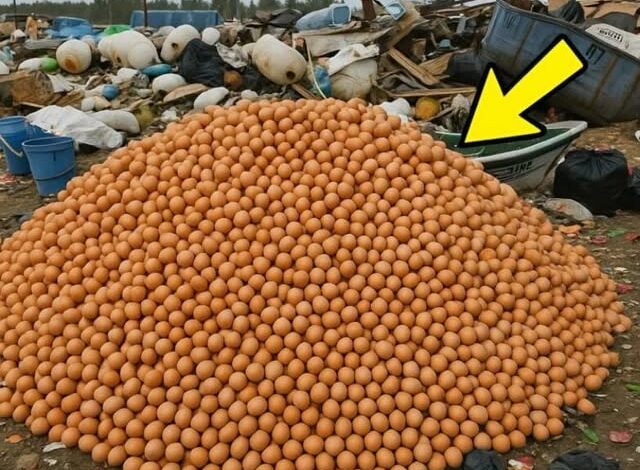
The caretaker thought the sound was coming from a broken machine.
It was barely sunrise when he heard it.
A faint, scattered peeping somewhere beyond the heaps of discarded furniture, torn garbage bags, shattered bottles, and rusting appliances.
He stopped beside the landfill gate and listened.
There it was again.
Peep.
Then another.
Then dozens.
By the time he climbed over a mound of debris and saw what was making the noise, he could barely believe his eyes.
The ground was moving.
Not literally.
It only looked that way because hundreds of tiny yellow chicks were scrambling across the garbage.
They stumbled between plastic containers.
They disappeared beneath scraps of cardboard.
Some had crawled inside discarded tires for warmth.
Others pressed themselves against one another beside pieces of rusted metal.
A few stood trembling on broken glass.
The caretaker froze.
For years, he had worked around things people no longer wanted.
Broken televisions.
Old mattresses.
Rotten food.
Shoes without partners.
Toys abandoned after childhood ended.
He understood waste.
But this was different.
These weren’t discarded objects.
They were alive.
He immediately began calling for help.
Within minutes, other workers arrived.
Their reactions were almost identical.
Confusion first.
Then disbelief.
Then urgency.
“Where did they come from?”
Nobody knew.
“Did someone dump them?”
Nobody had seen anything.
“Are there more?”
That question changed everything.
Workers spread through the landfill, carefully searching beneath cardboard, plastic sheeting, and piles of rubbish.
Everywhere they looked, they found chicks.
Some were energetic enough to run.
Others barely moved.
The smallest simply huddled together, desperate for warmth.
One worker removed his jacket and placed several inside it.
Another found an empty cardboard box and lined the bottom with old cloth.
Someone brought water.
Someone else began calling local authorities.
Word traveled faster than anyone expected.
By midmorning, people had gathered outside the landfill fence.
Some came because they’d heard an unbelievable rumor.
Others arrived after seeing photographs online.
A few brought boxes.
One woman arrived carrying three old blankets.
A teenager brought towels.
An elderly man appeared with a laundry basket.
People stood staring through the fence at a place they had passed countless times without giving it a second thought.
Now it was alive with tiny voices.
Phones appeared almost immediately.
People filmed the chicks wandering through the debris.
One disappeared into an old shoe.
Another climbed awkwardly across a crushed plastic bottle.
Several huddled beneath a broken wooden cabinet as though it were a shelter built specifically for them.
The images were surreal.
Tiny animals associated with farms, barns, and springtime were suddenly surrounded by everything a city had thrown away.
Life and waste occupied the same frame.
Authorities eventually arrived and restricted access to parts of the site.
They needed to determine what had happened.
Had someone abandoned the chicks?
Had eggs somehow been dumped there and hatched?
Was there a nearby poultry operation?
Could unusual pockets of heat created by decomposing organic material have contributed?
People wanted a dramatic explanation immediately.
Officials were more cautious.
They spoke about investigating the source.
They warned residents not to rush into unsafe sections of the landfill.
They pointed out hazards beneath the garbage—glass, metal, contaminated material, unstable piles.
All reasonable concerns.
But standing outside the barrier, people heard something more immediate.
Peeping.
Constant, fragile peeping.
And suddenly bureaucracy felt unbearably slow.
Residents began passing supplies toward workers.
Boxes.
Towels.
Scarves.
Pieces of fabric.
Anything that could help carry the chicks away from sharp debris.
One woman removed the sweater she was wearing and handed it over.
“Use this.”
“You’ll be cold.”
“I have another one at home.”
That became the mood of the day.
People gave whatever they had.
Not because the chicks were valuable.
Not because anyone expected a reward.
Simply because something helpless had appeared in an awful place, and walking away felt impossible.
The rescue became organized gradually.
Chicks that appeared weak were separated from stronger ones.
Makeshift containers became temporary shelters.
People tried to provide warmth while arrangements were made for safer locations.
Some residents volunteered to care for them.
Others contacted farms and animal groups.
Children stood beside their parents watching boxes leave the landfill one after another.
Each box seemed impossibly light considering how much emotion people attached to it.
One little girl watched a worker place several chicks inside a container.
“Are they going home?” she asked.
Her mother hesitated.
“They’re going somewhere better.”
Perhaps that was enough.
Nobody could explain exactly how so many fragile animals had ended up surrounded by garbage.
And perhaps that uncertainty was part of what made the sight so haunting.
A landfill represents an ending.
Everything there has supposedly finished being useful.
We throw something away because its story, at least to us, is over.
But that morning, the landfill refused to behave like an ending.
Something was beginning there.
Against rust.
Against broken glass.
Against the smell of decay.
Life was making noise.
By afternoon, photographs of the rescue had spread far beyond the neighborhood.
People argued about what had happened.
Some demanded investigations.
Others criticized whoever might have abandoned the animals.
Many simply stared at the images.
Because there was something almost impossible about them.
A yellow chick standing inside a black tire.
Another sleeping against a discarded bottle.
Dozens gathered on stained cardboard as volunteers reached toward them.
The contrast made people uncomfortable.
Maybe because it revealed two things humans don’t particularly enjoy seeing together.
Our capacity to discard.
And life’s refusal to cooperate with that decision.
As evening approached, the landfill became quieter.
Boxes containing rescued chicks had been carried away.
Workers continued searching the debris for stragglers.
Every few minutes, someone would stop.
Listen.
Then follow another faint peep.
The caretaker who had discovered them remained until nearly dark.
His boots were filthy.
His hands smelled terrible.
His jacket had become an improvised blanket for animals he hadn’t known existed when his shift began.
Someone asked him what he thought about everything that had happened.
He shook his head.
“I’ve worked here a long time.”
Then he looked across the landfill.
“I’ve never seen the garbage move before.”
People laughed.
But there was sadness beneath it.
Because by then, everyone understood that not every chick would survive.
Some had been exposed too long.
Some were injured.
Some were simply too weak.
There would be no perfect ending.
Rescue stories rarely have one.
Still, that didn’t make the effort meaningless.
Perhaps it made it more important.
You help because something needs help.
Not because you’re guaranteed a happy conclusion.
By the following days, the landfill returned to what it had always been.
Trucks arrived.
Machines moved piles.
Workers continued sorting through what the city had discarded.
The crowds disappeared.
The fence stood quietly again.
But people who had witnessed that morning couldn’t look at the place quite the same way.
For a few strange hours, a landscape built from endings had become a nursery.
Neighbors who barely knew one another had passed blankets over fences.
Workers had abandoned routine tasks to carry tiny animals out of danger.
People who arrived only to take photographs ended up holding boxes.
A place defined by what nobody wanted became the center of extraordinary attention.
Maybe that is why the story stayed with them.
Not because anyone proved that something miraculous had happened.
Mysteries don’t automatically become miracles simply because we don’t immediately understand them.
But wonder doesn’t require abandoning reason.
Sometimes wonder is simply what happens when reality gives us an image we weren’t prepared to see.
A landfill.
A thousand pieces of trash.
And somewhere underneath them:
Peep.
Peep.
Peep.
A sound so small it should have disappeared beneath the machinery.
Instead, people heard it.
They stopped.
They came closer.
And they helped.
Perhaps that is the part worth remembering.
Life doesn’t always appear where we expect it.
Neither does compassion.
Sometimes both emerge in places we’ve already decided are worthless.
And occasionally, surrounded by everything we’ve thrown away, something fragile reminds us that being unwanted and being without value are two very different things.