By the end of that summer, the apple tree no longer belonged only to me.
For years, I had thought of it as Dean’s tree.
Ours, really.
It stood in the yard like a piece of our marriage that had somehow remained alive after he was gone. Every branch carried a memory, every scar in the bark seemed connected to some afternoon I could still picture if I closed my eyes long enough.
Dean and I had planted it when it was barely more than a stick.
I remember looking at the thin trunk and laughing.
“This thing is supposed to give us apples?”
Dean leaned on the shovel and grinned.
“Give it time.”
That was always his answer.
Give it time.
He said the same thing when the first winter nearly killed it.
He said it when insects chewed holes through the leaves.
He said it when several springs passed without a single blossom turning into fruit.
“One day,” he promised, “this tree is going to surprise you.”
I used to tease him about that.
After he died, the words stopped being funny.
The tree remained.
Dean didn’t.
For a while, I resented it for surviving him.
That sounds ridiculous now, but grief isn’t reasonable.
I would stand at the kitchen window and stare at those branches moving in the wind, angry that something we had planted together was still growing while the person who had dug the hole beside me was gone.
Then, eventually, the first apples came.
Dean never saw them.
I remember holding one in my palm and crying so hard I had to sit down in the grass.
It wasn’t a particularly beautiful apple.
Small.
Slightly crooked.
A little blemished on one side.
To me, it was perfect.
It was proof that something he had believed in had finally happened.
After that, I became protective of the tree.
Maybe too protective.
It wasn’t simply landscaping anymore.
It was memory made physical.
Something I could water.
Prune.
Defend.
When Ryan entered the story and the tree was damaged, my anger went far beyond broken branches and torn bark.
He had touched something sacred without understanding what it was.
Then came the excuses.
The denials.
The explanations that never quite matched what I could see with my own eyes.
For a while, every time I looked at Ryan, I saw only the damage.
And every time I looked at the tree, I saw what had almost been taken from me.
But trees don’t understand grudges.
They understand seasons.
That autumn passed.
Then winter.
The damaged branches stood bare beneath the snow, and I spent months wondering whether spring would expose just how badly the tree had been hurt.
When warmer days finally returned, I inspected it obsessively.
Every bud felt like a verdict.
Then green appeared.
Not everywhere.
Some branches were gone for good.
But the tree was alive.
By early summer, blossoms covered the surviving limbs.
More than I expected.
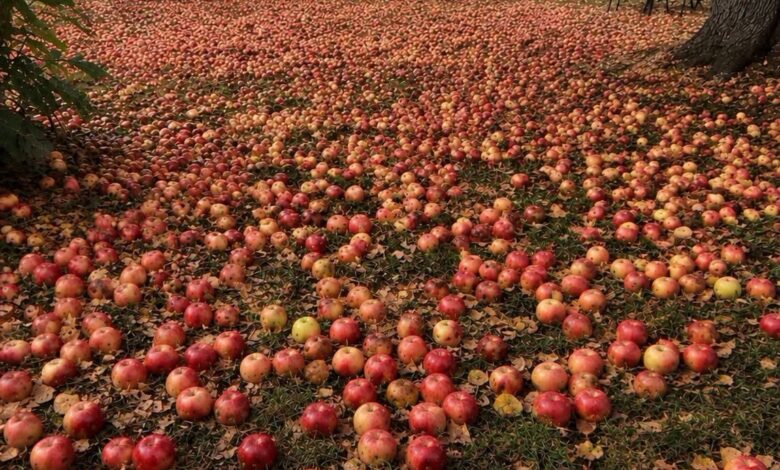
By August, apples were hanging everywhere.
Bright red against deep green leaves.
So many that some branches bent under their weight.
I stood beneath them one evening and heard Dean’s voice as clearly as if he were beside me.
“Give it time.”
I laughed.
Then I cried.
And somewhere between those two things, the tree changed again.
The first neighborhood children came because they saw apples hanging near the fence.
They would slow down while walking past, looking up at the branches with that particular expression children have when they’re deciding whether wanting something badly enough makes it theirs.
One little boy finally asked.
“Can we have one?”
My first instinct was almost automatic.
No.
These were Dean’s apples.
Then I looked at the tree.
There were more apples than I could possibly eat.
More than I could bake.
More than I could give to relatives.
So I picked one and handed it to him.
His entire face changed.
“Really?”
“Really.”
The next evening he came back with his sister.
Then another child appeared.
Then another.
Soon I stopped waiting for them to ask.
I put a basket near the fence with a handwritten sign.
TAKE ONE.
That lasted approximately ten minutes.
So I changed it.
TAKE A FEW.
By late summer, my yard had become something I never expected.
Families gathered beneath the branches in the evenings.
Children ran across the grass while parents filled bags with apples.
Someone brought cider.
Another neighbor arrived with an apple pie made from fruit she’d picked two days earlier.
People who had lived three houses apart for years without knowing one another’s names suddenly stood beneath Dean’s tree exchanging recipes.
And everyone asked the same question.
“How old is this tree?”
That was how I began telling Dean’s story.
At first, saying his name to strangers felt intimate.
Almost dangerous.
“We planted it together,” I’d explain.
“Years ago.”
Then somebody would ask whether he still lived there.
And I would say:
“No. Dean passed away before it ever produced fruit.”
There would usually be a pause.
People never know exactly what to say after that.
I learned to rescue them.
“He always said it would surprise me.”
That usually brought a smile.
Eventually, I started enjoying the telling.
Dean became more than the photograph on my dresser.
More than the clothes I had eventually forced myself to donate.
More than the empty side of the bed.
Through those conversations, he became a man my neighbors could almost picture.
I told them how impatient I had been when the tree refused to grow.
How Dean refused to give up on it.
How he talked to plants as though encouragement might actually help.
How terrible he was at pruning.
How certain he remained that someday we would have more apples than we knew what to do with.
He had been right.
Painfully, beautifully right.
Something happened to my grief during those evenings.
The tree stopped being a monument.
Monuments face backward.
This tree kept moving forward.
Children climbed beneath it who had never known Dean.
Neighbors ate apples from branches he had once carefully tied to stakes.
People laughed beneath the same leaves that had once made me cry simply by moving in the wind.
Dean’s absence remained.
But the tree was no longer asking me only to remember what I had lost.
It was giving me something to share.
Ryan remained outside all of this.
At least initially.
We saw each other.
We nodded sometimes.
That was about it.
There had been too much anger between us, too many accusations and defensive explanations.
Neither of us seemed interested in reopening any of it.
Then one afternoon, I noticed a little girl standing near the fence.
Ryan’s daughter.
She couldn’t have been more than five or six.
She was staring at the apples.
Not touching.
Not asking.
Just looking.
Ryan stood several steps behind her.
When he saw me, his expression tightened.
I could almost watch the old history return to his face.
For a moment, I felt it too.
The damaged tree.
The arguments.
The lies.
The anger.
Everything I had spent so much time carrying.
Then his daughter pointed upward.
“Daddy, look.”
I looked at her.
Then at Ryan.
Then at the tree.
And suddenly I was tired of making a child inherit a conflict she had never created.
I went inside and found a small basket.
I filled it with apples.
Not the bruised ones.
Not the tiny ones.
The best ones I could reach.
Then I walked toward the fence.
Ryan watched me approach.
His daughter looked at the basket.
Her eyes widened.
“These are for you,” I said.
She looked at her father before taking them.
Ryan hesitated.
For one second, I wondered whether pride would make him refuse.
Then he nodded.
“Go ahead.”
She wrapped both hands around the basket.
“Thank you!”
I smiled.
“You’re welcome.”
Ryan looked at me.
There were a hundred things either of us could have said.
He could have apologized.
I could have demanded one.
He could have explained himself again.
I could have reminded him that I knew exactly what had happened.
Instead, he simply said:
“Thank you.”
Quietly.
No performance.
No excuses.
I nodded.
That was all.
And somehow, for the first time, it felt like enough.
The following year, autumn arrived early.
Leaves covered my yard faster than I could rake them.
One Saturday morning, I was outside fighting a losing battle against another gust of wind when I heard someone behind me.
“Need a hand?”
Ryan.
He was holding a rake.
I stared at him.
He gave a small shrug.
“I’ve got another one in the garage.”
I could have said no.
Part of me wanted to.
Not because I still hated him.
Because accepting help felt like letting go of the final piece of the fight.
But I looked at the leaves.
Then at the tree.
Then back at Ryan.
“Sure.”
He returned with the rake.
We worked side by side for almost an hour.
We talked about ordinary things.
Weather.
His daughter.
A broken gutter.
The ridiculous number of apples the tree had produced again.
We did not talk about what had happened.
Not once.
Years earlier, that would have felt like cowardice.
Now it felt different.
Some apologies arrive in sentences.
Others arrive carrying a rake.
I don’t know whether Ryan understood that.
Maybe he did.
Maybe he didn’t.
But forgiveness, I learned, wasn’t the same as pretending the damage had never happened.
The scars were still visible on the tree.
If you knew where to look, you could see exactly where branches had been broken.
New growth had formed around some of the wounds.
The tree had not erased what happened.
It had incorporated it.
Perhaps people do the same.
Dean had always understood patience better than I did.
He believed things could survive seasons that looked final.
He believed growth sometimes happened where nobody could see it.
Underground.
Inside bark.
In places that appeared completely still.
I thought the tree’s great surprise would be its first apple.
I was wrong.
The apples were only the beginning.
Its real surprise was everything that gathered beneath it.
Children laughing.
Neighbors talking.
Bags filling with fruit.
Dean’s name being spoken by people who had never met him.
A little girl receiving a basket from someone who had every reason to resent her father.
Ryan standing beside me the following autumn, pulling leaves into the same pile.
And me, finally understanding that preserving a memory does not require freezing it.
For years, I had protected Dean’s tree because I was afraid sharing it would somehow make it less ours.
Instead, sharing it brought him back into the world.
Not literally.
I knew better than that.
But his patience lived there.
His optimism lived there.
His ridiculous certainty that the tree would eventually surprise me lived there.
Every autumn, the branches still fill.
Children still appear.
Some of the little ones who once needed help reaching the lowest apples are tall enough now to pick their own.
Parents still bring bags.
Sometimes someone new asks me:
“What’s the story with this tree?”
And I tell them.
I tell them about Dean.
About the skinny sapling we planted.
About all the years it refused to produce anything.
About the man who kept insisting we needed to give it time.
I don’t always tell them everything.
They don’t need the arguments.
The damage.
The resentment.
Those belong to another part of the story.
What matters is what survived them.
One evening, after everyone had gone home, I stood beneath the tree alone.
The yard was covered with the soft gold of late sunlight.
A few apples remained high in the branches.
Across the street, Ryan was walking home with his daughter.
She was carrying one of them.
I placed my hand against the trunk.
The bark beneath my palm was rough and scarred.
Alive.
“You were right,” I whispered.
The leaves moved above me.
Of course, there was no answer.
There didn’t need to be one.
Dean had given it years ago.
Give it time.
I used to think he was talking about the tree.
Now I know he was teaching me something I wouldn’t understand until long after he was gone.
Some wounds don’t disappear.
Some losses never become small.
Some people never give you the apology you imagined you needed.
But life can grow around what happened.
Not covering it.
Not denying it.
Growing around it.
And sometimes, if you’re patient enough, what emerges isn’t merely survival.
It’s abundance.
A tree heavy with fruit.
A yard full of laughter.
A neighbor carrying a rake.
A child holding a basket.
A dead man’s name still being spoken beneath branches he once planted with his own hands.
Dean never lived to taste a single apple from that tree.
For years, that fact broke my heart.
Now I see it differently.
He planted something whose gifts were never meant to belong only to him.
Or even only to me.
And every autumn, when the branches bend under more fruit than I can possibly keep, I remember the promise he made beside a ridiculous little sapling all those years ago.
One day, this tree is going to surprise you.
It did.
It still does.