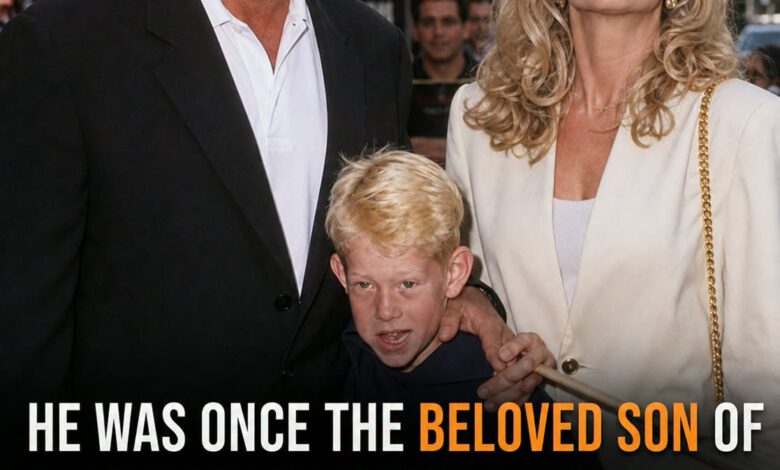
When Farrah Fawcett was nearing the end of her life, the world remembered the poster.
She remembered her son.
For millions, Farrah would always exist in sunlight: the feathered blond hair, the famous smile, the red swimsuit, the effortless glamour that turned a single photograph into one of the defining images of the 1970s. She had been a television phenomenon, a beauty icon, and a woman whose face became so familiar that strangers felt as if they knew her.
But fame has a strange way of preserving one version of a person while real life keeps moving.
Behind the photographs and television appearances was a mother watching something she could not control.
Her son, Redmond O’Neal, was struggling.
And as Farrah’s cancer advanced, the question haunting her was no longer simply whether she would survive.
It was what would happen to Redmond if she didn’t.
That fear transformed the final chapter of her life.
Cancer had already stripped away much of the illusion surrounding celebrity. Hospital rooms do not care how many magazine covers someone has appeared on. Treatments do not become less exhausting because the patient is famous. Pain is stubbornly democratic.
Farrah fought publicly and privately, documenting parts of her illness and refusing to disappear quietly.
Yet underneath her own battle was another one.
A mother’s battle against the knowledge that she might have to leave a vulnerable child behind.
Redmond was not a child in the ordinary sense anymore.
He was an adult.
But parenthood does not obey birthdays.
A son can be grown and still occupy the frightened, protective part of a mother’s heart that remembers him small enough to carry.
Farrah had watched Redmond struggle with addiction and legal trouble.
There had been arrests.
Relapses.
Chaos.
Promises.
Hope.
Then more trouble.
The cycle familiar to so many families touched by addiction had become part of theirs.
For a parent, addiction creates a particular kind of helplessness.
Love tells you to rescue.
Reality tells you rescue has limits.
You pay for treatment.
You answer the phone.
You forgive.
You draw boundaries.
You soften them.
You try again.
Every period of stability feels like the beginning of recovery.
Every setback feels like falling through the same floor.
And somewhere in the middle, a terrible truth emerges:
You cannot want another person’s recovery more effectively than they can pursue it themselves.
That does not stop a mother from trying.
Farrah’s illness made the situation even more painful because time was becoming finite.
She could no longer tell herself there would always be another year.
Another conversation.
Another chance to help Redmond stabilize.
Cancer had placed an expiration date over possibilities she once might have assumed were endless.
According to accounts of her final hours, Redmond remained at the center of her concern. Her longtime friend Mela Murphy later said Farrah’s final word was his name.
“Redmond.”
If true, there is something almost unbearably human about that.
Not a grand statement about fame.
Not a final reflection on Hollywood.
Not a line designed for biographies.
Her son’s name.
A mother reaching mentally toward the person she feared leaving behind.
It is tempting to romanticize such moments after death.
We turn final words into symbols because symbols make loss easier to organize.
But there is nothing tidy about what Redmond’s name represented.
It wasn’t simply love.
It was love tangled with fear.
Who would protect him?
Who would help him?
Who would recognize when he was slipping?
Who would stand between him and the consequences of his worst decisions?
And perhaps the most frightening question:
Could anyone?
Farrah tried to prepare for a future in which she would no longer be there.
Money became part of that preparation.
But simply leaving a large inheritance to someone struggling with instability can create new dangers rather than security.
So the financial arrangements surrounding Redmond were structured through a trust.
That distinction mattered.
It was not merely:
Here is money.
Spend it however you choose.
It was an attempt to create guardrails.
Farrah could not remain physically present.
But perhaps a structure could.
Perhaps legal documents could accomplish some small part of what a worried mother had spent years trying to do herself.
Protect.
Limit.
Provide.
Prevent catastrophe.
In that sense, the trust was not simply an inheritance.
It was one final act of maternal planning.
A shield built from paperwork.
But paperwork cannot cure addiction.
Money cannot manufacture stability.
And death does not magically end the problems that existed before it.
Farrah died in 2009.
The world mourned an icon.
Redmond lost his mother.
Those are two completely different events even when they happen on the same day.
The public loses an image.
A child loses the person who knew him before the image existed.
Farrah had been famous long before Redmond could understand what fame meant.
To the public, she was Farrah Fawcett.
To him, she was Mom.
That difference matters when trying to understand what followed.
Because Redmond’s life did not suddenly become easier once his mother’s suffering ended.
His struggles continued.
Legal trouble returned.
So did deeply disturbing allegations surrounding later incidents.
Over the years, headlines increasingly described him not through his parents’ fame but through arrests, court appearances, addiction, alleged violence, and questions about his mental condition.
Each new photograph seemed to produce another wave of public shock.
He looked different.
His face and body were heavily tattooed.
The familiar visual connection to the glamorous parents people remembered seemed harder for outsiders to see.
Tabloids seized on the contrast.
LOOK AT HIM NOW.
That framing is irresistible to celebrity culture.
Show the beautiful parents.
Show the troubled son.
Create a before-and-after story.
Let readers stare.
But human beings are not cautionary photographs.
Behind every sensational court image was a much more complicated reality involving addiction, legal accountability, psychiatric concerns, family history, and years of instability.
None of those factors excuses harm done to other people.
That distinction is essential.
Pain can explain behavior without erasing responsibility for it.
Mental illness can complicate a criminal case without making alleged victims irrelevant.
Addiction can destroy judgment without transforming every consequence into somebody else’s fault.
Compassion and accountability are not opposites.
A person can be deeply unwell and still cause profound harm.
Both realities can exist at once.
Redmond’s later legal problems became increasingly serious.
The story moved far beyond the familiar celebrity narrative of partying, possession charges, or rehabilitation.
There were allegations involving violence.
Court proceedings became entangled with questions about his competency and mental condition.
Treatment and psychiatric commitments entered the picture.
At that point, the story stopped resembling the glamorous world associated with his parents almost entirely.
Yet their fame remained attached to every headline.
“Farrah Fawcett’s son.”
“Ryan O’Neal’s son.”
Imagine carrying that description through every failure.
Most people who collapse publicly are allowed at least some anonymity.
Their worst day does not automatically become international entertainment.
Redmond never had that protection.
His parents’ names guaranteed attention.
And attention is not the same thing as help.
That may be one of the saddest contradictions in his story.
He was visible.
Extremely visible.
But visibility did not save him.
His mother had been one of the most recognizable women in America.
His father, Ryan O’Neal, was a major Hollywood star.
Their family had access to resources many struggling families could never dream of possessing.
Money.
Connections.
Treatment opportunities.
Lawyers.
Doctors.
Influence.
And still, the central problem remained brutally resistant.
This is where celebrity mythology collides with reality.
We assume wealth provides control.
Often it provides options.
That is not the same thing.
Money can purchase treatment.
It cannot guarantee recovery.
Fame can open doors.
It cannot force someone to walk through them.
A parent can provide housing, therapy, financial safeguards, legal assistance, and endless second chances.
They cannot climb inside another adult’s mind and make the decision that finally changes everything.
Farrah seems to have understood at least part of that helplessness before she died.
Perhaps that was why Redmond frightened her future more than cancer frightened her own.
She knew what death meant for herself.
What she could not know was what life would mean for him afterward.
That uncertainty followed her to the end.
It also complicates the way we remember Farrah.
The famous poster froze her at 29.
Healthy.
Radiant.
Carefree.
A cultural fantasy.
Cancer showed another woman.
Older.
Frightened.
Determined.
Still glamorous at times, but unmistakably mortal.
Motherhood revealed another dimension again.
Here was a woman who could command enormous public attention and still be powerless before the suffering of someone she loved.
That is far more relatable than celebrity mythology usually allows.
Millions of parents know some version of that terror.
Their children may struggle with addiction.
Severe mental illness.
Destructive relationships.
Criminal behavior.
Financial chaos.
Repeated self-sabotage.
The parents lie awake asking the same impossible questions.
How much help is too much?
When does support become enabling?
When does a boundary become abandonment?
How do you protect someone from themselves?
And what happens to them when you’re gone?
There are no universally satisfying answers.
Love encourages intervention.
Experience teaches limits.
Eventually, some families discover that the most painful boundary is also the most necessary one:
You can love someone without being able to rescue them.
Farrah’s trust appears almost symbolic when viewed through that lens.
She knew she couldn’t remain.
So she tried to leave protection behind.
A system.
Rules.
Resources.
Something stronger than a simple check.
But even the most carefully constructed financial shield could only address certain dangers.
It could not repair everything happening inside Redmond.
That is the tragedy.
Not that Farrah failed to love him enough.
Not that fame somehow cursed the family in a supernatural sense.
But that some human problems remain stubbornly larger than the tools families possess.
The temptation is to search backward for a single cause.
Hollywood.
His parents’ turbulent relationship.
Privilege.
Addiction.
Family dysfunction.
Grief.
Mental illness.
Perhaps each played some role.
But complicated lives rarely collapse because of one clean explanation.
They are built from overlapping vulnerabilities, choices, environments, relationships, illnesses, opportunities, and consequences.
Reducing Redmond to “the troubled son of famous parents” may produce a convenient headline.
It does not explain a human being.
Neither does turning him exclusively into a victim of circumstance.
Adults still make choices.
Other people can be harmed by those choices.
The challenge is holding the whole picture at once.
A suffering person can also cause suffering.
A loving family can still be dysfunctional.
Wealth can provide enormous advantages without guaranteeing salvation.
A mother’s devotion can be real without being powerful enough to change the ending.
And a person can inherit extraordinary resources while remaining desperately poor in the one thing money cannot directly purchase:
Inner stability.
The public often encounters stories like Redmond’s only when something terrible happens.
An arrest.
A courtroom appearance.
A shocking photograph.
Then we consume the image and move on.
But deterioration rarely happens in one dramatic instant.
It unfolds across years.
A missed treatment.
A relapse.
A family argument.
A police encounter.
A period of stability.
Another crisis.
Each episode becomes part of a pattern.
By the time outsiders notice, everyone closest to the person may already be exhausted.
That exhaustion deserves recognition too.
Families dealing with chronic addiction or severe psychiatric instability can spend years oscillating between hope and dread.
A phone ringing late at night becomes terrifying.
Silence becomes terrifying too.
Good news is treated cautiously because everyone remembers how quickly previous recoveries disappeared.
Love becomes vigilance.
That is no way anyone wants to love their child.
But sometimes it is the only form available.
Farrah’s final concern for Redmond therefore feels less like a celebrity anecdote and more like the most ordinary thing about her.
Strip away the fame.
The photographs.
The television career.
The red swimsuit.
The Hollywood relationships.
What remains?
A dying mother worrying about her son.
She knew she was running out of time.
She knew he wasn’t okay.
She knew she couldn’t solve his life from a hospital bed.
And she knew that soon she would lose even the ability to try.
There is no glamorous version of that.
No perfect ending.
No inspiring final act in which love suddenly cures everything.
Farrah died.
Redmond continued struggling.
The trust remained.
The headlines continued.
Years passed.
The world kept looking at him and asking some version of the same question:
How could the child of two famous people end up here?
Maybe that is the wrong question.
Fame was never immunity.
Beauty was never protection.
Money was never a cure.
Children do not inherit their parents’ public mythology.
They inherit something messier.
Genes.
Memories.
Relationships.
Advantages.
Wounds.
Expectations.
Names.
And then they must somehow become themselves beneath all of it.
For Redmond, that burden unfolded publicly.
The world watched the son of Farrah Fawcett and Ryan O’Neal struggle to become anything other than a tragedy attached to famous surnames.
Whether his story can still move toward greater stability is not something old headlines can determine.
As long as someone is alive, their life is not a completed narrative.
That matters.
It is easy to treat a troubled person as though their worst years have already written the final paragraph.
Life is less orderly than that.
Recovery can happen late.
So can accountability.
So can reconciliation.
None is guaranteed.
But neither is permanent collapse.
Perhaps that uncertainty is where Farrah’s hope ultimately has to remain.
She could not guarantee the future.
She could only prepare for it as best she could.
She left resources with restrictions.
She worried.
She loved.
And, according to the account of her final moments, she said his name.
Redmond.
One word carrying decades of motherhood.
Fear.
Hope.
Exhaustion.
Protection.
The knowledge that she had reached the one boundary even a mother could not negotiate.
She had to leave.
Her son’s struggle would continue without her.
Farrah Fawcett’s public image may always remain frozen in sunshine, young and smiling into a camera.
But perhaps one of the most revealing images of her life contains no camera at all.
It is simply a mother near the end, thinking not about how the world would remember her, but about the child she was terrified to leave behind.
The world had spent decades looking at Farrah.
At the end, Farrah was looking toward Redmond.
And no amount of fame could answer the question that frightened her most:
Who would protect her son when she no longer could?