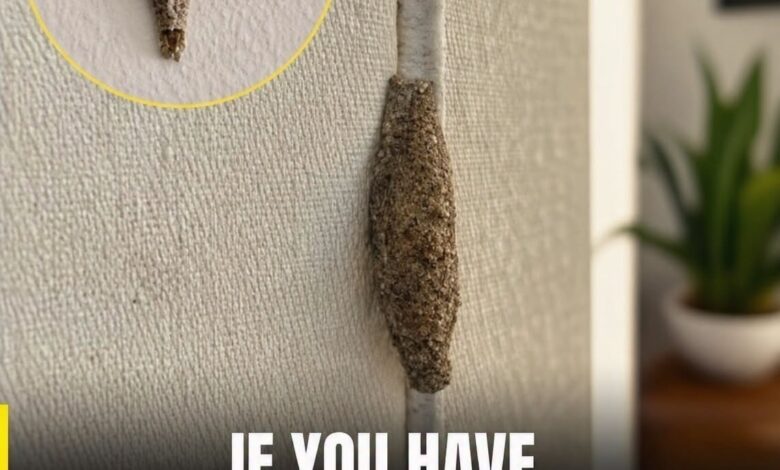
At first, it looks like nothing.
A tiny gray speck clinging to the wall.
Maybe a piece of lint.
A bit of dried dirt.
Something caught in an old cobweb.
You notice it near the ceiling, make a mental note to wipe it away later, and continue with your day.
Then, sometime afterward, you look again.
The speck has moved.
Not much.
Perhaps only a few centimeters.
But enough to make you stare.
That little piece of “dirt” may not be dirt at all.
It could be a case-bearing moth larva, commonly called a household casebearer and often casually referred to as a bagworm. And the strange object crawling across the wall isn’t merely something stuck to the insect.
It’s the insect’s portable home.
The larva constructs its case from whatever materials it can collect from its surroundings. Dust, lint, hair, tiny fibers, spider-web material, and other debris can become woven into the structure.
The result is remarkably effective camouflage.
Instead of looking like an obvious insect crawling openly across a clean wall, it resembles exactly the kind of household debris most people have trained themselves to ignore.
That is what makes the discovery so unsettling.
It has been hiding in plain sight.
The larva remains protected inside its little case, extending enough of its body to move and feed before retreating again.
From a distance, the whole thing can look almost lifeless.
Then it crawls.
Once you’ve recognized one, you may suddenly begin noticing others.
Along ceiling edges.
In corners.
Near baseboards.
Behind furniture.
Inside closets.
Around headboards.
Under beds.
In laundry areas.
In bathrooms.
Places where lint, hair, dust, dead insects, spider webs, and other organic debris accumulate can provide exactly the kind of environment these tiny scavengers exploit.
That doesn’t mean your house is filthy.
Even well-maintained homes contain microscopic ecosystems.
Hair falls.
Fabric sheds.
Dust settles.
Spiders build webs.
Tiny insects enter through doors and windows.
Furniture creates inaccessible spaces where debris can accumulate unnoticed.
A spotless-looking bedroom can have an entirely different landscape underneath the bed.
Move furniture that hasn’t shifted in months and you may discover dust clinging to the wall, abandoned webs in the corners, strands of hair caught against the baseboard, and lint collected where a vacuum rarely reaches.
To us, that’s something to clean.
To a tiny larva, it can be habitat.
This is why spotting one shouldn’t automatically trigger panic.
A few cases on a wall do not necessarily mean your home is experiencing some catastrophic infestation.
Instead, treat them as information.
Something in that area is allowing them to survive.
The solution often begins not with spraying everything in sight, but with removing the environment that supports them.
Start with the obvious specimen.
Vacuum it up or physically remove it rather than leaving it attached to the wall.
Then look around.
Not just at eye level.
Look upward.
Inspect where the walls meet the ceiling.
Check the corners.
Look behind curtains.
Examine the area around wardrobes and dressers.
Move the bed if possible.
Check beneath furniture.
Inspect baseboards carefully.
You may be surprised by how much material accumulates in places that appear clean during ordinary daily life.
Vacuum thoroughly.
A quick pass across the center of the floor isn’t enough.
Use attachments to reach edges, cracks, corners, and other neglected areas.
Run the vacuum along baseboards.
Reach into ceiling corners where cobwebs remain.
Clean behind furniture.
Pay particular attention to places where lint and hair collect.
Then remove spider webs.
This matters because webs and the material caught in them can provide useful resources for case-bearing larvae.
That forgotten cobweb high in the corner may seem harmless, especially if the spider has disappeared.
But leaving it indefinitely creates another reservoir of material.
Wipe it away.
Do the same around windows, closet ceilings, storage spaces, and other quiet areas.
Bedrooms deserve particular attention.
Beds naturally create difficult-to-reach zones.
Hair, skin debris, fabric fibers, and dust accumulate underneath and behind them.
A headboard pressed against a wall can create a protected strip that may go untouched for months.
Pulling the bed away from the wall occasionally can reveal an entirely different world.
Vacuum it.
Wipe the wall.
Clean the baseboard.
Check the underside and surrounding corners.
Closets are another obvious target.
A closet can remain dark and undisturbed for long periods, especially behind boxes or clothing that is rarely moved.
Take items out periodically.
Vacuum the floor and edges.
Shake out stored fabrics.
Remove abandoned webs.
Avoid allowing piles of unused textiles to sit indefinitely without inspection.
If you notice damage to natural-fiber clothing or stored fabrics, don’t simply assume every case on the wall is responsible. Different household moth species and other pests can be involved, and correct identification matters before choosing a treatment.
Laundry rooms can also collect surprising quantities of lint.
Everyone knows to clean a dryer’s lint filter regularly, but lint does not restrict itself to the filter.
It drifts.
It settles behind machines.
It catches against walls and pipes.
It gathers underneath appliances.
Clean those areas when they can be reached safely.
Bathrooms present another combination of protected corners, hair, lint, and occasional spider webs.
Again, the principle is simple:
Remove what the larvae can use.
The less debris available, the less welcoming the environment becomes.
Regular cleaning also interrupts their ability to remain unnoticed.
That matters more than achieving some impossible standard of sterility.
Your house does not need to become a laboratory.
It needs fewer forgotten zones.
Think about cleaning in terms of disturbance.
Many small household pests benefit from places humans rarely touch.
Behind the dresser.
Above the wardrobe.
Inside the back corner of a closet.
Under the bed.
Along the ceiling.
Behind stored boxes.
When those places are routinely vacuumed, wiped, inspected, and disturbed, it becomes much harder for a hidden population to establish itself unnoticed.
This also explains why simply removing the visible cases may not solve the problem.
If you pick three little “bags” off the wall but leave months of lint and cobwebs untouched behind the furniture, you’ve removed the symptom without changing the conditions.
Clean the habitat.
Then monitor.
After a thorough cleaning, pay attention over the following days and weeks.
Are new cases appearing?
Where?
How many?
Are they concentrated in one room?
Do you see actual moth activity?
Is clothing being damaged?
Patterns provide clues.
If you removed one or two cases and none return, extensive intervention may not be necessary.
If they repeatedly appear despite thorough cleaning, or if you’re seeing substantial numbers or textile damage, the situation deserves closer investigation.
At that point, identification becomes especially important.
“Bagworm” is a broad informal label that people use for different case-carrying insects, and not everything that looks similar has identical habits.
A local pest professional or entomology resource may be able to identify a specimen and determine what you’re actually dealing with.
That is more useful than blindly applying insecticides based on a photograph or social-media post.
It is also safer.
The internet has a tendency to turn every household insect into an emergency.
One strange bug appears on a wall and suddenly you’re told to fumigate the house, throw away your clothes, replace your mattress, and question every decision you’ve made since childhood.
Usually, reality is less dramatic.
Homes contain insects.
Most of them are not evidence of personal failure.
Buildings provide warmth, shelter, moisture, food, and thousands of tiny hiding places.
The goal isn’t to create a completely insect-free biological vacuum.
The goal is to notice when something is becoming established and remove the conditions encouraging it.
There is another reason these little cases fascinate people.
They are ingenious.
Unpleasant to discover in your bedroom?
Absolutely.
But ingenious nonetheless.
Imagine being a larva only a few millimeters long in a world full of predators and environmental hazards.
Your solution is to construct armor from the environment itself.
A strand of hair becomes building material.
Lint becomes camouflage.
A piece of web becomes structural material.
Dust becomes disguise.
Then you carry the entire structure with you.
The thing humans mistake for garbage is, from the larva’s perspective, architecture.
That doesn’t mean you need to let it live above your bed.
Admiration and eviction can coexist.
Vacuum it up.
Then clean the room.
There is no need for guilt and usually no reason for horror.
In fact, the discovery can be useful.
That moving speck is effectively pointing toward the parts of your cleaning routine that are easiest to overlook.
Maybe you vacuum every week but never reach the ceiling corners.
Maybe the visible bedroom is immaculate while the area behind the headboard hasn’t been touched since the furniture was installed.
Maybe boxes have been sitting against the closet wall for years.
Maybe lint has accumulated behind the dryer.
The insect has found the blind spot.
Now you know where it is.
A practical routine is straightforward.
Vacuum floors normally, but periodically add the perimeter.
Use the attachment along baseboards and wall edges.
Clean corners.
Remove cobwebs as soon as you notice them.
Move lightweight furniture occasionally.
Inspect behind beds and headboards.
Keep closets reasonably organized so the floor and walls remain accessible.
Shake out or inspect fabrics that have been stored for long periods.
Control excessive lint.
Don’t allow dead insects and webbing to remain indefinitely in forgotten corners.
You don’t have to do all of this every day.
Consistency matters more than obsession.
And don’t rely entirely on whether a room “looks clean.”
Humans naturally judge cleanliness from the spaces we can see.
Pests exploit the spaces we can’t.
Under.
Behind.
Above.
Inside.
Those are the directions worth remembering.
There is also no benefit in becoming hypervigilant about every fleck on the wall.
Most dirt really is dirt.
Most lint really is lint.
The difference becomes obvious when the supposed debris changes position or when multiple similar cases begin appearing in characteristic areas.
If you’re curious, observe from a reasonable distance.
You may eventually see the larva extend itself and slowly drag the case forward.
That tiny movement is the moment many homeowners realize the thing they’ve been ignoring isn’t attached to the wall at all.
It’s traveling across it.
And once you’ve seen that, you’ll probably never look at a suspicious piece of lint quite the same way again.
Still, keep the discovery in perspective.
One tiny case is not a declaration that your home has been conquered.
It is a signal.
Remove it.
Inspect the area.
Clean thoroughly.
Reduce dust, hair, lint, cobwebs, and other accumulated debris.
Then watch for recurrence.
If nothing else appears, continue ordinary maintenance.
If numbers increase or fabrics show damage, identify the pest accurately and consider professional guidance.
Simple.
Measured.
No panic required.
Because the most effective response to many household pests isn’t fear.
It’s understanding what allows them to stay.
Case-bearing larvae thrive by taking advantage of what we overlook.
The silent corner.
The forgotten web.
The lint behind the furniture.
The dust beneath the bed.
Take those resources away and your home becomes considerably less attractive.
The strange little “bag” on the wall loses both its camouflage and its support system.
And that may be the most useful thing about discovering one.
It forces you to look at your house from a completely different scale.
What appears to you as an insignificant strand of hair may be construction material.
What looks like a harmless cobweb may be food or shelter.
What feels like an empty gap behind the dresser may be an entire protected habitat.
Clean those spaces, and the equation changes.
So the next time you notice a tiny gray-brown fleck clinging to a wall, don’t immediately assume you’ve discovered some horrifying infestation.
But don’t automatically dismiss it as dirt either.
Take a closer look.
If the “dust” has built itself a house and started walking away with it, you’ve found your answer.
Then reach for the vacuum.
Your tiny tenant has already packed its own luggage.