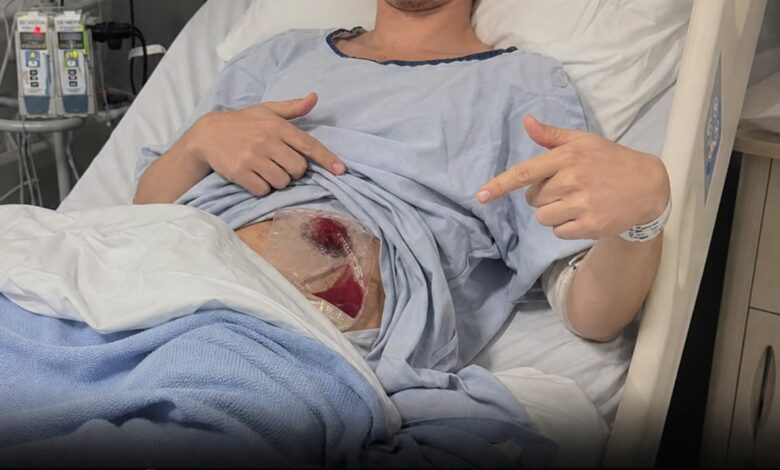
At 30, Jordan Brunoli thought he had time.
Time to make more music.
Time to play more shows.
Time to build the kind of future most people his age assume is still waiting somewhere comfortably ahead.
What he did not expect was to find himself fighting to convince people that something was seriously wrong inside his own body.
The symptoms were real.
So was the fear.
Yet the reassurance came easily.
It was probably a virus.
Something temporary.
Something that would pass.
Jordan was young, after all.
And youth has a dangerous way of being mistaken for immunity.
When you’re 30, cancer can sound like a disease belonging to another stage of life. It belongs to somebody’s parent, somebody’s grandparent, somebody decades older.
Until it doesn’t.
Jordan knew what he was feeling wasn’t normal.
His body was telling him something with an urgency that casual reassurance could not silence.
Still, he felt dismissed.
The explanation remained frustratingly ordinary while his condition felt anything but ordinary.
Just a virus.
Wait.
See what happens.
Hope it improves.
But Jordan didn’t improve.
Eventually, doctors looked deeper.
And when they finally found the answer, it wasn’t the reassuring explanation everyone had hoped for.
It was colorectal cancer.
Worse, the disease had already spread.
His liver was involved.
So were his lymph nodes.
Suddenly, the problem wasn’t simply cancer.
It was advanced cancer.
The kind of diagnosis that divides a life instantly into two eras:
Before you knew.
And after.
One day, you’re thinking about work, friends, music, plans, bills, rehearsals, and whatever you’re doing next weekend.
Then somebody says the word “cancer,” and the future stops behaving like a promise.
Jordan was forced into a world he had never expected to enter so young.
Appointments.
Scans.
Blood tests.
Treatment plans.
Surgeries.
Chemotherapy.
Medical language that quickly becomes part of everyday conversation because you have no choice but to learn it.
The body that once allowed him to move through life without much negotiation suddenly became the center of everything.
What can it tolerate?
What is the cancer doing?
Did the treatment work?
What does the next scan show?
What happens now?
There is a particular cruelty in becoming seriously ill at an age when everyone around you seems to be accelerating into life.
Friends are making plans years ahead.
Careers are developing.
Relationships are deepening.
People are talking about houses, weddings, children, holidays, tours, ambitions.
And you are learning how to interpret test results.
Jordan’s diagnosis also destroyed one of the most comforting assumptions surrounding colorectal cancer:
That young people don’t really need to worry about it.
His experience became evidence that “too young” is not a diagnosis.
A person’s age can influence probability.
It cannot make serious disease impossible.
That distinction became part of the story Jordan decided to tell publicly.
He could have retreated.
Nobody could reasonably have blamed him.
There is no moral obligation to turn illness into advocacy.
A person with cancer does not owe strangers inspiration, education, bravery, or a public diary of their suffering.
Sometimes surviving the day is enough.
But Jordan made a different choice.
He talked.
About what happened.
About being dismissed.
About colorectal cancer.
About the danger of assuming that a younger person’s symptoms must automatically have a harmless explanation.
In doing so, he turned his own nightmare into a warning.
Listen to your body.
Take persistent symptoms seriously.
Ask questions.
Keep asking when something feels wrong.
And don’t let the idea that you’re “too young” become the end of the investigation when your body is telling you otherwise.
The message was not about panic.
It was about attention.
Because early symptoms can be easy to rationalize.
People are busy.
They don’t want to seem dramatic.
They don’t want to waste a doctor’s time.
They search for ordinary explanations because ordinary explanations are comforting.
Maybe it’s stress.
Maybe it’s diet.
Maybe it’s a bug.
Maybe it’ll disappear next week.
Often, symptoms really do have harmless causes.
But when something persists, worsens, changes, or simply doesn’t feel right, reassurance should not become a substitute for appropriate evaluation.
Jordan learned how costly delay can feel when the eventual diagnosis is already advanced.
Yet cancer did not merely invade his medical life.
It threatened the thing through which he understood himself.
Music.
Before all the scans and hospital rooms, Jordan was a musician.
Cancer could call him a patient.
Doctors could describe him using diagnoses and treatment histories.
But those labels did not erase the person who existed before them.
He still wanted to create.
So while treatment attacked the disease, Jordan kept returning to music.
Sometimes under conditions that would have made quitting entirely understandable.
Chemotherapy can leave marks that are invisible to anyone who has never experienced it.
Exhaustion.
Nausea.
Weakness.
Pain.
Mental fog.
And, for Jordan, neuropathy.
The sensation in his hands became so badly affected that there were times he struggled to feel the guitar properly.
For a guitarist, that isn’t a minor inconvenience.
Hands are language.
Pressure matters.
Touch matters.
The relationship between fingertips and strings is built through thousands of hours of repetition until movements become almost instinctive.
Then imagine losing reliable sensation.
You know where your fingers should go.
You remember how the instrument should feel.
But the physical feedback that once connected you to it has been disrupted.
Cancer wasn’t content merely to threaten Jordan’s life.
Treatment was interfering with the way he expressed that life.
Still, he recorded.
Through surgeries.
Through chemotherapy.
Through the uncertainty of whether any particular treatment would finally be the one that worked.
He kept making the album that would become Head Noise.
The title feels almost painfully appropriate.
Serious illness creates its own relentless internal soundtrack.
What if this treatment fails?
What will the scan show?
How much time is left?
Should I make plans?
Is it cruel to make plans?
What do I tell people?
What don’t I tell them?
How do I spend today when tomorrow has suddenly become negotiable?
The noise can become deafening.
Music offered another sound.
One Jordan could control.
Recording meant there was still something being created while cancer was destroying.
Every finished song pushed against the idea that his remaining life belonged entirely to disease.
That distinction became increasingly important as treatment after treatment failed to deliver the future everyone wanted.
Cancer stories are often told using the language of battle.
Fight.
Warrior.
Victory.
Defeat.
Beat cancer.
Lose the battle.
Those words can feel empowering for some people.
They can also create an unfair implication: that survival is something earned through sufficient courage.
Jordan had courage.
He underwent treatment.
He endured surgeries.
He kept going.
But courage cannot guarantee that a drug will work.
Determination cannot order malignant cells to disappear.
When treatments fail, the person has not failed.
The disease has simply refused to respond the way everyone desperately hoped it would.
Eventually, the conversation changes.
Not because hope disappears completely.
Because hope changes its address.
At first, hope might mean cure.
Then another treatment.
Then more time.
Then enough strength to finish something meaningful.
Enough time to see certain people.
Enough good days to live rather than merely remain alive.
For Jordan, music became part of that recalibration.
Head Noise wasn’t simply another project waiting for release.
It became evidence.
I was here.
I made this.
Cancer occupied my body, but it did not receive exclusive ownership of my identity.
And then came the shows.
Farewell shows.
There is something almost unbearable about putting those two words together.
A concert normally points forward.
See you next time.
Another venue.
Another album.
Another tour.
A farewell show acknowledges the possibility that “next time” may not exist.
But Jordan did not seem interested in turning the stage into a funeral held prematurely.
He wanted to play.
To be with people.
To hear the music outside himself.
To experience the electricity that exists when performers and an audience occupy the same room and, for an hour or two, agree to care about nothing except what is happening right there.
Cancer measures time clinically.
Months.
Cycles.
Appointments.
Prognoses.
Music measures it differently.
Bars.
Beats.
Songs.
A set list.
An encore.
Maybe that was precisely what Jordan needed.
To stop counting life only in medical units.
Because somewhere along the way, illness can consume a person’s identity.
People stop asking what you’re making and ask how treatment is going.
They stop talking about ordinary nonsense because they are frightened of wasting your limited time.
Every conversation becomes heavy.
Every visit starts carrying the emotional weight of possibly being the last.
The sick person can gradually disappear behind the sickness.
Jordan seemed determined not to allow that.
He was still a musician.
Still a friend.
Still someone capable of laughing, swearing, creating, performing, and wanting things.
He was dying, but he was also living.
Those statements are not contradictory.
In fact, one of the most profound things terminal illness exposes is how badly the rest of us confuse them.
We imagine dying as something that begins after living stops.
But people with terminal diagnoses still wake up.
They drink coffee.
Send messages.
Get irritated.
Listen to songs.
Laugh at stupid jokes.
Make plans for Friday.
Cancel plans because they’re exhausted.
Fall asleep.
Wake again.
Life continues inside the knowledge that it will end.
Jordan’s refusal to spend whatever remained solely as “a patient” was therefore not denial.
It was reclamation.
Medicine had an important role.
Doctors mattered.
Treatment mattered.
But he was more than the body being treated.
And when treatment could no longer offer what everyone wanted from it, the question became brutally simple:
What do you do with the time that remains?
Jordan’s answer was not subtle.
He intended to enjoy the f*** out of it.
There is anger in that declaration.
Humor too.
Defiance.
But most importantly, permission.
Permission to stop performing the role of the appropriately tragic dying person.
Permission to have fun.
Permission to make noise.
Permission to spend limited energy on things that may have no medical value whatsoever but enormous human value.
A guitar.
A friend.
A stage.
A song.
A night people will remember.
Terminal illness has a way of making ordinary pleasures look almost revolutionary.
We spend so much of healthy life postponing them.
I’ll call them later.
I’ll take the trip eventually.
I’ll make the record when things calm down.
I’ll tell them next time.
I’ll enjoy myself after I finish everything important.
But “later” is a privilege nobody actually possesses.
Most of us simply behave as though we do.
Jordan lost that illusion earlier than anyone should.
There is nothing beautiful about that.
Cancer does not become a gift merely because somebody extracts meaning from living with it.
Pain is still pain.
A shortened future is still a devastating loss.
Friends still have to contemplate a world without someone they expected to grow older beside.
Family members still carry anticipatory grief.
There is no inspirational slogan capable of making that fair.
What Jordan could control was what he did inside the unfairness.
He chose visibility.
He chose music.
He chose to speak about what happened to him.
He chose to use his experience to challenge the assumption that colorectal cancer belongs only to older people.
And he chose to make the end of his life belong to him as much as possible.
That may be the most powerful part of his story.
Not that he was fearless.
Fearlessness is overrated.
Courage is doing something meaningful while fear remains in the room.
Jordan knew what his prognosis meant.
He understood what failing treatments meant.
He knew why the shows were being called farewells.
And he picked up the guitar anyway.
Even when his hands betrayed him.
Even when neuropathy interfered with the physical connection he had spent years developing.
Even when recording required more from him than it once had.
The music survived.
Soon, other people would hear Head Noise without sitting in the hospital rooms where parts of it were forged.
They might hear guitars.
Melodies.
Lyrics.
Production.
Jordan would hear something else too.
The surgeries he worked around.
The chemotherapy.
The numbness.
The uncertainty.
The stubborn decision to finish.
Albums usually preserve a period in an artist’s life.
This one carries the weight of a man creating while confronting the possibility that there might not be another.
That changes the silence after the final track.
But Jordan’s story should not become only an elegy.
That would repeat the very reduction he seems to resist.
He does not want his remaining identity swallowed by cancer.
So remember the disease.
Remember the warning.
Remember that persistent symptoms deserve attention regardless of age.
Remember how damaging it can feel when someone’s concerns are dismissed simply because serious illness seems statistically unlikely.
But also remember the musician.
The man making noise while his body was being pushed through treatment.
The friend who still wanted ordinary human connection.
The person who refused to turn every remaining day into a waiting room.
There is an important distinction between accepting death and surrendering life.
Jordan appears determined to demonstrate it.
Cancer may determine how much time he gets.
It does not get to decide what every minute means.
Some of those minutes will belong to grief.
Some to exhaustion.
Some to people he loves.
And some will belong to amplifiers, guitars, stages, and songs played loudly enough that nobody in the room can pretend he has already disappeared.
That is the answer Jordan seems to have chosen.
Not a sentimental ending.
Not false optimism.
Not pretending everything will somehow be okay.
Something fiercer.
If time is short, make it yours.
If your body limits what you can do, do what remains possible.
If people have reduced you to a diagnosis, remind them who was there before the diagnosis arrived.
If you still have something to create, create it.
And if there is enough strength left to climb onto a stage, stand beneath the lights and make enough noise to drown out cancer for one more night.
Jordan Brunoli was told, in effect, that his future had become painfully small.
His response was to fill what remained.
With honesty.
With friends.
With awareness.
With music.
With Head Noise.
Cancer may have taken the certainty of tomorrow.
But it never managed to take the one thing Jordan kept choosing for himself:
What to do with today.