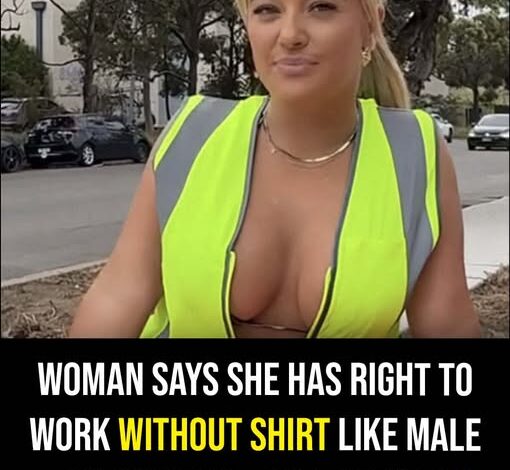
The debate surrounding Shianne Fox — widely known online as “The Bikini Tradie” — has become about far more than clothing on a construction site.
On the surface, the argument seems straightforward:
if male workers are allowed to remove shirts in extreme heat, why should women be treated differently?
Australia’s brutal summer temperatures make the question feel practical as much as political. Construction sites can become punishing environments where heat exhaustion, dehydration, and physical strain are genuine occupational hazards. Fox frames her position through that lens of equality and bodily autonomy:
if bodies are natural and heat affects everyone, then women should be trusted with the same freedom men already exercise openly.
To her supporters, the issue exposes a double standard rooted less in safety and more in discomfort with female bodies themselves. Men working shirtless are often viewed as ordinary or even expected in physically demanding outdoor labor. Women doing the same immediately become controversial, sexualized, or accused of seeking attention.
That contrast raises an uncomfortable question:
is equality truly equality if it disappears the moment women exercise the same freedoms normalized for men?
Fox also argues that visibility matters. Skilled trades remain heavily male-dominated industries, and many sectors are actively struggling with labor shortages. She believes presenting trades as more open, confident, and less restrictive toward women could potentially attract more female participation into environments where women have historically felt excluded or unwelcome.
But the backlash reveals emotional layers far deeper than a simple dress-code dispute.
Many female tradies criticizing Fox are not reacting primarily from conservatism or prudishness. They are reacting from exhaustion.
For decades, women entering construction, electrical work, plumbing, welding, and other trades have fought to be evaluated primarily through competence rather than appearance. Many describe spending years navigating environments where they were:
underestimated,
sexualized,
talked down to,
or treated as novelties instead of professionals.
In that context, some fear highly sexualized online branding risks reinforcing exactly the stereotypes they have worked hardest to dismantle.
Their concern is not only:
“Should women be allowed to go topless?”
It is:
“What are the consequences for women trying to build long-term professional respect inside workplaces already struggling with gender bias?”
That distinction matters enormously.
Because while Fox experiences empowerment through visibility and bodily confidence, other women experience vulnerability through the same dynamics. A younger apprentice entering a male-dominated site may already feel pressure surrounding appearance, harassment, or credibility. Some fear that emphasizing sexuality — even voluntarily — could intensify assumptions that women on worksites exist to be looked at before they are listened to.
And importantly, both perspectives contain legitimate emotional truth.
One side argues equality means equal freedom.
The other argues equality means equal dignity and professional recognition.
Those goals are not always perfectly aligned in practice.
The debate also exposes broader cultural confusion surrounding feminism and workplace equality in modern society. Earlier generations of workplace feminism often focused heavily on minimizing gender-based differences professionally:
women wanted access,
respect,
fair pay,
and evaluation based on skill rather than appearance.
More contemporary conversations sometimes emphasize autonomy differently:
the right to define empowerment personally,
including through visibility, sexuality, or rejection of traditional modesty expectations.
Conflict emerges when these frameworks collide.
For some women, empowerment means refusing shame around the body entirely.
For others, empowerment means being allowed to work without the body becoming central to workplace identity at all.
Neither perspective is entirely simple.
Construction sites themselves complicate the issue further because they are not purely symbolic spaces. They are physically dangerous environments governed by safety regulations, liability concerns, and workplace culture. Questions about appropriate attire intersect not only with equality debates, but with:
sun protection,
protective equipment,
harassment policies,
professional standards,
and employer responsibilities.
Public reaction became especially intense because social media compresses these complex workplace realities into viral imagery and polarized commentary. Online audiences often consume stories like this through simplified narratives:
freedom versus oppression,
confidence versus sexism,
attention-seeking versus empowerment.
But real workplaces are emotionally messier than internet debates.
A woman working in trades may simultaneously want bodily autonomy,
professional respect,
protection from harassment,
and freedom from restrictive double standards.
Those desires can coexist while still creating tension around how equality should function practically.
Perhaps the deepest issue exposed by the controversy is the difference between sameness and transformation.
For decades, workplace equality discussions often aimed at giving women access to freedoms men already possessed. If men could do something without criticism, women should be able to do it too.
But some critics now ask whether mirroring male workplace norms necessarily produces healthier environments overall. If shirtless male labor culture itself contributes to hypermasculine or unprofessional atmospheres, should equality mean extending that culture universally — or reconsidering workplace standards for everyone?
That reframing changes the conversation completely.
The question stops being:
“Why can men remove shirts but women can’t?”
And becomes:
“What kind of workplace culture actually supports dignity, safety, and respect for all workers?”
That is a much harder conversation because it challenges assumptions on multiple sides simultaneously.
Importantly, the emotional intensity surrounding Fox also reflects how heavily women’s bodies remain symbolically loaded in public culture. Male shirtlessness rarely generates national debates about professionalism, morality, feminism, or societal collapse. Female bodies still carry layers of cultural anxiety involving sexuality, power, objectification, and public control that men often move through without noticing.
That imbalance explains why identical acts can produce radically different reactions depending on gender.
Yet the female tradies criticizing Fox are also responding to lived experience rather than abstract ideology. Many have spent years proving competence repeatedly in environments where mistakes are remembered more harshly and credibility is harder won. They fear anything shifting attention away from skill toward appearance risks reinforcing barriers already exhausting to navigate.
And perhaps that is why this debate resonates so strongly:
because underneath arguments about bikinis and construction sites lies a larger unresolved cultural question about what equality should actually look like.
Is freedom enough on its own?
Is visibility empowering or limiting?
Can bodily autonomy coexist comfortably with professional neutrality?
Do women gain equality by entering existing systems unchanged, or by reshaping workplace culture entirely?
There are no simple answers.
But maybe the most revealing part of the controversy is that nearly everyone involved ultimately wants the same deeper thing:
a world where women in trades are respected fully as workers,
not reduced to stereotypes,
not excluded from opportunity,
and not forced to choose between visibility and credibility.
The disagreement lies in how to get there.
And that tension — between freedom, perception, professionalism, and identity — says far more about modern society than any viral worksite photograph ever could.