Farmer Finds Hundreds Of Strange Eggs In His Crops – But When They Hatch, He Bursts Into Tears

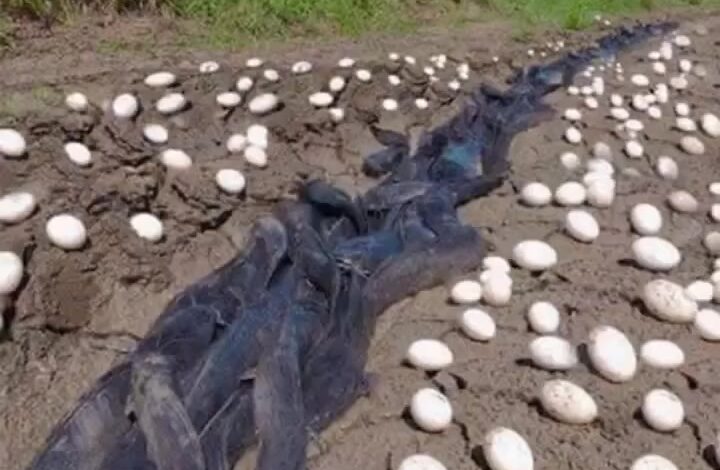
When Thomas Rayner first saw the creature move beneath the fractured soil of his back field, he thought grief had finally begun distorting his mind.
The land behind his farmhouse had been quiet for years.
Too quiet.
After his wife Eleanor died, silence settled over the acreage like frost that never fully melted. The porch swing stopped creaking at night because nobody sat there anymore. The vegetable garden shrank season by season until weeds reclaimed half the rows she once kept perfectly straight. Even the birds seemed fewer somehow, as though the world itself recognized that something gentle had disappeared from the property and decided not to linger too long afterward.
Thomas adapted the way lonely people often do:
through routine.
Coffee before sunrise.
Fence repairs no longer urgently needed.
Long evenings listening to old radio stations drifting through static while dusk rolled slowly across the fields.
At seventy-two, he had stopped expecting surprises from life.
That was why the movement in the soil unsettled him so deeply.
At first it looked almost like moonlight trapped underground.
A faint silver shimmer pulsing beneath the dirt near the old pear trees Eleanor used to love. Thomas stood motionless beside the fence line gripping his flashlight tighter while cold wind moved softly through the grass around his boots.
Then the earth split open gently.
Not violently.
Not dramatically.
As though something delicate was simply unfolding itself into existence.
The creature that emerged could not be explained by any ordinary category his mind recognized.
It was small enough to fit inside his hands, fragile-looking at first glance, yet strangely luminous beneath the fading evening sky. Silver-tipped wings folded tightly against its narrow body while soft blue light traveled faintly beneath translucent skin like distant starlight moving under water.
Thomas should have felt fear.
Instead, he felt memory.
Because the creature tilted its head in a very specific way before looking directly at him with wide amber eyes filled not with aggression, but curiosity.
And suddenly he was twenty-six again sitting beside Eleanor on the porch while summer storms rolled across distant hills. She always tilted her head that exact same way whenever she noticed something beautiful before he did.
A bird’s nest hidden beneath the railing.
Lightning bugs blinking in tall grass.
The moon turning fields silver after midnight.
Eleanor spent her entire life believing wonder deserved protection.
“Most people stop seeing magic because they get embarrassed by needing it,” she once told him.
Standing there in the cold field decades later with impossible silver wings trembling in his hands, Thomas heard her voice so clearly it nearly brought him to his knees.
The creature made no sound.
It simply looked at him trustingly.
And in that moment, Thomas made a decision that would quietly alter the rest of his life.
He chose not to fear the unknown.
He chose to shelter it.
He carried the tiny being carefully inside wrapped in Eleanor’s old quilt while snow began falling softly beyond the farmhouse windows. The creature curled against the warmth almost immediately, wings folding tighter as though exhaustion had finally overtaken it.
Thomas sat awake beside the kitchen table all night watching it breathe.
By morning, there were three more.
They emerged near the same patch of disturbed earth beneath the pear trees, each one slightly different:
varying patterns of silver along their wings,
different shades of glowing light beneath delicate skin,
different curious little expressions when they studied him cautiously from the grass.
He called them Aetherlings because no other word felt right.
Something about them seemed less biological than celestial, as though fragments of night sky had learned briefly how to become alive.
For several days, Thomas told nobody.
Not because he feared ridicule exactly.
Because the creatures felt too fragile for the world outside his property.
He understood what people would do once discovery replaced wonder:
scientists would dissect,
journalists would sensationalize,
corporations would monetize.
Human beings rarely leave miracles untouched for long.
But secrecy became impossible after a passing drone photographer captured footage of silver-winged shapes spiraling above Thomas’s fields one evening at sunset.
Within forty-eight hours, trucks arrived.
Researchers.
Reporters.
Government officials.
People carrying cameras and clipboards and urgent questions.
The tiny farmhouse transformed overnight into an international curiosity.
They wanted samples.
Measurements.
Bloodwork.
Access.
Thomas hated the way they spoke about the creatures.
Specimens.
Resources.
Anomalies.
Not living beings.
One young biologist arrived carrying enough empathy to notice his discomfort immediately.
Her name was Dr. Maya Chen.
“They trust you,” she observed quietly after watching an Aetherling perch calmly on Thomas’s shoulder while avoiding everyone else.
Thomas looked down at the tiny creature grooming silver feathers carefully beneath the porch light.
“Maybe they know I’ve buried enough things already,” he answered.
That sentence stayed with her.
Together, they slowly created boundaries around the property.
Fences went up, but not to imprison the Aetherlings.
To protect them.
Security blocked invasive media crews.
Researchers underwent strict supervision.
Every interaction prioritized the creatures’ safety first rather than scientific ambition.
Many criticized Thomas publicly for it.
Some called him naïve.
Others accused him of obstructing discoveries that could “benefit humanity.”
But Thomas remained stubborn.
Because somewhere beneath all the global fascination, he understood something deeply simple:
wonder becomes cruelty very quickly once profit enters the room.
The acreage changed over the following months.
Not physically at first.
Emotionally.
Life returned.
The Aetherlings multiplied slowly, nesting beneath trees and abandoned sheds while filling the night sky with impossible spirals of silver-blue light. At dusk, they rose together above the fields like living constellations twisting through the darkness.
People drove miles just hoping to glimpse them from distant roadsides.
Children pressed against fences staring upward in stunned silence.
Scientists argued endlessly over origin theories.
Religious leaders called them signs.
Skeptics called them elaborate hoaxes.
Thomas ignored most of it.
His world narrowed beautifully instead.
Morning feeding routines.
Repairing sheltered nesting spaces.
Watching the creatures learn trust gradually enough that some eventually landed directly in his weathered hands.
He named every one.
Eleanor would have done the same.
Some names came from old jazz singers she loved.
Others from stars visible above the farmhouse porch during clear winter nights.
One especially mischievous Aetherling repeatedly stole shiny buttons from Thomas’s jacket pockets and hid them beneath flowerpots. He named her June after Eleanor’s younger sister who once stole silverware during family dinners for reasons nobody fully understood.
For the first time since Eleanor’s death, laughter returned naturally to the property.
Not forced.
Not nostalgic.
Alive.
Dr. Chen noticed the transformation before Thomas did.
“You smile now,” she told him one evening while they watched dozens of Aetherlings sweep low across the fields beneath a sky burning orange with sunset.
Thomas looked genuinely surprised.
As though smiling had become something he forgot his body still knew how to do.
The strangest thing about grief is how thoroughly it convinces people their emotional world has permanently ended.
After enough loss, survival begins feeling smaller each year:
fewer risks,
fewer attachments,
fewer reasons to imagine tomorrow differently than today.
But the Aetherlings disrupted that shrinking.
Not because they solved grief.
Nothing does.
Eleanor remained gone.
The porch still held absence.
Certain songs still hollowed him out unexpectedly.
But life had expanded around the sorrow instead of replacing it.
That distinction mattered enormously.
One evening nearly a year after the first emergence, Thomas stood alone beside the fields while hundreds of silver-winged shapes drifted silently through the darkening sky above him.
They moved together like breathing starlight.
Living wonder suspended over old farmland once emptied by loss.
Thomas thought then about the first night he held one trembling creature in his hands and realized how close he came to choosing fear instead of care.
How easily loneliness could have hardened him against astonishment entirely.
Instead, he built sanctuary.
Not just for the Aetherlings.
For himself.
Because somewhere between feeding impossible creatures at sunrise and watching children gasp at silver wings under evening skies, Thomas Rayner quietly reentered life.
And perhaps that became the true miracle hidden beneath the headlines and scientific debates.
Not the creatures themselves.
But the reminder they carried:
that hope can still hatch unexpectedly from broken ground,
that wonder sometimes arrives after people stop searching for it,
and that even lives hollowed deeply by grief remain capable of sheltering beauty again if they choose not to turn away from it when it finally appears trembling in the dark.