For several tense minutes, the center of American power no longer looked untouchable.
The White House complex is built to project permanence, order, and overwhelming security. Tourists photograph its fences. Reporters deliver live broadcasts calmly from the North Lawn. Staff move through rehearsed routines beneath layers of surveillance and armed protection so extensive that most people assume chaos could never truly break through there.
Then gunfire shattered the illusion again.
Witnesses described agents flooding the North Lawn almost instantly, voices cutting through the air with commands to get down as shots echoed sharply off surrounding government buildings. The sound reportedly transformed the atmosphere in seconds:
from ordinary Washington rhythm
to pure emergency instinct.
ABC correspondent Selena Wang was in the middle of recording when the shooting began. Like many journalists nearby, she reportedly dropped low and sprinted toward the press briefing room alongside camera crews and White House staff. Inside, doors were locked while a single armed agent guarded the entrance.
That detail captures the emotional reality of these moments powerfully.
The White House press corps spends years operating inside highly controlled environments where crisis is often observed rather than physically experienced. Reporters document national emergencies from podiums and briefing rooms, but suddenly becoming part of the emergency itself changes everything psychologically.
Outside the gates, Washington rapidly transformed into something witnesses compared to a war zone.
Streets sealed.
Armored vehicles arriving.
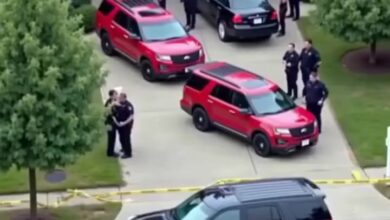
Heavily armed tactical teams moving block by block along 17th Street near the Eisenhower Executive Office Building.
National Guard personnel taking positions behind barricades.
FBI agents joining Secret Service response teams as overlapping radio traffic filled the air.
For bystanders and journalists sheltering nearby, the escalation reportedly felt both surreal and terrifyingly familiar. This was already the second time in weeks many members of the press corps had been forced into lockdown conditions following violence connected to high-profile political events, including the recent Correspondents’ Dinner shooting.
That repetition matters emotionally.
One security scare can feel shocking.
Repeated incidents begin altering the emotional atmosphere surrounding public life itself.
People stop viewing lockdowns as unimaginable interruptions and start experiencing them as recurring possibilities. The psychological effect of that shift is significant because it changes how journalists, tourists, staff, and officials move through spaces once associated primarily with ceremony and routine.
Inside the White House, President Trump reportedly remained working on diplomatic negotiations tied to a possible peace arrangement involving Iran while the lockdown unfolded beyond the gates.
That contrast feels almost painfully symbolic:
inside,
officials attempting to manage fragile international tensions;
outside,
armed federal teams responding to violence at the literal doorstep of the presidency.
Modern governance increasingly exists inside exactly this kind of layered instability. Political leaders attempt to negotiate wars, economic crises, and international conflict while simultaneously navigating rising domestic tension, threats against institutions, and growing public anxiety around political violence itself.
The White House has always represented more than a residence or office building.
It functions psychologically as a symbol of continuity. Even during wars, scandals, assassinations, and national emergencies, the building projects the idea that the American system remains standing. That symbolism is precisely why incidents near its perimeter feel so emotionally charged.
An armed individual approaching the White House does not merely threaten physical harm.
The act threatens perception:
the perception of safety,
control,
institutional stability,
and national confidence.
That is why the federal response becomes immediate and overwhelming.
Secret Service protocols are built around the assumption that hesitation can become catastrophic. Agents cannot wait calmly to determine intent once weapons are drawn near presidential security zones. Every second carries worst-case implications:
assassination attempts,
coordinated attacks,
mass casualty scenarios,
or diversions masking larger operations.
To the public, these responses can look militarized almost instantly.
But from a security perspective, speed is the point.
By around 7 p.m., authorities lifted the lockdown and confirmed the suspect had survived and been transported to a hospital. Investigators immediately began reconstructing the timeline:
why the individual approached the area,
whether political motives existed,
whether the attack was planned or impulsive,
and whether anyone else may have been involved.
Those investigations matter because violence near centers of political power reverberates psychologically far beyond immediate casualties. Even lone actors can create national emotional consequences disproportionate to the duration of the event itself.
And perhaps what lingers most after incidents like this is how abruptly normality disappears.
One moment:
journalists recording stand-ups,
tourists taking photos,
staff walking between buildings,
traffic flowing normally through downtown Washington.
Then suddenly:
agents screaming orders,
sirens closing streets,
rifles drawn,
people crouched behind podiums and barricades wondering whether more shots are coming.
Within minutes, the ordinary world feels unrecognizable.
Eventually the barricades come down.
Motorcades resume.
Press briefings continue.
Tourists return.
But something subtle changes each time.
People carry away the memory of how thin the boundary really is between routine and catastrophe. They remember how quickly familiar spaces transformed into emergency zones. And they remember the deeply unsettling realization that even the most fortified address in America can, for a few terrifying moments, feel exposed and vulnerable under the sound of gunfire.
That vulnerability is what stays with witnesses long after the streets reopen.
Not only fear of what happened —
but awareness of how quickly it could happen again.