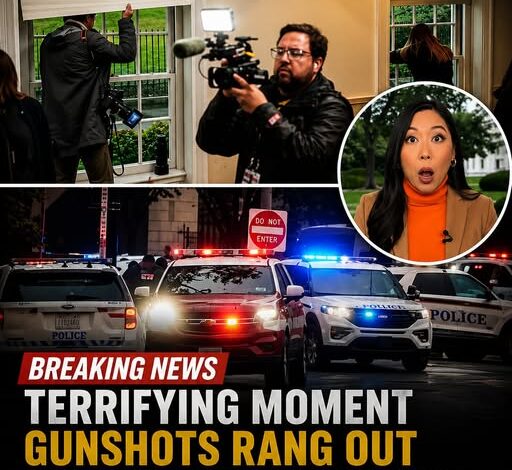
What made the moment so jarring was not only the sound of gunfire near the White House, but the sudden collapse of emotional distance.
For years, Selina Wang and the other journalists stationed on the North Lawn had reported on crises from a position that felt structured, controlled, almost ritualistic. Cameras rolled. Correspondents delivered polished standups. Behind them stood one of the most fortified buildings on earth — a symbol designed to project continuity no matter how turbulent the headlines became.
Then the first shots cracked through the evening air, and the illusion vanished instantly.
Wang was reportedly smiling into her iPhone moments earlier, mid-recording in the familiar media area known informally as “Pebble Beach.” The transition from ordinary reporting to raw survival happened in less than a heartbeat:
shouting,
agents sprinting,
reporters dropping low,
commands cutting through confusion.
The emotional power of the scene lies partly in how quickly professionalism gave way to instinct. Television correspondents spend careers narrating danger happening elsewhere:
wars overseas,
mass shootings,
political unrest,
natural disasters.
But this time, the danger surged directly into the physical space where they stood.
No teleprompter.
No prepared framing.
No emotional buffer.
Just fear.
Witnesses described Secret Service agents moving with overwhelming urgency as gunfire echoed near the perimeter around 17th Street and Pennsylvania Avenue. Reporters were reportedly ordered not simply to relocate calmly, but to run — immediately — toward the press briefing room as agents raced toward the gate where the shooter had opened fire.
That detail matters psychologically because emergency language changes atmosphere instantly. “Walk inside” suggests precaution. “Run now” signals mortal uncertainty.
And in moments like these, uncertainty becomes its own form of terror.
The White House is psychologically important not only because presidents work there, but because Americans associate it with layers upon layers of invisible protection. Most people assume that if anywhere in the country remains secure, it is there.
So when gunfire erupts near the gates, the event feels symbolically destabilizing far beyond the immediate danger itself.
If chaos can pierce even this perimeter, people instinctively wonder:
where is safety truly guaranteed?
Inside the briefing room, journalists reportedly crowded near windows, phones shaking while they filmed scenes they normally describe from emotional distance. That inversion is what makes Wang’s reaction resonate so deeply. Her later comment on X that it “sounded like dozens of gunshots” stripped away the polished neutrality audiences often associate with White House correspondents.
For a moment, viewers were not watching a composed political reporter analyzing events professionally.
They were watching another human being frightened in real time.
And perhaps that vulnerability mattered because modern journalism often demands emotional armor. Reporters covering politics are expected to remain measured even amid extraordinary events. Audiences consume their work through polished clips, carefully edited packages, and calm live shots that create the impression crises remain containable through information itself.
But gunfire disrupts narrative control immediately.
Bodies react before analysis begins:
adrenaline,
tunnel vision,
shaking hands,
the instinct to find cover.
In that sense, Wang’s visible fear became strangely connective. It reminded audiences that journalists covering national power structures are still physically vulnerable people operating inside unpredictable environments.
The image of Secret Service agents moving “with terrifying precision” also lingers emotionally because it captures the dual reality of modern presidential security:
reassuring and frightening simultaneously.
Their speed represented protection.
But it also signaled how seriously authorities perceived the threat.
Armored officers sprinting with rifles drawn transform symbolic government spaces into something resembling military zones within seconds. Streets seal. Radios erupt. Sirens layer over shouted commands. And suddenly the carefully managed public image of the White House gives way to the raw mechanics of crisis response.
For journalists sheltering inside, the experience reportedly carried additional emotional weight because it followed another recent shooting connected to the White House Correspondents’ Dinner.
Repeated lockdowns change how people psychologically inhabit spaces.
The first emergency shocks.
The second introduces anticipation:
the uneasy realization that this may happen again.
That repetition slowly erodes the sense of routine professionals rely upon to function normally. Every loud sound begins carrying potential threat. Every unusual movement draws attention.
And perhaps the most striking line in the account is this:
“the distance between those who cover danger and those who live it simply disappeared.”
That is exactly what happened.
Normally, journalism creates observational separation. Reporters stand beside events without fully entering them emotionally or physically. They become translators between crisis and public understanding.
But during those minutes, there was no separation left.
The correspondents were not narrating fear.
They were inside it.
Not discussing security responses abstractly,
but depending on them personally.
Not interviewing witnesses afterward,
but becoming witnesses themselves.
That collapse of distance reveals something important about modern public life too. Increasingly, political reporting in America unfolds inside environments shaped by rising tension, threats, and instability. Journalists covering power are no longer merely observers of conflict from comfortable remove. They are operating inside spaces where violence feels increasingly imaginable.
And yet, amid all the chaos, another emotional truth emerged:
gratitude.
Wang’s reflection reportedly emphasized not only fear, but relief that the response came faster than the bullets. That phrasing captures the terrifying arithmetic underlying protective security work around the presidency. In such moments, seconds matter overwhelmingly. The difference between containment and catastrophe often depends on reaction speed almost invisible to the public afterward.
Eventually the lockdown lifted.
The suspect was hospitalized.
The White House resumed operations.
The press corps returned to work.
But psychologically, nights like this leave residue.
Reporters who once delivered calm standups from “Pebble Beach” now carry firsthand memory of sprinting for cover there. The North Lawn no longer exists solely as a familiar media backdrop. It also contains echoes:
shouted commands,
gunshots,
agents running,
phones trembling in unsteady hands.
And perhaps that is what lingers most powerfully after the footage fades:
the reminder that beneath the polished rituals of politics and media are ordinary human nervous systems reacting to danger exactly the way anyone else would.
No spin.
No podium.
No carefully managed narrative.
Just people suddenly realizing how thin the line can be between witnessing history —
and surviving it.