Doña Carmen had never considered herself the suspicious type.
She was not the kind of woman who searched through drawers, questioned every silence, or imagined darkness hiding behind ordinary faces. Her life had always been built around practical love — folded towels stacked neatly beside the bathroom sink, soup bones saved carefully in freezer bags, and prayer cards tucked behind clocks because faith, in her opinion, belonged inside everyday life.
Her son Alejandro was the center of that life.
For years she measured time by the stages of his growing.
School uniforms hanging to dry in the patio.
Soccer shoes abandoned beside the back door.
Late-night coughs.
Teenage arguments.
Work boots leaving mud tracks through the kitchen after long shifts.
When Alejandro married Valeria, Doña Carmen welcomed her with the same patience she had once offered him.
She gave the young couple keys to her home.
Recipes for herbal remedies.
Advice only when asked.
And most importantly, she gave them permission to ask for help before exhaustion turned into shame.
Then little Santi was born.
Only two months old, he was still so tiny that Doña Carmen could hold his entire body in the bend of one arm. She called him her “second sunrise” because his cries woke everyone in the house but somehow made life feel brighter anyway.
Valeria looked exhausted after childbirth.
Alejandro looked nervous in the way young fathers often do — trying to disguise fear as responsibility.
He spoke too quickly.
Checked his phone constantly.
Insisted they were “handling everything” even when his tired eyes betrayed him.
Doña Carmen noticed those things.
But she explained them kindly inside her own mind.
New parents were overwhelmed.
Babies cried.
Marriage after childbirth was difficult.
And she knew something else too:
A mother-in-law could become dangerous if she mistook every tired face for a confession.
That Saturday morning began ordinarily.
The house smelled of strong coffee, disinfectant cleaner, and rain-damp tile. Sunlight filtered weakly through the kitchen curtains while the old clock above the sink ticked steadily with the stubborn rhythm of cheap plastic gears refusing to miss a second.
At exactly 11:23 a.m., Alejandro placed Santi carefully into her arms.
His smile appeared too quickly.
Valeria adjusted the baby’s blue blanket and kissed his forehead.
“We’re just going to the plaza for one hour,” she said casually.
Later, Doña Carmen would replay that sentence endlessly inside her mind.
Not because it sounded obviously false.
Because it sounded rehearsed.
Too polished.
Too prepared.
The kind of sentence people practice when they want normality to sound convincing.
Alejandro grabbed the keys.
Valeria took her purse.
Then the front door closed behind them.
At first, Santi’s crying seemed ordinary.
Doña Carmen warmed the prepared bottle left on the kitchen counter and tested the milk against her wrist before settling carefully into the old rocking chair where Alejandro himself once slept through thunderstorms.
But when she offered the bottle, Santi turned away.
Milk dribbled down his cheek.
Then his cry changed.
Not louder.
Different.
There are sounds experienced mothers recognize immediately even when they wish they didn’t.
This was no longer hunger.
It was distress.
Doña Carmen felt her own chest tighten instantly.
She began softly singing the lullaby she once used for Alejandro — the old song about the moon guarding children through darkness until morning arrived.
Usually babies softened at rhythm before they even understood words.
But Santi screamed harder.
At 11:38, she glanced toward the kitchen clock again.
Only fifteen minutes had passed.
Yet something inside the house suddenly felt wrong.
The clean smell of disinfectant.
The warm coffee.
The folded towels.
None of it matched the fear rising inside her hands.
Then Santi suddenly arched his tiny back violently.
His fists pressed tightly against his chest.
And his cry sharpened into something terrifying.
Any experienced grandmother knows the difference between a baby wanting comfort and a baby begging for help.
Doña Carmen had learned that truth decades before she ever learned how to read a thermometer.
Carefully, she carried him to the changing table.
Her movements were so controlled they almost resembled calm.
But her fingers trembled against the snaps of his onesie.
Each click sounded unnaturally loud in the quiet room.
When she lifted the diaper edge, she froze completely.
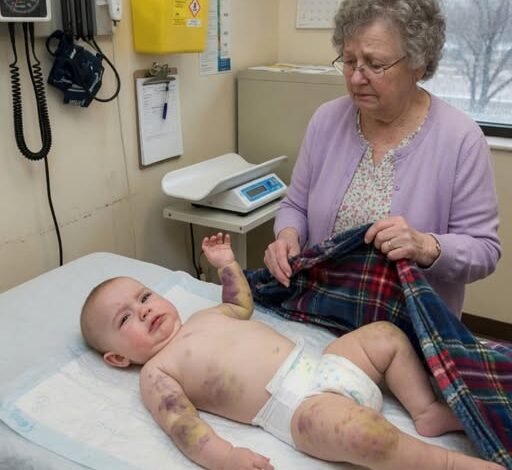
Just above the diaper line on Santi’s stomach sat a dark swollen bruise.
Not random.
Not accidental.
Four distinct marks curved across his tiny skin beside the heavier shadow of a thumb.
Human fingers.
Pressure.
Force.
For one terrible second, her brain refused to understand what her eyes were seeing.
Then the truth arranged itself clearly before her.
This was not a rash.
Not irritation.
Not a blanket mark.
Someone had gripped this baby hard enough to leave bruises.
Doña Carmen’s first instinct was rage.
Her second instinct saved her grandson.
She did not call Alejandro immediately.
She understood something important in that moment:
Panic alone changes nothing.
Proof does.
With trembling hands, she took one clear photograph beside the yellow changing cloth without touching the injury.
Then she grabbed an old electricity bill envelope and carefully wrote:
Saturday — 11:41 a.m.
She slipped it into the diaper bag beside the bottle.
Her anger became frighteningly cold after that.
She imagined Alejandro arriving home with explanations already prepared.
She imagined Valeria crying before accusations were even spoken aloud.
She imagined exhaustion trying to disguise itself as innocence.
Without wasting another second, she wrapped Santi tightly in the blue blanket, packed the bottle, the photo, the diaper bag, and carried him to the car.
Her hands only started shaking after the seatbelt clicked into place.
The drive to the Municipal Pediatric Emergency Unit felt endless.
Every red traffic light felt personal.
Every whimper from the back seat tightened her throat.
When she finally arrived, the hospital doors slid open beneath harsh fluorescent lights.
Inside, the waiting room quieted almost immediately.
A mother stopped feeding her child mid-sentence.
A security guard froze with a clipboard in his hand.
People recognized emergency before hearing explanations.
The nurse behind the desk heard Santi crying before she fully saw him.
Her face changed instantly.
Not dramatically.
Professionally.
The kind of expression medical workers develop after witnessing enough pain to recognize urgency without permission.
“Who was alone with this baby?” she asked immediately.
Doña Carmen swallowed hard.
“His parents,” she answered. “Alejandro and Valeria.”
Saying their names aloud inside that emergency room felt devastating.
Because once spoken there, they stopped being simply family.
Now they became part of an investigation.
The nurse examined Santi quickly while another staff member called for the pediatric doctor.
Then the nurse reached into the diaper bag searching for intake paperwork.
Inside she found a partially completed pediatric form.
At the top sat Santi’s name.
Under “Reason for Visit,” someone had begun writing in blue ink:
“Won’t stop crying since last night.”
The sentence ended there.
Unfinished.
The time section blank.
That discovery changed the room instantly.
Because now this no longer looked sudden.
It looked delayed.
The doctor documented everything carefully.
Photographs.
Measurements.
Medical notes.
A hospital social worker arrived.
Mandatory child safety reports were filed before Alejandro and Valeria even returned from the plaza.
Doña Carmen remained beside Santi quietly through all of it.
One hand rested near his tiny foot while doctors worked around them.
She felt ancient and young at the same time.
Like a mother all over again.
Alejandro finally called at 12:09 p.m.
She let the phone ring.
Valeria called next.
Then Alejandro texted:
“Did he calm down yet?”
As though the situation could still somehow become ordinary again.
By 12:31, child protection investigators and police officers had arrived.
The photograph.
The bruise.
The unfinished intake form.
The nurse’s documentation.
Everything was already being reviewed before the parents walked through the emergency room doors.
When Alejandro and Valeria arrived, panic replaced whatever rehearsed calm they had practiced earlier.
Alejandro looked first at the officers.
Then his mother.
Then Santi wrapped in the blue blanket.
Valeria saw the intake form immediately and stopped moving entirely.
“What happened?” Alejandro asked.
But the question sounded wrong.
Not confused.
Strategic.
Like someone trying to determine which version of events had already reached the room.
Investigators separated them immediately.
Doña Carmen never heard the full interviews.
But she saw enough through the glass windows to understand something deeply painful.
Valeria cried quickly.
Alejandro sat unnaturally still.
Neither one asked to hold the baby first.
That detail haunted her more than the shouting that came later.
Because innocent frightened parents reach for their child before explanations.
Alejandro reached for excuses.
Valeria reached for tissues.
The medical report later confirmed bruising consistent with gripping force.
Not definitive accusations.
Medical professionals speak carefully.
But every photograph, timestamp, and statement narrowed the spaces where lies could survive.
Santi remained under observation overnight.
Doña Carmen refused to leave him.
She sat beside the hospital crib through the entire night until one nurse quietly draped a blanket over her shoulders without asking permission.
By morning, temporary custody had been assigned to her while investigations continued.
Alejandro argued.
Valeria sobbed.
But the officer’s calm repetition of court orders somehow sounded harsher than yelling ever could.
Over the following weeks, the house transformed.
Bottles became carefully labeled.
Appointments meticulously logged.
Medication schedules written down precisely.
Doña Carmen documented everything now because documentation had already protected Santi once.
Alejandro was allowed supervised visits only after the first court hearing.
Valeria was ordered into counseling and parenting assessments.
None of it felt victorious.
Victory was too loud a word for a baby still healing.
The legal case moved slowly, as these cases always do.
Paperwork.
Reports.
Evaluations.
But the backbone of the investigation remained the same:
The photograph taken at 11:41.
The unfinished intake form.
The bruises.
In court, Alejandro eventually admitted he “didn’t realize how hard” he had gripped Santi during a stressful night of nonstop crying.
Valeria admitted they had planned to seek medical help earlier but feared judgment.
Doña Carmen listened silently from the courtroom benches.
Her rage had changed by then.
It no longer burned wildly.
Instead, it hardened into something steadier.
Protective.
The judge ordered continued placement with Doña Carmen while strict conditions were imposed for both parents.
It wasn’t a fairy-tale ending.
It was simply a barrier placed carefully between a vulnerable child and dangerous excuses.
Months later, the bruises faded completely.
Santi learned how to smile at ceiling fans.
Grip fingers tightly.
Fall asleep listening to the moon lullaby his father once heard in the same room years earlier.
Doña Carmen kept the blue blanket folded carefully inside a drawer afterward.
Not because she wanted to preserve fear.
Because she wanted to remember something important:
Love without action is only emotion.
That Saturday, Alejandro and Valeria left their baby with his grandmother for “just one hour.”
But that hour became the dividing line between what a family pretended to be and what one woman became brave enough to recognize.
Later, whenever people asked how she knew something was wrong, Doña Carmen always answered quietly:
“Panic becomes useful only after it learns how to stand upright as proof.”
And if she could leave the world with one lesson, it would be this:
Babies cannot explain pain.
So the people who love them must learn how to listen before suffering becomes undeniable.