Dolly Parton Left One Wish For Dollywood – What The Park Did The Morning After Her Death Says Everything

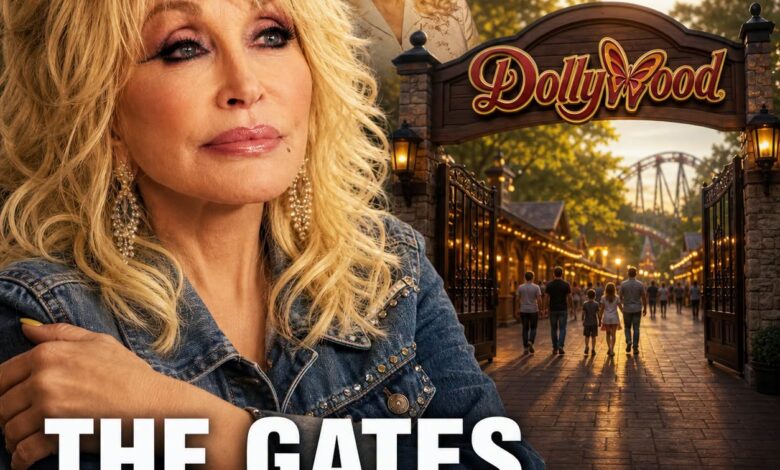
The morning after Dolly Parton died, the gates of Dollywood opened.
For thousands of grieving fans, that simple act carried more weight than any elaborate memorial could have.
The woman whose imagination had transformed a corner of the Smoky Mountains into one of America’s most recognizable entertainment destinations was gone. Yet the rides started moving. Music drifted through the park. Families walked through the entrances holding children’s hands.
And somehow, laughter returned.
It might have seemed strange to some.
How could a place so closely identified with Dolly continue operating when the loss was still so raw?
But closing indefinitely would have misunderstood what she had built.
Dollywood was never supposed to be a monument to Dolly Parton.
It was supposed to be alive.
That distinction became especially powerful in those first hours after her death.
Flowers began appearing near entrances and other meaningful locations. Fans stopped to take photographs, embrace one another, and quietly reflect. Some arrived wearing Dolly shirts. Others carried memories of vacations taken there decades earlier.
There were tears.
Plenty of them.
But beyond the mourning, the park continued doing exactly what Dolly had always wanted it to do.
Children screamed happily on rides.
Fiddles played.
Food was served.
Performers walked onto stages.
Families made memories.
The mountains kept echoing with life.
For Dolly, that had always been the point.
Long before Dollywood became an internationally known attraction, those Tennessee mountains represented home.
She had grown up nearby in circumstances almost unimaginably different from the world she would later create.
Her childhood was crowded and poor, but Dolly rarely told those stories merely to emphasize hardship. She remembered music, faith, family, imagination, and the stubborn conviction that something larger existed beyond the hills.
When success finally gave her the resources to build something substantial in the region, she didn’t simply construct an attraction bearing her name.
She invested in home.
Dollywood became part amusement park, part celebration of Appalachian culture, part economic engine, and part physical manifestation of Dolly’s belief that dreams shouldn’t require forgetting where you came from.
That made the atmosphere after her death complicated.
Visitors weren’t simply mourning a celebrity.
Many felt as though they were walking through a piece of her imagination.
Everywhere they looked, there were reminders.
Music.
Craftsmanship.
Butterflies.
Mountain imagery.
Stories about family.
Messages encouraging people to dream.
Dolly’s fingerprints seemed to be everywhere without requiring Dolly herself to stand at the center.
That was precisely why the park could continue.
Dollywood president Eugene Naughton emphasized that the values associated with Dolly would remain fundamental to the park—the kindness, hope, hospitality, and encouragement that had shaped its identity.
The message wasn’t that nothing had changed.
Everything had changed.
Dolly could no longer unexpectedly appear at an event.
There would be no new photograph of her waving from a parade float.
No familiar voice arriving to celebrate another anniversary.
No possibility that visitors might suddenly hear that Dolly herself was somewhere on the property.
That absence was real.
Pretending otherwise would have made the grief feel hollow.
Instead, Dollywood faced a harder challenge.
How do you preserve someone’s spirit without turning the place they loved into a mausoleum?
The answer arrived almost naturally.
You keep going.
Not carelessly.
Not as though nothing happened.
You pause.
You remember.
You cry.
And then you open the gates.
A shared moment of silence allowed visitors and employees to acknowledge what had been lost.
For those few moments, the park that usually thrummed with sound became a place of reflection.
Then life resumed.
There was something almost poetic about that transition.
Silence.
Then music.
Grief.
Then laughter.
Stillness.
Then motion.
It mirrored much of Dolly’s own philosophy.
Her songs were filled with hardship, but they rarely surrendered completely to it.
She could write about poverty without allowing poverty to become shame.
She could sing about heartbreak while somehow leaving the listener stronger.
She could acknowledge rejection, loneliness, sacrifice, and disappointment without accepting that any of them deserved the final verse.
Dollywood embodied that same refusal.
Dolly had always understood that joy wasn’t the absence of suffering.
Sometimes joy was what people deliberately built in response to it.
That was happening again.
Parents who had awakened to headlines announcing her death still brought their children through the gates.
Grandparents told younger family members about the first time they’d heard Dolly sing.
Strangers exchanged memories.
Employees who were grieving personally still greeted visitors.
People placed flowers, wiped their eyes, and then walked toward the attractions.
From a distance, that might have looked contradictory.
It wasn’t.
Celebrating something someone created can be one of the most intimate forms of mourning.
And Dolly had created Dollywood specifically for people to enjoy.
She didn’t build it so visitors would walk around solemnly contemplating her greatness.
She built it so families could spend time together.
So children could experience wonder.
So Appalachian musicians and craftspeople could have a stage.
So jobs could exist in the region that raised her.
So people might leave believing their own dreams were a little less impossible.
That mission did not disappear with her.
If anything, it became more important.
Because the true test of any legacy begins when its creator is no longer there to maintain it.
Dolly had spent decades making herself indispensable as an entertainer while simultaneously building institutions designed to function without her.
Her music would continue being played.
Her books would continue reaching children.
Her businesses would continue employing people.
And Dollywood would continue welcoming families into the mountains she never stopped calling home.
That is a different kind of immortality.
Not simply being remembered.
Continuing to create consequences.
A child visiting Dollywood years from now may never have experienced Dolly Parton as a living celebrity.
To that child, she may initially be a face in photographs or a voice coming from an old recording.
But that child can still encounter something she made.
Perhaps they’ll hear bluegrass music for the first time.
Perhaps they’ll watch an artisan practicing a craft tied to Appalachian history.
Perhaps they’ll ride a roller coaster with a parent and remember the day for the rest of their life.
Perhaps they’ll encounter Dolly’s story and decide that being born without much doesn’t determine how far you’re allowed to go.
That’s how a legacy escapes becoming nostalgia.
It keeps producing new memories.
The morning after Dolly’s death demonstrated that beautifully.
The park didn’t need to pretend she wasn’t gone.
The flowers made that impossible.
So did the tears.
Instead, Dollywood held grief and joy in the same place.
Visitors could mourn her and still laugh.
They could stand silently in her memory and then take their children onto a ride.
They could feel the absence of Dolly Parton while being surrounded by evidence that she had once been here.
And perhaps that was exactly the farewell she would have understood.
Dolly spent her career resisting the idea that sadness and happiness had to exist separately.
Some of her brightest songs carried enormous pain underneath.
Some of her funniest stories came from difficult years.
Even her famously extravagant image was built by someone who knew what it meant to grow up with very little.
She understood contrast.
The morning after her death was full of it.
Flowers beside turnstiles.
Tears beneath smiling photographs.
Mourning families surrounded by children’s laughter.
A park grieving its founder while opening for another day.
None of those things canceled the others.
They completed the picture.
In the years ahead, Dollywood will inevitably change.
New attractions will appear.
Old ones will disappear.
Employees will come and go.
Children visiting today will someday return with children of their own.
The mountains themselves will remain the backdrop, just as they were when a young Dolly Parton looked beyond them and imagined a life almost nobody around her could have predicted.
But the most important thing the park can preserve isn’t a particular ride, costume, building, or photograph.
It’s the idea underneath all of it.
Dream bigger than your circumstances.
Remember where you came from.
Treat people kindly.
Share what success gives you.
And leave something behind that continues helping people after you’re gone.
On that first morning without Dolly, those principles didn’t need to be carved into stone.
They were already happening.
Someone unlocked the gates.
Employees took their places.
Musicians lifted their instruments.
Families entered.
Children ran ahead.
The rides began moving.
And across the Smoky Mountains, the extraordinary dream of a girl who once had almost nothing continued exactly as she had intended.
Dolly Parton was gone.
Dollywood was grieving.
But the gates were open.
The music was playing.
And the dream was still alive.