My Neighbor Constantly Borrowed My Appliances – When She Returned My Mixer Dirty and Broken, I Taught Her a Lesson

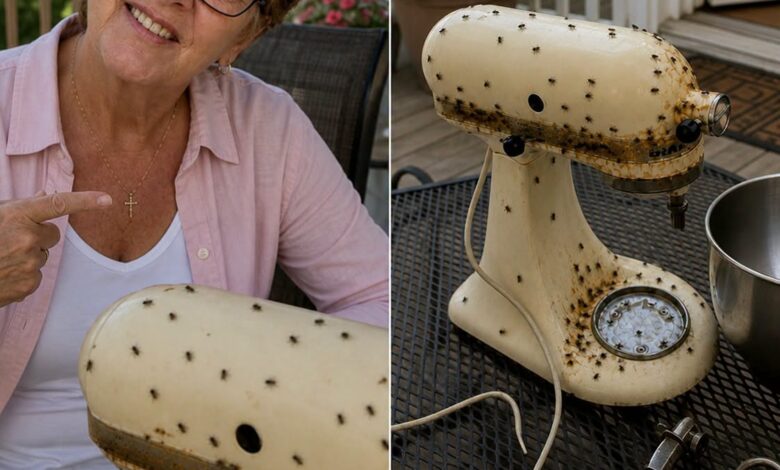
The mixer came back with dried frosting packed around the beaters and a motor that smelled burned.
I stood at my kitchen counter staring at it while Denise talked as though nothing unusual had happened.
“It started making that noise yesterday,” she said. “These old things eventually give out.”
Old things.
My mother’s mixer had survived thirty-seven years.
It had survived birthday cakes, Christmas cookies, school bake sales, two kitchens, three moves, and my mother’s habit of beating mashed potatoes far longer than any potato deserved.
It had survived my childhood.
Then I loaned it to Denise for one weekend.
Now it wouldn’t turn on.
“I told you not to run it continuously,” I said.
Denise sighed.
“I didn’t.”
There was frosting inside the ventilation slots.
I touched the side of the mixer.
Sticky.
“Did you clean it?”
“I wiped it.”
I looked at her.
She looked back with the familiar expression that had ended dozens of arguments before they started.
It said: Are we really going to make this a thing?
Usually, the answer was no.
That was my role.
Denise borrowed.
I accommodated.
She returned things late, dirty, damaged, or occasionally not at all.
I told myself objects didn’t matter more than relationships.
So when my serving platter came back chipped, I said nothing.
When she kept my folding tables for eight months, I waited.
When a gardening tool disappeared entirely, I accepted her explanation that she “must have returned it.”
When my good roasting pan came back scratched, I bought another.
Being nice had slowly become indistinguishable from pretending I wasn’t bothered.
But the mixer was different.
Not because it was valuable.
Because it was my mother’s.
After Mom died, I had kept surprisingly few things.
The mixer was one of them.
Whenever I used it, I could still picture her hand resting on top of it while batter spun beneath the beaters.
Denise knew that.
And somehow that knowledge had not made her more careful.
“I’ll have it repaired,” I said.
She shrugged.
“If you want. But honestly, it’s probably cheaper to buy a new one.”
I looked at her.
“I don’t want a new one.”
That was the moment something changed.
Not dramatically.
I didn’t shout.
I simply stopped pretending replacement was the same as restoration.
The repair shop called two days later.
The motor had been damaged.
The estimate was not small.
For the first time in our relationship, I sent Denise the bill.
Her response arrived within minutes.
You’re seriously charging me?
I typed:
Yes.
Then came the phone call.
“You can’t prove I broke it.”
“It worked when you borrowed it.”
“It was ancient.”
“It was functioning.”
“You’re being incredibly petty.”
Maybe I was.
But underneath the embarrassment of being called petty was another feeling.
Relief.
“I need you to pay for the repair.”
She laughed.
“You’ve never cared about this stuff before.”
There it was.
The sentence that explained everything.
I had cared.
I simply hadn’t made my caring inconvenient for her.
The following morning, I opened a notebook and began writing down everything Denise currently had.
Two folding chairs.
A casserole dish.
My hedge trimmer.
Three storage bins.
A carpet cleaner.
A set of holiday serving trays.
Seeing the list surprised even me.
Then I added estimated replacement values.
After that, I wrote a simple lending agreement.
Nothing complicated.
Item.
Condition.
Return date.
Replacement value.
For expensive items, a refundable security deposit.
When Denise came by the following week asking to borrow my carpet shampooer again, I handed her the page.
She stared at it.
“What is this?”
“My lending agreement.”
She laughed.
I didn’t.
“You want me to sign a contract to borrow a carpet cleaner?”
“Yes.”
“We’re family.”
“I know.”
“This is insane.”
“Then don’t borrow it.”
She stared at me as if I had changed languages.
“You’re really doing this because of that stupid mixer?”
“No. I’m doing this because of everything before the mixer.”
That silenced her.
For years, I had believed boundaries required a dramatic confrontation.
They didn’t.
Sometimes a boundary was simply a piece of paper saying:
This belongs to me.
This is the condition it is in.
This is when I expect it back.
If you damage it, you are responsible.
Denise called it cold.
I called it clarity.
And clarity worked.
Within two weeks, objects began returning.
The folding chairs came back first.
Clean.
Then the casserole dish.
Then the hedge trimmer, which Denise had apparently forgotten was still in her garage.
The storage bins appeared with their lids.
Even the holiday trays returned wrapped carefully in towels.
It was almost funny.
Years of quiet resentment had accomplished nothing.
One sheet of paper changed everything.
Then Denise paid the repair bill.
No apology.
Just a transfer.
The repair shop called several days later.
The mixer was ready.
When the technician switched it on, the motor settled into that familiar steady hum.
I nearly cried.
Not because an appliance worked.
Because something I had assumed was lost had been repaired without being replaced.
I brought it home and placed it back on the kitchen counter.
For the first time, I understood that generosity without boundaries hadn’t made me generous.
It had made me resentful.
There is a difference.
Generosity is something freely given.
Resentment begins when giving stops feeling voluntary but continues anyway.
I had trained Denise as surely as she had taken advantage of me.
Every time she returned something damaged and I said, “Don’t worry about it,” I taught her not to worry.
Every time she kept something for months and I refused to ask for it, I taught her that my deadlines were optional.
Every time I replaced something at my own expense, I taught her that damaging my belongings had no consequence.
I thought I was preserving the relationship.
Instead, I was quietly poisoning it.
Months passed.
Denise stopped borrowing things for a while.
The distance between us was uncomfortable, but it was honest.
Then one afternoon she came over carrying a pie.
Not my pie plate.
A disposable one.
I noticed.
She noticed me noticing.
“Don’t say anything,” she muttered.
I smiled.
We drank coffee.
Eventually, she looked toward the mixer.
“Is that Mom’s?”
“Yes.”
“Works?”
“Perfectly.”
She stared at her cup.
Then she said, “I’m sorry.”
I waited.
“For the mixer. And the other stuff.”
There was no but.
No joke about contracts.
No reminder that we were family.
“I got used to you saying yes,” she admitted.
“I got used to saying it.”
She nodded.
That was enough.
I still lend Denise things occasionally.
The agreement remains in the drawer.
Sometimes we use it.
Sometimes we don’t.
The point was never paperwork.
The point was learning that I could say no without becoming cruel.
I could ask for something back without becoming selfish.
I could expect another adult to repair what she damaged without valuing possessions more than people.
Boundaries did not destroy my generosity.
They rescued it from resentment.
My mother’s mixer still sits on my counter.
The casing is scratched.
The controls are outdated.
The repaired motor isn’t perfectly quiet.
I love every imperfection.
Sometimes when I use it, I think about Mom.
But I also think about the woman I was when I handed it to Denise.
She believed being kind meant making herself endlessly convenient.
She believed peace meant swallowing irritation.
She believed loving someone required protecting them from the consequences of how they treated her.
I don’t believe that anymore.
The mixer taught me something my mother probably could have explained in a single sentence:
You can love people without giving them unlimited access to what belongs to you.
Now, when that old motor hums across my kitchen, it sounds like more than an appliance working again.
It sounds like generosity without bitterness.
Kindness without surrender.
Love with a boundary around it.
And after all these years, I finally understand that a boundary is not where love ends.
Sometimes it is the thing that keeps love from wearing out.