Lionel Messi did not leave Argentina in anger.
There was no scandal.
No furious press conference.
No final argument with a coach or federation official.
Instead, the goodbye arrived in the quiet, devastating language that had always seemed more natural to him than spectacle.
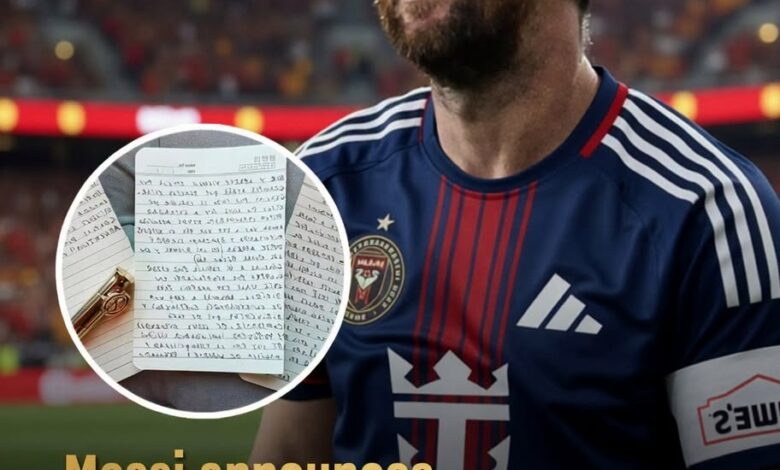
In his farewell message on Instagram, Messi sounded less like the most celebrated footballer of his generation and more like a man who had finally reached the end of something he had spent almost his entire life carrying.
Time, he suggested, had made the decision.
His legs had given what they could give.
His heart had given even more.
And now there was nothing left to offer Argentina except gratitude.
He thanked the coaches who had guided him, the teammates who had fought beside him, the staff and officials who had supported the journey, and especially the supporters whose songs had followed him from stadium to stadium and across continents.
For those fans, the words were difficult to absorb.
Because Messi had seemed permanent.
Players came and went around him.
Managers changed.
Generations of teammates disappeared.
Argentina suffered heartbreak, rebuilt, suffered again, and eventually celebrated.
Messi remained.
For years, the sight of him in Argentina’s colors carried almost impossible emotional weight.
He was not simply expected to play well.
He was expected to solve history.
Every tournament became a referendum.
Every defeat became personal.
Every comparison returned to Diego Maradona.
Every missed opportunity reopened the same question: could Messi ever give Argentina the kind of triumph that would make the country embrace him without reservation?
There were years when the burden appeared almost cruel.
Finals were lost.
Criticism became relentless.
At one point, he had already tried saying goodbye to the national team, exhausted by disappointment.
But he returned.
That return became part of the mythology.
Eventually came the victories that transformed the story.
The celebrations.
The trophies.
The image of Messi finally lifting the prize that had followed him like a question throughout his career.
For Argentina supporters, those moments were never only about football.
They were release.
Years of frustration suddenly had somewhere to go.
And Messi, once criticized for supposedly failing to reproduce his club brilliance for his country, became inseparable from one of the most celebrated periods in Argentina’s football history.
That is what made this farewell feel so final.
The words had first taken shape in the shadow of another crushing disappointment: Argentina’s World Cup final defeat to Spain.
A match capable of hurting on its own became the backdrop to a much larger goodbye.
But before Messi’s message became public, grief entered his life in a far more intimate form.
His father, Jorge, died.
The man who had been there before the stadiums.
Before the trophies.
Before the endorsements, cameras, chants and debates.
Before Lionel Messi became Messi.
Jorge belonged to the beginning.
Rosario.
Childhood pitches.
A small boy with extraordinary ability.
A family trying to understand what that ability might become.
The long road from local football to Barcelona and eventually to a kind of fame few athletes in history have experienced.
For all the people who later entered Messi’s professional world, his father had walked beside the journey from its earliest chapters.
That made the timing of the retirement painfully appropriate and unbearably sad.
Football had already taken Messi to the edge emotionally.
Then life reminded him that there were losses no scoreboard could contain.
The farewell was no longer simply about an athlete recognizing that his body could not continue forever.
It became the closing of an entire era of his life.
Perhaps that is why gratitude dominated rather than bitterness.
There was plenty Messi could have complained about.
The scrutiny.
The criticism.
The impossible expectations.
The years when every Argentina defeat seemed to be placed disproportionately on his shoulders.
But that was not the tone he chose.
He looked backward and thanked people.
Maybe that is what happens when a career becomes large enough.
The arguments begin to shrink.
The memories remain.
Fans will remember goals, of course.
The impossible dribbles.
The passes that seemed to travel through spaces nobody else had noticed.
The free kicks.
The celebrations.
The trophies raised beneath showers of confetti.
But they will also remember smaller images.
Messi standing during the anthem.
Messi surrounded by teammates.
Messi walking toward supporters after victories.
Messi staring into the distance after defeats.
A career that lasted so long eventually becomes woven into other people’s lives.
Children who watched him grew into adults.
Parents introduced him to their sons and daughters.
Families planned weekends around Argentina matches.
People who had never met him shouted his name together.
That is what retirement takes away.
Not the history.
The possibility.
There will be no next tournament in which Messi might produce one more impossible moment.
No next World Cup run.
No wondering whether he can summon something extraordinary one final time.
The archive is closed.
Everything Argentina supporters will ever have from Lionel Messi in that shirt now exists in memory.
That realization changes how even familiar moments feel.
Old highlights become artifacts.
Photographs become history.
The number on his back belongs increasingly to an era rather than an active player.
Argentina, of course, will continue.
It has to.
Another captain will eventually lead the team.
Young players will emerge.
New stars will carry expectations that currently seem unimaginable.
Children who never saw Messi at his peak will choose different heroes.
Football is mercilessly good at moving forward.
That is both its beauty and its cruelty.
No player, however great, gets to stop the game when he leaves it.
But moving forward is not the same as replacing someone.
Messi cannot be replaced because what he represented was created by a specific combination of talent, time, failure, persistence and eventual triumph.
Another Argentine may someday win more.
Someone may break one of his records.
A future player may produce numbers that make statisticians reopen every comparison.
Still, numbers will never fully explain why this goodbye hurts.
Messi’s Argentina story was never simply a collection of statistics.
It was a relationship.
Complicated.
Sometimes painful.
At times unfair.
Eventually joyful.
He spent years trying to give his country what it demanded from him, while millions of people spent years trying to decide exactly what he meant to them.
In the end, they found each other.
That is why his farewell does not feel like the retirement of just another great footballer.
It feels like a door closing on part of Argentina’s collective memory.
Now Messi becomes what every athlete eventually becomes.
A supporter.
One more person watching from somewhere else.
The difference is that when Argentina takes the field without him, millions will instinctively search for a familiar figure who is no longer there.
For so long, Argentina’s biggest football nights began with the same possibility:
Messi is playing.
Anything can happen.
Now anything can still happen.
It simply won’t happen through him.
The trophies remain.
The records remain.
The photographs remain.
The songs will certainly remain.
And somewhere inside all that history will always be the boy from Rosario who carried an entire country’s expectations long enough to turn them, eventually, into celebration.
Argentina will play again.
Football will move on.
Messi will move on too.
But eras do not end because people stop remembering them.
They end because, one day, there is no next match.
And for Lionel Messi in Argentina’s shirt, that day has finally come.